Clown Questions and the Post-Media Era

It’s 1951.  Underneath the stands at Old Yankee Stadium, Joe DiMaggio dresses after a game, a gaggle of sportswriters crowding around his locker eager for a nugget of wisdom from Joltin’ Joe.  A cub reporter from the 78 daily newspapers New York City had at the time elbows his way through and asks if he plans will celebrate tonight’s win with a late night rendezvous with Marilyn Monroe.

Joe’s eyebrows raise in a mixture of mockery and disbelief.  “I’m not going to answer that,” he chuckles.  “That’s a clown question, bro.”

As the entire world knows now, that quote didn’t come from the Yankee Clipper but the National Treasure, Bryce Harper.  There were t-shirts for sale by the next morning, there are video mash up jokes, and, of course, tweets-a-plenty.

Mark it down: this is when Washington DC officially accepted baseball.  For all Ryan Zimmerman’s heroics as the franchise’s first home-grown star since the relocation from Montreal and Stephen Strasburg’s at-times otherworldly pitching and always otherworldly hype, nothing feeds this particular home town crowd like a witty retort to the press.  Inside the Beltway Bubble, pundits pondered over whether the quote might find it’s way to the podium at the White House briefing room.

Jokes aside, it’s a valid point.  And one the other Mormon looking to stick around DC might think about. Harper’s disdain for the reporter (if not his word choice) might work for politicians.  Remember the infamous 2008 interview where Katie Couric asked inane inquiries about Sarah Palin’s news consumption habits?  Palin did herself no favors trying to answer what were pretty dumb questions.

When done right, a snarky, off-the-cuff comeback is more powerful than answering a question “the right way.”  That reporter who wanted to know if Harper was going to crack open a cold one might have been put off by Harper’s flippant response, but it didn’t matter.  The rest of the world saw it, and liked it, and unless that reporter is friends with Cole Hamels there isn’t much he can do.  Harper’s message is out.

It’s doubtful that the communications firms in town are prepping an office for Communications Strategist Bryce Harper after his playing days are over – he may be a whale of a ballplayer, but his wisecrack was just a wisecrack.  Maybe there’s a second lesson there though: that if you have to overthink your response to a question, your answer will suffer.

Or as Yogi Berra put it, you can’t think and hit at the same time.
Careful what you wish for…

Politico points out today how the Obama 2012 machine has been thrilled with Rick Perry’s attacks on Mitt Romney, occasionally piling on to wound the erstwhile Massachusetts governor.  The reasoning goes that Perry (or anyone else from the GOP field) would be easier for the President to beat in the general election.

That may sound familiar.  In 2008, with their own nomination pretty much decided, some Republicans went to the polls in late primary states intending to affect the Democratic ballot.  In Texas, a vote for then-candidate Obama was a way to put the final nail in the coffin for the Clinton Era.  In Virginia, some Republicans insisted on voting for Obama to encourage the Democrats to nominate an inexperienced, first-term Senator as their nominee.

Whether as part of an “Anybody But Hillary” movement or whether they believed that Obama was the weaker candidate, would those Republicans vote the same way if they could go for a spin in Doc Brown’s DeLorean?   If they had a hot tub time machine, do you think the 2007 Patriots would have rooted a bit harder for the talented-on-paper Packers or the Cowboys to come out of the NFC for Superbowl 42?

Similarly, Team Obama may think Rick Perry, with his low poll numbers and early campaign missteps, would be a more attractive opponent in November 2012.  It certainly looks like that match up would favor the President prohibitively – and the President looks good up against any of the other GOP hopefuls, too.  It isn’t even November of 2011 yet, though – and a year is a long time.

The Googlization of Government

Rep. Tim Huelskamp has been banging the drum on a proposed Health and Human Services rule that would mandate insurance companies share patient data with the federal government.  The purpose of the program ostensibly noble – the administration wants to collect as much data on health care as possible to determine.  But Huelkamp correctly notes that data is not always secure.  Companies and governments lose personal data on customers and citizens periodically.

In a related story, Google revealed that the US government asks the search company for more user data than any other government on the planet.  In fact, there were more requests for Google data than there were wiretaps on phones last year.

While Google may look skeptically on the government requests for information, the HHS program sounds like something out of Google labs – aggregating data about users of the health care system to ensure better future outcomes.  Just as Google has multiple touch points where it meets its users (search, YouTube, Android, Gmail, etc.), so does the government.  What if they started connecting the dots?  We send tax returns in each year, so the IRS knows how much we make, where we live, whether we own or rent, what we do for a living.  On a state level, readily available voter registration data tells them how often we vote and may even give them a good idea how we would vote, based on primary voting history.  That doesn’t even get into people who participate in federal programs for medical help, student loans, social security, or public assistance.  And it doesn’t take into account the possibility of government looking elsewhere for data.  Today it’s Google, but a host of other companies are out there looking at what you but, what magazines you subscribe to, how often you gas up your car, and what TV shows you watch.

Eventually, other government agencies could follow the same model as HHS, expanding their data points on each citizen.  That’s when it could get really interesting, especially if some enterprising staffer in some agency realizes all the information that’s pouring in.  Imagine if the roadblocks between executive agencies came down, all the data was in one big pile?  The administration could be an even more voracious consumer of data, and use if to create detailed analyses of national trends, attitudes, and issues.  Here’s a video representation of how this might look:

A campaign or company wouldn’t use available data to recruit new customers or make life better for existing ones.  When I go to Amazon or Best Buy’s website, they look at what I’ve bought in the past and make recommendations; it’s simply good business.  An executive agency, which is supposed to strive for efficiency, would pick up on this trend as a way to streamline government services.  The difference, though, is that if you’re creeped out, you can always shop somewhere else.


Presidential Power Rankings: 10.22.2011

Every major professional sport except college football has an entire system to determine the best team. That doesn’t stop those covering each sport from postulating who the best team is on a week-to-week basis. Since the Presidential race has become an odd mix of reality television, sports, and horse racing, why not do the same?

Here’s what my white board looks like this week:

1. Barack Obama. Dean Wormer: Dead! Niedermeyer: Dead! Gaddafi: Dead! The President looked Presidential this week, and American Crossroads polling indicated his “tax the rich” rhetoric has a chance to resonate.

2. Mitt Romney. The sheen of inevitability was nicked in the last debate, but Romney continues to line up endorsements.

3. Rick Perry. The signs of life Perry showed in the Nevada debate should re-energize supporters, donors, and the rest of the campaign infrastructure for a short time. His points on domestic energy development, which he has been bringing up in debates consistently, give him a positive issue to run on that no other serious candidate is talking about.

4. Herman Cain. Cain is driving the Republican discussion with his 9-9-9 plan. The row over his pro-life beliefs won’t be a deal-breaker because there is no meat to it, but may be indicative of a more serious problem with message discipline. His ability to do the blocking and tackling it takes to build an election-winning organization is still suspect. Still the front-runner for the Vice President slot on the GOP ticket.

5. Ron Paul. Paul is still the life of the party. The troop withdrawal in Iraq will give him another chance to tell the rest of the party he told them so.

6. Michelle Bachmann. Her staff in New Hampshire wasn’t all that important, anyway. Iowa is Bachmann’s make-or-break playing field.

7. Chris Christie. Despite denials and endorsements to the contrary, still more likely to be President in 2013 than the last two people on this list. On the outside chance that Romney and Perry wind up in a brokered convention stalemate in August 2012, Christie looks like an obvious choice to unite the party. Sure, it’s a long shot, but still more likely than…

8. Rick Santorum. Santorum looked shrill and childish going after Romney in the Nevada debate, but he made his points. He could wind up as the kamikaze of the debate season.

9. John Huntsman. Still waiting for his mojo. His candidacy is tough to define, though his shots at Herman Cain in the previous debate were witty and clever.

Romney’s online ads and offline issues

Last week, Mashable and David Weigel both noted that Mitt Romney has been investing in web ads, but that he has yet to run an actual TV commercial in the early primary states (or any other states, obviously).  Mashable chalks it up to a money-saving move that has the added benefit of appealing to young voters:

It’s possible the candidates are waiting to amass more funds to pay for more-expensive airtime. Or, they could be engaged in an informal standoff for who will try to rule the airwaves.

On the other hand, web ads are a smart move. They are relatively cheaper to make and broadcast and naturally appeal to younger, web-savvy voters — traditionally a weak spot for Republicans.

After the criticism he took in last night’s debate, though, a web-focused strategy makes perfect sense for Mitt Romney.  The video which spawned last week’s round of coverage chided the Obama Administration on trade and intellectual property rights, which isn’t exactly a front-page-news-making issue.  It does, however, speak to some key audiences.  It’s one thing to say you appeal to philosophical conservatives who view government as an instrument to protect citizens’ rights and voters whose views align with business and commerce; but Romney’s ad deals brings up a niche issue that demonstrates an understanding of these voters’ motivations and concerns.

These are also the types of voters who are probably still deciding whether or not a Romney Presidency would be better enough than an Obama Presidency to be excited about a Romney candidacy.  Despite the fireworks of last night’s debate and this morning’s conventional wisdom that the other candidates put him on the defensive, Romney still carries the mantle of inevitability as the 2012 Republican nominee.  He still has plenty of people to convince to avoid being an also-ran in the same category as former inevitable nominees Bob Dole and John McCain.  He won’t be able to explain away his Massachusetts health plan, but online video gives him a medium to show conservatives he understands other issues.

Weed the People

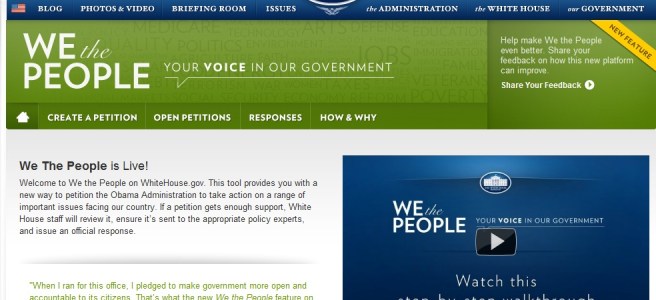
We the People have spoken, and according to the White House’s citizen-driven petition site, the most important issue in America is: the legalization of marijuana.

The White House launched We the People last month as a way to provide commoners like you and me a “direct line to the White House on issues and concerns that matter most” to us.  So far, a petition to legalize pot is the top performer, according to The Hill.  The call for decriminalization has attracted over 50,000 signatures.  It also illustrates nicely why the site is such a waste of time for serious advocacy campaigns:

[National Organization for the Reform of Marijuana Laws Executive Director Allen] St. Pierre said online petitions help spread the word and generate supporters who can call and write Congress, but they have not translated into the real-world pressure — and money — needed for his side to win.

St. Pierre is right: online petition campaigns are an excellent way to find and recruit audience.  So how many supporters did this online petition generate?

None.

To sign the petition, site visitors had to create an account on WhiteHouse.gov.  That means that the White House has their contact information (along with whatever issues are important to them) but NORML gets nothing.  Had NORML hosted the petition on their own site, they might have been able to collect signers’ contact information and email address, which would have allowed them to go back to those folks later with calls to action – such as calling or writing Congress.

At least NORML got some good press out of it, which could indirectly recruit grassroots support.  But if NORML – or any other issue advocacy group – wants to generate real impact, pointing people to the White House’s petition platform isn’t going to work.

Online petitions can recruit and mobilize supporters, but they’re better as a starting point, rather than a finish line.  Since We the People doesn’t allow for the next steps, NORML’s apparent success is actually a wasted effort.

Cross-posted on PunditLeague.us.

Applauding the extreme

A thoughtful E.J. Dionne editorial this weekend lauds Dr. Martin Luther King Jr.  Obviously, that’s nothing new – outside of Klansmen and contrarians,  there aren’t a lot of people writing anti-MLK op eds.  What’s striking about Dionne’s piece is that it points out King’s radicalism:

This focus on calling out injustice — pointedly, heatedly, sometimes angrily — is what the people of King’s time, friend and foe alike, heard. It made many moderates (and so-called moderates) decidedly uncomfortable.

Anyone tempted to sanitize King into a go-along sort of guy should read his “Letter from Birmingham Jail,” from April 1963. It’s a sharp rebuke to a group of white ministers who criticized him as an outsider causing trouble and wanted him to back off his militancy…  And recall King’s response to being accused of extremism. Though “initially disappointed at being categorized as an extremist,” he wrote, “as I continued to think about the matter I gradually gained a measure of satisfaction from the label.” Jesus, he said, was called “an extremist for love,” and Amos “an extremist for justice.” The issue was: “Will we be extremists for hate or for love? Will we be extremists for the preservation of injustice or for the extension of justice?”

For a shorter version of that last quote, thumb over to Barry Goldwater‘s page in Bartlett’s: “I would remind you that extremism in the defense of liberty is no vice. And let me remind you also that moderation in the pursuit of justice is no virtue.”

In fact, Dionne’s characterization of King invites comparison to the coverage of the movement for smaller government.  (To his credit, Dionne has shown he recognizes this parallel to a degree; he’s one of the few left-leaning columnists able to discern the tea party from Republican politics.)

It deserves mentioning that there are plenty of differences: Tea party rallies aren’t being broken up with fire hoses, rubber (or real) bullets, tear gas, or the releasing of any hounds.  King and his allies risked life and limb to make a stand for their big idea.

But they did have that big idea, and believed in it so much that compromise was unacceptable.  People were either equal, or they weren’t; they were either allowed to attend the same schools and drink from the same water fountains, or they weren’t.

With that in mind, let’s look at our policy landscape here in 2011.  There’s a snowballing debt thanks to a governing culture that allows government to spend lavishly to help build a society and direct an economy.  The debt puts at risk the stability of our currency and by extension things like houses and other long-term investments.  More important, the services financed by that debt are generally sub-par and fail to accomplish intended goals.

Either that governing culture changes – reigning in spending, allowing people to make their own decisions about health care and retirement, and eliminating waste – or it doesn’t.

The casualties of this movement include moderate and Washington-centric politicians – such as Mike Castle and Bob Bennett in 2010.  It makes “moderates and so-called moderates” (to borrow Dionne’s term) like Sen. Orrin Hatch uncomfortable.

But if you believe strongly that the government was biting off more than it could chew to deliver failing policies, and that the promises of Social Security, Medicaid, Medicare, and other public assistance programs are a bad check which will be sent back marked “insufficient funds,” you should be fighting.  And supposed allies who favor a “wait-and-see” approach while continuing to conduct the business of government the same way it has been conducted for 80 years aren’t really allies.

That isn’t “extremism,” it’s political advocacy – and as observers from King to Dionne have understood, it’s how policy making works.

Our Violent National Anthem

No one who has spent much time reading about America’s college campuses (campi?) will be surprised to learn that an institution has banned the singing or playing of the “Star-Spangled Banner” before sporting contests.

Who was behind it? The anti-American crowd?  The Marxists?   The hippies?  The greens?  Cornel West?

Try the Mennonites:  Goshen College in Indiana, the school which banned the tune, is a Mennonite school with the motto “Healing the World, Peace by Peace.”  The rockets’ red glare and bombs bursting in air are too violent.

The anthem is being replaced at Goshen sporting events by “America the Beautiful,” so we can assume this isn’t really a commentary on the nation we all call home being a haven for imperialist capitalist pigs.  Part of what makes America beautiful is that each person has the right to express their patriotism as they see fit.  If the students and administrators at Goshen don’t want to play the national anthem before their Division 8 field hockey games, that’s fine.  Those of us who have never donated to or attended Goshen have no right to tell them otherwise.

On the other hand, as an educational institution, so one would hope Goshen’s choice is educated.  And the idea that the anthem is a violent song is a bit misguided.

Of course, the “Star-Spangled Banner” does use military imagery, because it was famously written during the War of 1812 as a poem by Francis Scott Key – specifically, during the bombardment of Baltimore.  That was a fight that was brought to American shores by then-mortal foe England; we were on defense for that one.

Though set during a battle scene, the theme of the poem – especially the part used for the national anthem – is perseverance through difficulty.  Turbulence and war may come, Key writes (much more eloquently), but American ideals of freedom and peace endure.

Delve a little further into the story behind the poem, and it becomes even more apparent that it is hardly a call to arms.  Remember that Key saw the flag over Fort McHenry from a British ship; he was aboard on a peaceful mission to argue for the release of a popular Maryland doctor.  To make his case, Key presented letters from British soldiers lauding the care they received from American doctors (and this was before the current mess that passes for a British health care system).  The British acquiesced, but held Key and the doctor on the prison ship because the bombing of Baltimore was about to begin; they didn’t want to release a prisoner only to blow them up minutes later.  In the midst of war, both Key and the British officers demonstrated some level of civility and mutual respect.

The fact most worth noting is that the folks America was fighting in the background of Key’s poem, the British, are our closest allies today.  Despite fighting two wars within  30 years, Americans and Britons are fast friends.  (Heck, we can’t even launch a television show without swiping the concept from them, and they have, what, four channels?)

So in an educated historical context, the “Star Spangled Banner” is a song about perseverance through adversity and, after your business on the battlefield is over, making peace with your enemies.

Hey, that sounds like a pretty good song to play before an amateur sporting contest.

Cross-posted at PunditLeague.us.

Isn’t it good Norwegian video?

Some friends from Norway’s Conservative Party, Høyre, posted a new video on Facebook this week promoting the party’s youth auxiliary.   You don’t have to understand the language to appreciate the video:

Exciting, isn’t it?  Between the smiling faces, you have a good mix of high production value sequences and grassrootsy-looking handheld camera shots, plus a testimonial or two thrown in for good measure.  It’s also a great study in how little words matter to the effect a video has; the music and editing style portray the party’s youth wing and edgy and optimistic better than any script could.

Ron Paul is not suffering from media bias

A strong and close second-place finish at the Ames Straw poll for Ron Paul ignited almost no media coverage whatsoever – until some folks realized that Paul wasn’t getting any media coverage, which then became the story.  It’s one thing for Paul supporters to air their grievances about being ignored, but in a rare moment of astute political insight, even the Daily Show called out the media’s Paul-sized blind spot.

Charles Krauthammer had a valid answer: Paul will not be President.  He will not be as successful when the straw polls give way to caucuses, and he will do worse yet when the decisions come from the ballot box.  For a media covering horse race politics, giving serious ink to Ron Paul is like giving ink to Mr. Ed – he’s interesting, but he ain’t beating Secretariat, or any other horse.  On the other hand, while Tim Carney admits that Paul is a bad candidate, he points out that the Congressman has been consistently proven correct in his assessment of domestic and foreign policy over several years.  Stewart quips that Paul planted the small government seeds that germinated into today’s grassroots tea party movement.

Carney and Stewart are correct.  The real issue is a political press that doesn’t understand politics beyond the tally of votes in the second week in November.  The small government ethos that inspired the tea party to take out incumbents in 2010 has been brewing since late in the first term of George W. Bush, when the Republican party was entrenched in the legislative and executive but without a clear governing vision.  Paul was an early banner carrier for that philosophy, and in many way is the heart and soul of the current Republican party.  As he chugs along with single-digit polling numbers, other candidates have been and will be elected with Paul’s ideas.

Many political mini-movements see their standard-bearers run into electoral machine gun fire early on.  Remember that in 2004, Howard Dean crystallized the Democratic left but failed to win a single primary or caucus (except for his home state of Vermont, and that came after he had dropped out of the race).  By 2006, Democrat activists were dumping off Joe Lieberman in a primary and in 2008 they put a charismatic leader in the White House – bit it was Dean in 2004 who lit the fire.  There are winning candidates, and there are important candidates; the two are not always the same.