You Say You Want A Revolution?

This week, Revolution came up on my iPod on the way home from work one night this week.  Years ago, when I worked at the Leadership Institute, many of my colleagues enjoyed this song.  Travelling to campus after campus helping students build conservative organizations in overwhelmingly left-wing environments, we were at the forefront of the conservative revolution.

Listening to the lyrics again this week, the cautionary tune for the radical left of the 1960s and 1970s sounded like an appropriate warning for today’s political would-be warriors.

Monday night just hours after Chris Cillizza posted what read like an obituary for Sarah Palin.  Listen to the lyrics, and The coverage of her break with Fox News framed Palin as the poster child for soundbite-driven Republican party that was short on ideas.

Palin was hardly the only center-right figure to fall into this trap, so you can’t blame here for being the driving force behind the anti-intellectual discourse of the past four years.  It’s just as wrong to claim vapidity is the exclusive property of the right.  Remember that Palin’s 2008 ticket lost to a campaign that was paper thin behind the glowing ideas of “hope,” “change,” and “Yes We Can!”

There’s a lesson in that loss, and it’s summed up in the oft-quoted line, “But if you carrying pictures of chairman Mao / You ain’t gonna make it with anyone anyhow.”  Conservatives like to point to this and say even the hippy-dippy Beatles understood that communism sucks.  Possibly, but that’s not really the point.

Anyone who carries their politics on their sleeve is someone who gets avoided pretty frequently.  They are the people you defriend on Facebook because of their long screeds against corporate America and because they call you a fascist for liking McDonald’s french fries.  They are the people that can’t hold a conversation without talking about the encroachment of the Federal government on our collective rights.

These folks may have a point (except the french fry guy because McDonald’s is awesome). The problem is they bend over backwards to make it.  They’re trying too hard.

President Obama in one of the most overtly liberal Presidents of the past century.  That’s fine, he didn’t get elected because of his beliefs.  No President does.  Heck, no politician does, really.  That’s why it’s laughable to hear any analysis of a Republican primary where one candidate is deemed “too conservative” to win.  There’s no such thing as too conservative to win.

There is such a thing as too crazy to win.

Anyone who really wants a revolution (on either side) needs to remember that to avoid falling into the trap that Palin and other Republicans have for the past decade.

After all, we all want to change the world.

40 Years of Bench Law

The 40th anniversary of Roe vs. Wade, like several others before, marks an annual clash between those who support abortions and those who do not.  Issues of life are very important, and the abortion issue very literally is a matter of life and death – the whole debate should center on the origin point of life and what rights are extended to whom and when.  In moments of calm, good people on both sides should be able to rationally debate those points.  (Those moments of calm tend to be fleeting.)

Here’s another point, separate from the abortion debate: from a legal perspective, the majority opinion in Roe v. Wade is a really bad decision.

A couple years back, the Washington Examiner’s Tim Carney memorialized the Roe anniversary with a litany of quotes from pro-choice legal scholars who recognized Justice’s Blackmun’s opinion as, in the words of Michael Kinsley, “constitutional origami… a muddle of bad reasoning and an authentic example of judicial overreaching.”

Read the opinion, and really think about it.  Blackmun – not a doctor, by the way – reasons that dividing pregnancy into trimesters is the best way to handle the issue of conflicting rights.  One man wrote that opinion, even if he fielded input from others, and that opinion is now the legal definition of when life starts.

Let’s just think about that idea of a judge, sitting in his office in Washington, D.C., deciding that whatever is in his head will be the law of the land.  The absolutism of it recalls that Twilight Zone episode where “The State” deems Rocky’s trainer obsolete (and sentences him to death) for being a librarian.

It’s not the only example of an absolutely ridiculous Supreme Court decision, but it’s the only one whose anniversary is marked every year.

The Oncoming Gun Debate: Grassroots vs. Big Money

The types of donors who write big checks to super PACs are writing more to the Gabrielle Giffords-led group seeking to influence the upcoming debate on gun control:

Until now, the gun lobby’s political contributions, advertising and lobbying have dwarfed spending from anti-gun violence groups. No longer. With Americans for Responsible Solutions engaging millions of people about ways to reduce gun violence and funding political activity nationwide, legislators will no longer have reason to fear the gun lobby.

On the other hand, the NRA faced enormous public pressure to cave to gun control forces in the wake of Sandy Hook, stayed silent for a week and then botched their first public statement after the massacre, and then added 100,000 new members in the ensuing weeks.  That’s 100,000 new NRA members in a month when the political environment should have been driving people away from the organization.  That doesn’t count what people within the NRA call “psychic members” – people who claim NRA membership due to an enthusiasm of the organization’s ideals but don’t chip in the $25 membership fee.

Speaking of that membership fee, some simple math means the NRA has raised $2.5 million of their own.  This week one donor gave $1 million to Giffords’s PAC.  While a handful of donors will likely raise millions at a time to support anti-gun politicians, the NRA will be able to raise dollars by the fistful from a much broader base of support.

If that model sounds familiar, you may be thinking of Obama 2012’s quarterly bragging that a wide base of small-dollar donors would trump Mitt Romney’s billionaire buddies (which it did).  Remember the Republican super PACs that tried to support Romney by spending huge amounts of money running constant TV ads opposing Obama’s reelection?  Remember how well that worked against Obama’s surgical GOTV efforts?  Exactly.

All else being equal, boots on the ground will trump money in the air.

The term “Astroturf” tends to be over-used in Washington.  But Giffords’ PAC is actually Astroturf: flooding money into the system to combat the organic political influence of 4.2 million Americans.  The NRA has a big idea (gun rights) and a big group of people who support it and are motivated enough to take action.  They’ll call their Members of Congress, they’ll talk to their friends and neighbors, and they’ll vote.

There isn’t a check big enough to buy that kind of influence.

Christie: Palin Redux?

So far, 2016’s most buzz-generating possible Presidential candidate in Governor Chris Christie.  Every move the guy makes in recent weeks has been viewed through the lens of implications for 2016.  Was he too chummy with the President?  Was he too combative with the Speaker?  Is he moderating himself to appeal to independents?

Back in 2011, it looked like Chris Christie could have stepped into the Republican primary and carved out an immediate niche as a forceful voice opposing government largess.  At the time, some idiot even said that political memories are short, so if he wanted a shot 2012 was his time.   That might prove true now, as Christie finds himself as the most prominent nationally-recognized Republican in the public consciousness.

It’s the same spot Sarah Palin found herself in following the 2008 campaign.  Suddenly, the governor of Alaska was the standard bearer for a party in disarray, while still trying to play the role of maverick outsider.  Palin proved ill-equipped.  (After all, it’s tough to look Presidential by shutting down “lamestream media” contact to communicate through Facebook posts.  Crashing the Iowa straw poll to steal headlines wasn’t particularly helpful either.)

Christie isn’t likely to step into the same pitfalls as Palin, but he has a 2013 re-election effort that will likely be colored by the shadow of 2016.  Factor in that the national media already accepts  Christie as the GOP front runner, and it makes for a pretty big target the governor will have to lug around with him for a while.

3 things the NRA got wrong today

The National Rifle Association was already in a tough position when Wayne LaPierre took to the podium this morning.  A full week after the violence in Connecticut, the nation’s biggest advocate of gun rights broke its self-imposed silence to offer their side of the recent debate.

LaPierre’s calls for increased school security and have been widely panned.  That’s no surprise: the press conference really was a no-win situation, which they must have known when they decided it would be held on the Friday before Christmas weekend.  There is nothing LaPierre could have said that would have drawn a positive response; this is an “against-the-spread” PR situation where the biggest victory is in making the smallest waves.

Yet there were three points that stood out in the official NRA response that clouded even that goal:

1. Making it all about the NRA.  LaPierre explained his organization’s week-long silence as deferential to the community in mourning, but said he was forced to speak up:

Because for all the noise and anger directed at us over the past week, no one — nobody — has addressed the most important, pressing and immediate question we face:  How do we protect our children right now, starting today, in a way that we know works?

This has the makings of a pretty good thesis statement except, but it is off the mark on a couple points.  First, the noise and anger was not directed exclusively at the NRA in the last week.  Horrific events like those in Newtown stir the most visceral emotions; and in that maelstrom of sadness and pain thinking thoughts like “Ban all guns now!” is completely logical.  I’m sure there were plenty of freedom-loving Americans who, in the hours after the news of the shooting broke, would have gladly surrendered their Second Amendment rights to prevent a repeat of those events.  It would have been nice to acknowledge that – though there were plenty who took the opportunity to bash the NRA, those people whose allegiance to the Second Amendment was shaken a bit shouldn’t be lumped in with the Michael Moores of the world.

Second, people have been asking “How do we protect our children?” for the last week – nonstop.

Framing their statement this way makes the NRA look extremely narcissistic and a bit paranoid.  Yes, they will be under intense scrutiny from their political enemies, but that’s not who the most important audience was this morning.  The NRA needed to demonstrate understanding of the greater understanding of last week’s events to connect with the broader public.

2. Blaming the media.  The NRA followed a call for more security in schools with an admonishment of the media for their framing of the debate:

Now, I can imagine the shocking headlines you’ll print tomorrow morning: “More guns,” you’ll claim, “are the NRA’s answer to everything!” Your implication will be that guns are evil and have no place in society, much less in our schools.

Perhaps this was an attempt at inoculation – framing the response before the inevitable response came.  But chastising the media while standing in front of the media only encourages more negative coverage.

3. Talking about guns.  Here’s the crux of the problem: the shooting in Connecticut wasn’t about guns, it was about a sick person who took children’s lives for reasons the general public does not know yet.  The discussions about gun control are one aspect of the reaction to the shooting.  Unfortunately, that’s the area of discussion where the NRA decided to dwell.

The NRA is charged with defending its members’ rights to own guns – so it makes sense that the gun control angle would be the policy arena that was of most concern.  But by acknowledging only that angle, the NRA legitimized the idea that the reaction to Newtown should be exclusively about gun control.  Even when LaPierre mentioned other factors – such as American culture’s promotion of violence through video games – it was framed as the shifting of blame away from gun ownership.

By presenting this morning’s press conference within the context of the gun control debate, the NRA missed an opportunity to reduce the gun control element by elevating and expanding the overall conversation about what to do in the aftermath of Sandy Hook.  In many ways, the NRA allowed its opponents to shape this morning’s statement – which is a sure recipe to lose your point.

How It Could Have Gone Better

The reality is that the NRA had something important and possibly resonant to say.  After expressing his sympathies (which he did), LaPierre could have stated that in a situation like this it is important to think clearly and rationally to find solutions which will keep our children safe – and not be distracted by policies which do nothing to protect our children but allow politicians to pat themselves on the back.  We should not and cannot, LaPierre could have said, sacrifice progress for the sake of easy motion.  (There would have been some context mentioning the NRA as a four-million-person membership organization, which LaPierre worked in well this morning.)

LaPierre could have continued: Over the coming weeks and months there will be necessary and important discussions about what caused the horror in Connecticut – discussions in which the NRA will lend whatever expertise we can.  Those discussions will surely involve expanded mental health services, school security, and (naturally) the limitation of gun rights.

On that last item, LaPierre might have noted that the reaction was understandable in the wake of such events.  Without accusing anyone of trying to score political points, he might have called attention to a high level of misinformation and misunderstanding floating around in the media and in social media discussions.  Then he could have unveiled guncontrolfacts.com (the URL is available for not that much money) or some other new website dedicated to illuminating that discussion with truth – because, again, the ultimate goal is to find solutions that work.  A question-and-answer session would have been highly contentious, but would have been better than ignoring questions.

And that would have been it, because the goal of today would have been to return to the public eye, express understanding and a willingness to talk, and then to let the other side overreact if they felt the need to.

There would have been no Asa Hutchinson discussing a task force to put armed guards in schools – that policy push could come down the road.  There would be no lambasting of the media or aggressive posturing, and certainly no opinions about the effects of video games and movies.  The reaction from the punditocracy would have still been hostile, but the NRA would be better positioned to mitigate the likely gun control proposals that will emerge from the Biden Commission.

There also would be no shrinking from the NRA’s core values – just a recognition that, sometimes, tone matters, and that an effective response doesn’t mean having all the answers.
Merry Xmas, American Atheists

The American Atheists annual anti-Christian Christmas billboard has attracted it’s annual outrage.  The Catholic League, as expected, issued a response, focusing on the use of iconic imagery of a crucified Jesus.

This has to be the gift that keeps on giving for both groups.

The Atheists can’t be winning many converts to their non-religious religion; their messages are muddied and non-persuasive.  Christmas and Easter tend to be times of year where people identify more with religion, so it isn’t the time to try to take a crowbar and peel off the less devout.  Further, using Christmas images like Santa Claus while arguing against the celebration of Jesus Christ sends a mixed message.

The Christmas season is replete with Christian imagery, which likely cheeses off the hardcore atheists who would write checks to an outfit like American Atheists.  Making a public statement during Advent is the messaging equivalent of letting off steam.  It’s great timing for media coverage, too.

Getting some press attention and giving donors something to write checks for is probably plenty for the enterprise to be called a success.  But it sure isn’t effective for advancing their organization if the idea is to create more atheists.

In so many ways, Christmas is a season of guilt; you may feel guilty about not keeping up with old friends, or that you don’t do more for the less fortunate.  Have you ever been in a Catholic Church in the weeks before Christmas?  It’s packed to the gills with good folks whose lives got away from them and who are trying to slip some extra pew time in before the close of the fourth quarter.  Maybe American Atheist reasons that people would like to shed that guilt; they are incorrect.

We do it because we want to go to church for 52 weeks, but it’s easy to skip a week – just like we give to homeless shelters and food drives and Toys for Tots now because we know we should have earlier, but didn’t.

Christmas is a time when we’re all a bit closer  to the people we want to be.  You might be a religious person who has disagreements with your church’s stance on something or other throughout the year, but Christmas is rarely one of those points of contention.

That makes it pretty easy for a group like the Catholic League to stand up, draw support, and win some favorable coverage.  Who knew they’d get such a nice Christmas gift from an atheist?

Lack of enthusiasm? No problem.

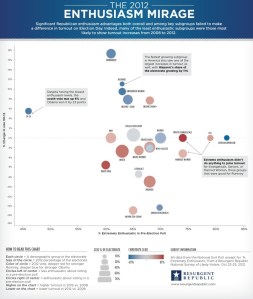
Resurgent Republic posted this infographic last week (which I swiped from an email from Pennsylvania political consultancy ColdSpark Media):

RR_Infographic

The full-size picture does it more justice.  It charts various groups, how strong their turnout was in 2012 versus 2008, and how excited the said they were to vote.

In the last month and a week, it seems like no two Republicans can talk to each other without a discussion of What Went Wrong.  It’s a great conversation because there’s no wrong answer.  Every person who says, “I’ll tell you what Romney missed out on…” and then fills in a reason is usually right.  So the tactical deficiency in that picture is a puzzle piece, but it isn’t the whole problem.

All that said, check out the bluest of the blue groups, staunch Obama demographics like single women, 18-29 year olds, and Hispanic voters.  Isn’t it funny that the blue groups that were least excited about voting but voted more than the red groups that were more excited?  Part of the vaunted Obama turnout operation was figuring out who needed to vote and doing what it took to drag them to the polls; this sure makes it look like the credit was well-deserved.

Googlizing Campaigns

If you caught the tail end of the Roger Hedgecock show on Friday night, you may have heard me chatting with guest host Matt Lewis about the use of data in campaigns.

Much has been written in the past few weeks about the amazing things the Obama 2012 campaign did in identifying and turning out voters.  Just as much has been written about the Romney campaign’s failure to do the same thing, but it isn’t quite as fair.  There were many reasons Obama won, but the ability to take advantage of more channels of information to identify voters was a big part of it.

The private sector has been doing this for years.  For advertisers like Google and Yahoo! and e-commerce sites like Amazon, knowing what you do and  where you click online is their bread and butter.  It helps them put products in front of you that you’re more likely to buy, because they don’t make money if you don’t click.  Obama’s team was better at adapting those techniques to the campaign world.

What I didn’t get to talk about with Matt do to time constraints was the fact that Republicans can take a great deal of solace in the fact that these aren’t new magical spells being cast by technological wizards.  These are old hat tactics that can (and probably will) help Republicans with in the next campaign cycle.  For years, the advertising dollars have been moving toward personal advertising (like online ads) which can present content to an audience with much greater precision than mass advertising.

Romney adviser Stuart Stevens was ridiculed for saying that Mitt Romney ran less of a national campaign than Barack Obama, but he’s right, and Obama was right to do it.

Weather or not it’s proof of climate change…

It’s cooled down a bit lately, but the last few weeks have seen the worst of what Summer offers in and around the Beltway.  A massive windstorm knocked out power in Alexandria, and heat indexes made mowing the lawn such and incredibly dangerous activity that it was to be avoided at all costs. (That’s the story we’ll go with.)

What does it all mean?  For some it’s unequivocal evidence of man-made climate change:

During their recent coverage of winter storms, Fox News has repeatedly mocked former Vice President Al Gore and cited the cold and snowy weather to attempt to discredit global warming. Fox News and other right-wing media routinely use snow to cast doubt on global warming, and internal emails from Fox News’ Washington bureau show that in the past Fox employees have been instructed to question climate science.

Wait, wait, no, I’m sorry, that’s an old Media Matters story, back when the eighteen feet of snow dumped on the Eastern seaboard was just “weather.”  There’s a difference, you see, between weather and climate, so a cold winter doesn’t mean anything for those looking to disprove global warming.

Yet this week, the anti-Keystone XL organization 350.org sent an email to their subscriber list highlighting the recent heat wave as evidence that radical environmental change is afoot.  Their leader, Bill McKibben, sarcastically needled global warming skeptics in the Daily Beast:

Please don’t sweat the 2,132 new high temperature marks in June—remember, climate change is a hoax…  On Friday, for instance, Washington set all-time heat records (one observer described it as like “being in a giant wet mouth, except six degrees warmer”), and then shortly after dinner a storm for the ages blew through—first there was five minutes of high wind, blowing dust and debris (and tumbleweeds? surely some tumbleweeds), followed by an explosive display of thunder and lightning that left millions without power.

That’s 350.org, whose big idea was to fund a giant ice sculpture on the steps of the U.S. Capitol spelling out the word “HOAX.”  You see, they were going to disprove climate skeptics by melting ice in July.  That was before they slammed on the brakes – ostensibly because they would appear insensitive to people suffering the heat wave, but more likely because it was just a really silly idea.

You can’t spend the winter preaching that weather and climate are different things, then using the summer heat to support the need for environmental action.  That’s not a scientific argument, that’s political hackery – though, come to think of there’s probably more money in simple hackery.

Kids make bad spokespeople

Somehow, some way, the political universe will have to come to grips with the mind-melting revelation that Jonathan Krohn is no longer a conservative wunderkind.  With a slow news week n Your Nation’s Capital, this non-story has been getting more digital ink than it’s worth.

Yes, I recognize the irony in that statement, but hear me out.  I’m not kvetching because it’s getting too much attention.

The national conservative leaders invited this story years ago, when they treated Krohn like the second coming of Bill Buckley, a thirteen-year-old in the temple of CPAC, arguing as equals with the elders of the movement.  By propping him up they created a sideshow, rather than provoking thought with a speech on fiscal policy or government regulation.

Then again, those speeches don’t make it onto YouTube – and when they do, no one watches.  So out comes Krohn, the Boy Wonder of the Right, to be a fun and kitschy carnival attraction.  But like any thinking adolescent, Krohn had (and likely still has) a long way to go on his own philosophical journey.

If you are looking to develop a movement leader, he or she would probably be better off listening at CPAC rather than talking.  Krohn himself realizes the exercise was a sham:

I mean, come on, I was between 13 and 14 when I was regurgitating these talking points! What does a kid who has never paid a tax bring to the table in a conversation about the burden of taxes? What does a healthy child know about people who can’t afford healthcare because of preexisting conditions? No matter how intelligent a person might be, certain political issues require life experience; they’re much more complicated than the black and white frames imposed by partisan America.

More than likely, there are folks on the left salivating over the opportunity to use him as a prop just the same as the right did years ago.  Whether the left or the right hand is grinding the organ, they both want the monkey to dance.

That’s not really fair to the monkey, though.  By using a teen as a figurehead, a political movement may score short-term points, but it sure doesn’t help the kid at all – and it isn’t the most dependable basket to drop your eggs in, either.