Crashing in and cashing in

Not since Sen. John McCain appeared in a movie with topless women have two party crashers caused so much controversy in Washington, DC as Tareq and Michaele Salahi.  And in addition to exposing what may be questionable security at the White House, they may have also highlighted one of the problems with big, mainstream media.

November 30:  Multiple media outlets report that the Salahis are asking for a six-figure payout for an exclusive interview.

December 1: The Today Show – one of my favorite programs for hard-hitting journalismruns an exclusive interview of the Salahis.

Playing two sides against Afghanistan

It’s one thing for a politician to draw criticism for a policy from his opponents, but the reaction to President Obama’s Afghani-plan speech last night from the left is potentially more problematic.

Obama’s speech was unsurprising – not only had his plans for troop escalation been the worst kept secret in Washington for weeks, he promised to do as much during the campaign last year.  Still, pundits like Michael Moore – normally a water boy for all issue blue – have issued strongly worded rebukes against such a strategy.

Moore’s warning, in an open letter, that Obama would “destroy the hopes and dreams so many millions have placed in” him suggests that he wasn’t paying attention to the substance of Obama’s campaign rhetoric.  As a likeable candidate, Obama made it easy for folks like Moore to ignore policy details and revel in the fact that their newest candidate wasn’t a wonkish robot (like Al Gore in 2000) or a New England blue blood (like John Kerry).

Unfortunately for the President, that raises expectations to the level of his follower’s wildest dreams – not a good thing in an environment where success or failure often comes down to the size of the yardstick.

Thanksgiving Recap: Turkey, Tiger, and TMZ

The Thanksgiving weekend accident that sent Tiger Woods to the hospital proves that what’s true of nature is true of modern media and media consumers: both abhor a vaccum.

The bizarre circumstances surrounding the situation suggest a deeper explanation than Woods heading out to his local Best Buy to snag some Black Friday door buster deals.  Traditional media outlets have reported  poked fun and spread rumors.  But TMZ is pointing to eyewitness reports that contradict the facts given by ESPN on the ubiquitous crawl across the bottom of the screen during the Thanksgiving weekend college football games.  TMZ also reports that law enforcement agencies are looking more deeply into the matter.

Honestly, the truth of Tiger Woods and his wild ride are of little import to world affairs.  Everyone – or at least, almost everyone – is happy that his injuries weren’t serious, and he can go back to being the amazing golf ball whacker guy that he was on Wednesday.

For TMZ, though, the Tiger tale gives them another notch on their belt to go along with their scoop on the death of Michael Jackson.  What used to be a disdained celebrity gossip site has now played a key role in two major stories over the past six months.  Woods even had to respond to the reports – predictably calling them false, but offering no new details.

TMZ succeeds because they fill a need for information that other media are unable to provide – working largely by interviewing witnesses, digging through public records, and other classic hallmarks of the un-sexy world of old fashioned shoe-leather journalism.  Contrast that with the largely opinion-driven chatter that permeates 24 hour news channels, and the secret of TMZ’s success becomes a little more clear.

New Moon, Old fashioned?

Conservatives complaining about the left-leaning bias of movies and TV shows is nothing new – and with each shrill criticism comes another round of shut-up-and-just-enjoy-the-movie eye rolling.  It turns out the whining comes from both sides of the aisle.

Campus Progress is none too fond of the #1 movie of last weekend; apparently the vampire flick New Moon is rife with disturbing hidden messages. For instance, a conversation about whether werewolves are born as werewolves or whether they choose to become werewolves is decried in light of the lack of gay relationships in the movie.  On top of this is what the author calls:

“[A] disturbingly explicit anti-premarital sex message which ends the movie… despite knowing the Mormon background of Meyer, I couldn’t believe that the director and screenwriter would have let the end credits roll without undertaking some sort of criticism of the ideas espoused by the main characters in the final scene.”

It sounds like these Mormon vampires are undead-set on pushing a social agenda.  Clearly, this movie about werewolves fighting vampires must be answered; and the best way to fight speech is, as always, with speech.  Maybe the folks who agree with Campus Progress can find some way to get a movie made which deals with alternative lifestyles, or one that puts promiscuous teenagers in a more positive light.

App shoot

Upon reflecting more about recent, high-profile rejections from Apple’s App Store, one thing is becoming apparent: with the iPhone/iPod platform is gaining popularity, more developers are investing time and resources writing software for it only to see their creations rejected.

The closed-door approach makes sense for Apple – since their platform is the first of its kind, any questionable use would reflect back on their highly-recognizable brand rather than an anonymous developer.  If Saturday Night Live legend Garrett Morris developed a game for the iPhone called “Gonna Get Me a Shotgun and Kill all the Whities I See,” Apple would bear the brunt of the protests for allowing it rather than Morris.  (When Morris famously – and hilariously – sang that line on the air in 1976, the NBC switchboard probably got more calls than Morris’s home phone.  By citing the actual sketch, do I avoid somehow being called a racist for quoting it?)

But the closed door has implications for potentially revolutionary uses of mobile technology.  In 2008 a developer created an excellent application for the Obama Campaign, allowing volunteers to prioritize their contacts for get out the vote calls.  If the time and effort invested in creating an app is possibly wasted, how will small, volunteer-driven campaigns for local or Congressional offices – the types of campaigns who could really use the technology – justify exploring the possibilities of the platform?

MSNBC would never say that (about a Democrat)

“Barack Obama is a stupid #$@&ing socialist!”  So said the Twitter feed @MSNBCHeadlines, which has since been discontinued after a profanity-laced Twitter tirade (twirade?) on Friday, as documented by TechCrunch.  Previously, it had just served up exactly what it promised – MSNBC headlines, without comment or blue language.

It’s easy to chalk this up to the feed being hacked, but as TechCrunch reports that Twitter account was never owned by MSNBC.  So here’s another possibility: @MSNBCHeadlines was a sleeper Twitter account built for the express purpose of saying things like “Chris Matthews sucks.”  But in order to maximize the impact, the owner of the account simply fed MSNBC headlines for a few months to build a follower base.

It’s pretty easy to do, and it might not be the last time we see something like this.  With big 2010 House and Senate races coming up, now would be the time to register a Twitter account like “@PASenateHeadlines.”

Let’s say you work for Joe Sestak, the Democrat Congressman challenging Arlen Specter for the nomination.  It would be easy to feed the account with the daily news stories about the race that run in various newspapers around the state thanks to Google news.  There wouldn’t need to be any slant to the stories, and the lack of a slant would attract more followers; interested parties (especially reporters) would follow the account just to get straight news from various sources that they may have missed.

The account exists on autopilot and seems innocuous for a few months.  Then, weeks before election day, you take more direct control of the account.  Instead of automatically feeding it any old story about the Pennsylvania Senate race, you serve up more consistent anti-Specter news.  If you have some potentially damaging information about Specter (like video of him hanging out with George W. Bush) you could use this Twitter feed to attract attention.

Maybe @MSNBCHeadlines got hacked.  But maybe it was a prank that provided a blueprint for an effective campaign tactic.

Quite an enemies list you’re building there…

Ever heard of Edmunds.com?  It’s an information site for prospective car customers.  As businesses looking for free publicity often do, they decided to publicly discuss something which was already making news, releasing an analysis of the Cash-for-Clunkers program that put the per-car cost to taxpayers at $24,000.

The dignified. measured response from the White House to mild criticism from an obscure consumer site?  A point-by-point analysis of the analysis… under the headline “Busy Covering Car Sales on Mars, Edmunds.com Gets It Wrong (Again) on Cash for Clunkers.”

If you’re scoring at home, Fox News is not an officially approved news organization and Edmunds.com is where to buy your Mars rover.  And the White House doesn’t take kindly to made-up numbers… well, usually.

St. Barack of Chicago

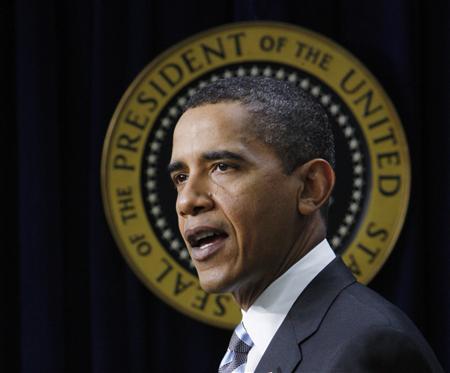
An enterprising Reuters photographer – likely with a sense of humor – took this picture of President Obama today:

Obama

The President was speaking about his administration’s programs to help small businesses.  No word on whether he said anything about money-changers.

An image like this is probably not set up on purpose.   The White House communication staff will probably have to spend a little more attention to the sight lines for photographers at future press events.

Although, we probably should not judge them, lest we be judged.

Bad news for old school papers

The troubles of traditional print newspapers, including those in major metropolitan areas, is well documented – with news consumers moving toward online sources, advertisers are less likely to buy space in printed periodicals.  Unfortunately for most news organizations, it turns out that the advertisers are not moving online along with the readers – even though online advertising spending continues to rise.  If you consider the way ads are displayed on newspaper websites, and internet advertising models, it makes sense.

Back when print advertising was all the rage – in the olden times before 1997 or so – the model for effective advertising was fairly simple: you bought space in a publication that matched your target demographic.  If you were a Boston-based business, for instance, that meant advertising in the Boston Globe or the Herald.  It was expensive, but you were paying for exposure – the more pairs of eyes would look at your ads, the more customers you would get at the other end of the funnel. When you paid your advertising dollars, you paid for exposure.

Online advertising has changed that model in every way imaginable, especially search advertising.  When you buy search ads today on Google or Bing, you pay based on how many people click on your ads.  That creates an extra incentive for the search engine folks to put your text ads in places where people are most likely to click.  With search advertising, you are paying not for how many people see your ad, but for how many people actually show interest.

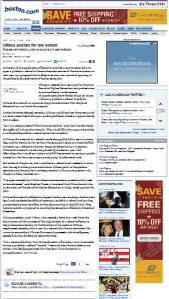
So, why aren’t newspapers able to capture those online advertising dollars?  To illustrate their problems, let’s use the Boston Globe – a paper which has had very public issues adapting to the new world of news.  If you visit the Boston Globe and search for my alma mater, UMass, one of the first stories you get is about UMass angling to open their own law school.  Check out what the page looks like:
globe1

Note the three ads – a banner across the top, a box in the right column, and a tower ad running down the right side a little ways down the page.  The banner and tower in this image are for Roadrunner Sports, and as near as I can tell they rotate.  The big, blue Air France rectangle, though, is all over the Boston Globe’s site today.  That probably means Air France bought a high level of visibility – in other words, they bought ads online the same they would have in the print version of the Globe.

But here’s a pertinent question: why would someone be reading this story?  What does that indicate about their interests?  Air travel seems like an odd fit for a story like this, which one might read if he or she is researching law schools or is a UMass alum.

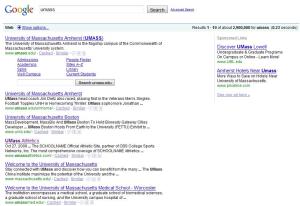
To contrast, here’s what I found when  searching for “UMass” on Google:
google1

Along the right side are two simple text ads for one of UMass’s satellite campuses and Priceline.com – the Priceline ad trumpeting their ability to find good hotel deals in and around Amherst.  What’s more, the ads look much like the search results – with the search term showing up in bold.  If you are searching for “UMass” because you are looking to further your education or visit your alma mater, these ads are up your alley; if not, the companies that bough the ads lose nothing because they only pay if you click.

While the search ad model anticipates the user’s possible interests and serves ads based on that, newspapers and the ad networks through which they work too often continue to display the ads that they want the user to see – even online.  Why would anyone pay for eyeballs when they could pay for the whole brain?