Bawling Boehner could learn from the Boss

The new Speaker of the House has an image problem.  After weeping in an election night victory speech and again in a 60 Minutes interview, John Boehner again shed tears when taking the gavel from Nancy Pelosi.  Now an established pattern, Boehner’s tears have David Letterman wondering if he’s on drugs.  Others simply wonder if this is the new status quo of American politics.  Either way, being “the guy who cries a lot” is a pretty open invitation to the brand of ridicule that would diminish a message.

Boehner might find some inspiration from a fellow Ohioan, the late George Steinbrenner.

In 1990, Steinbrenner appeared on Saturday Night Live during his commissioner-ordered sabbatical from baseball.  In one memorable sketch, The Boss played a convenience store owner who refused to fire employees, no matter how much they underperformed:

Where is it written if you don’t get results right away, you fire people? How would you like it everytime something went wrong, I just blamed you, the supervisor, huh? Let’s just fire the supervisor! Then I’ll hire some other guy, and something would go wrong and I’d fire him, and I’d probably rehire you!Then fire you again, bring in someone else, then fire him and rehire you again! Then fire and hire, back and forth until the whole thing’s just a big joke! Is that the kind of owner you want? Some yammering nincompoop in a fancy suit? No way you take that road, ’cause before you know it, you’ll probably be banned from running the entire company!

Three years later, Steinbrenner was back in baseball, but his self-deprecating sense of humor remained sharp.  He played himself in the 1994 movie The Scout, and filmed an unaired cameo for Seinfeld.  His public criticism of Billy Martin and Derek Jeter both became tongue-in-cheek commercials, nearly three decades apart.  The results of this were last year’s kind eulogies, which forgave many of his faults.

So what does that mean for the Weeper of the House?  Boehner would be wise to aggressively embrace self-deprecating right away – diminishing both his tendency to cry and his critics’ tendency to make a big deal of it.
And now, the real news about the fake news

The Onion debuts two cable television programs this month.  The fake newspaper turned fake internet news site presents a unique and specific genre of comedy – the obviously false presented as seriously real.  It’s similar but a bit different from slapstick comedies like Airplane! or Spaceballs.  It’s closer to Saturday Night Live’s Weekend Update as delivered by the more deadpan performers, like  Kevin Nealon in the early 1990s.  The 1970s spoof talk show Fernwood 2 Night and the long-forgotten short-lived Nick at Night television review series On the Television may be the best examples, even if short-lived.  Because the audience is in on the joke but the performers are apparently not, it depends as much on performance as it does on clever writing.

Since this type of humor is so specific, it’s unsurprising that the Onion’s television ancestors met with limited success.  What has given the Onion its staying power?

The Onion – which started as a small, regionally distributed newspaper in 1988 – became an early example of the internet’s power of viral distribution.  It may be difficult for a network television show to find the audience it needs to build a niche following; the Onion’s following grew over time as its stories were forwarded by email.  When the Onion’s television shows air this month, they will have already recruited their niche audience online over approximately 15 years.

There’s one final layer to peel back, and that’s the Onion’s business model based on generating large amounts of free, high quality content.  The term “viral growth” is overused, but is applicable to the Onion’s rise through virtual word-of-mouth.  The content brought traffic, and the traffic brought money – both in terms of advertising, book deals, and now television shows.  None of it would have worked without something that was worth sending in an email to a friend.  Funny always came first – and the money followed.  Other small, regionally distributed newspapers who are struggling may want to take note.

Revisiting Willie Horton

The Boston Herald reported that a Massachusetts cop-killer could prove to be “Mitt Romney’s Willie Horton.”  According to Politics Daily, a sex offender in Minnesota just may end up as “Tim Pawlenty’s Willie Horton.”  Last year, Michelle Malkin chronicled a pair of violent criminals vying for the title of “Mike Huckabee’s Willie Horton.”

The stories themselves are sickening, but will likely have little impact on the 2012 primaries.  Still, the coverage highlights something interesting in the way Willie Horton’s name is invoked.  In each case, a criminal who was pardoned by a governor committed a second offense – mimicking Willie Horton, who incredibly got a weekend off from a Massachusetts prison while Michael Dukakis was governor and used his time off to commit more violent crimes.

For these Republican candidates, referencing Horton alludes to incompetence in governing.

But when Sharron Angle used extremely questionable imagery in an ad attacking Harry Reid, Horton was brought up again.  In 2006, a hilarious ad against hard-partying former Congressman Harold Ford incredibly led to the H-word being bandied about by a few racial arsonists.

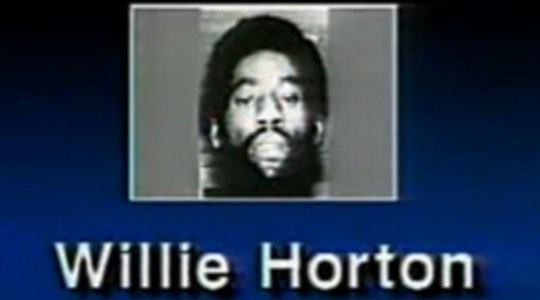
In these cases, Horton is synonymous with political dirty tricks – and worse yet, dirty tricks which prey upon voters’ racism.  This, of course, goes back to the famous 1988 attack add on Dukakis:

This might simply be the observation of someone who didn’t grow up in the South, but pictures of Horton are not very scary.  The ad’s shock value lies in the subtitles, which graphically detail Horton’s crimes.  Horton’s race is irrelevant if the commercial’s impact relies on the Horton’s crimes, and the breakdown in law enforcement governance that allowed them to happen.

So either Willie Horton symbolizes race baiting, or Willie Horton symbolizes incompetence.  It cannot be both.

Now, if you want a really racist commercial… well, there’s always room for Jello.


Why 2010 is the Year of Facebook

Time Magazine ignited some controversy this month by naming Mark Zuckerberg their Person of the Year.  Zuckerberg deserved the award, said Time, for “connecting more than half a billion people and mapping the social relations among them, for creating a new system of exchanging information and for changing how we live our lives.”

Indeed, Zuckerberg did all that – but he arguably did so in 2003, when he invented Facebook in his Harvard dorm room.  So why is he the person of the year seven years after actually making this contribution to humanity?  Or did Time discover Facebook only weeks after their grandmother, as “Julian Assange” suggested?

There are actually two questions here, so there are naturally two answers.  Question 1 is why Time gave Zuckerberg the award this year; and Question 2 is why 2010 is The Year of Facebook.

Culturally speaking, the last half of 2010 is a perfect storm of Facebook hype.  The Social Network was a big hit and created some preliminary Oscar buzz.  The next time you watch live TV, watch how many commercials end with URLs for a Facebook page.  And Zuckerberg scored headlines with his pledge to donate half his fortune to charity and $100 million to Brick City, NJ.  The success of social gaming in 2010 is linked directly to those games using Facebook as a platform for popularity – even non-gamers have seen their friends’ Farmville, Cityville, or Mafia Wars updates pop up in their own news feeds.

In short, Facebook is everywhere in a way it hasn’t been in years past.  But why is 2010 REALLY the Year of Facebook?  It turns out, there are some numbers to back it up.

Facebook’s traffic numbers surpassed Google’s in 2010.  That indicates a huge difference in how people are consuming information – instead of searching the internet and relying on Google’s algorithms to tell them what’s important, they are relying more and more on friends (a point I made yesterday in a post on Pundit League).  Trusting friends is something people are most likely predisposed to do; Facebook makes it easier to do that.

More important, Facebook continues to report increases in ad revenue.  It’s one thing for a website to have a good and popular idea; it’s quite another for a website to make money.  That Facebook has proved it could do the latter is no small feat and guarantees solvency for the foreseeable future.

So 2010 was more than just the year when America collectively noticed Facebook; it was the year when Facebook set down stakes as a permanent entity that gave legitimacy to its foothold in the public consciousness and culture.

And for that, Mark Zuckerberg really is the Person of This Year

Media bias exposed!

Playing the Julian Assange to Fox News’ Western Civilization, Media Matters intercepted emails that showed media bias at Fox News:

At the height of the health care reform debate last fall, Bill Sammon, Fox News’ controversial Washington managing editor, sent a memo directing his network’s journalists not to use the phrase “public option.”

Instead, Sammon wrote, Fox’s reporters should use “government option” and similar phrases — wording that a top Republican pollster had recommended in order to turn public opinion against the Democrats’ reform efforts.

Sammon suggested various terms, which stressed that the public option would be government-run health insurance – when in reality, the public option would in fact be run by… well, the government.

But the intrepid bias-hunters at Media Matters have a point – words make a difference.  Media Matters’ counterpart on the right, Newsbusters, has taken this on by pointing out that maintaining current tax rates is not an increase in government spending – a misnomer used by CNN and other media outlets.  (As an aside, Republicans have failed miserably in defining the expiration of the “Bush Tax Cuts” as a de facto tax increase.)

While factually accurate, describing the public option as “government health care” does convey a negative connotation.  But maybe the question isn’t in the word choice among Fox News correspondents.  A better question, perhaps, might be posed to the Administration and the President: Why hide the government health care program behind euphemisms?

Shut up, I have freedom of speech

Don’t want to do business with WikiLeaks?  You might find your website getting hacked, like MasterCard or Paypal.  (And you might also get hacked if you represent women who are making accusations of rape, depending on whom they accused.)  Participants in what has been dubbed “Operation Payback” seem just organized enough to take some time off from complaining about not being able to get unlimited movies and music for free online to wreak a little bit of havoc.

The hackers’ concerns are echoed by DataCell, a company that helps WikiLeaks process payments.  DataCell is getting ready to sue Visa and MasterCard to force them to work with WikiLeaks, according to CEO Andreas Fink:

We strongly believe a world class company such as Visa should not get involved by politics and just simply do their business where they are good at. Transferring money. They have no problem transferring money for other businesses such as gambling sites, pornography services and the like so why a donation to a Website which is holding up for human rights should be morally any worse than that is outside of my understanding.

Visa is hurting Wikileaks and DataCell ehf in high figures. Putting all payments on hold for 7 days or more is one thing but rejecting all further attempts to donate is making the donations impossible. This does clearly create massive financial losses to Wikileaks which seems to be the only purpose of this suspension. This is not about the brand of Visa, this is about politics and Visa should not be involved in this.

To summarize what Fink appears to be driving in his sputtered sentence fragments: Visa should not be involved in politics, therefore Fink will use a political entity (the judicial system) to force them to do business with a political organization (WikiLeaks).  Fink and Operation Payback are each quick to defend WikiLeaks’s right to publish unpopular speech, but intolerant of other groups’ choices to simply take their business elsewhere.

The whole mess is a dress rehearsal for the coming clash on American internet regulations like net neutrality. If a site (like WikiLeaks) depends on other companies (like ISPs, hosting companies, and donation platforms) for their survival, will those companies be forced by law to support WikiLeaks and their mission?

Jeter vs. the Yankees: Framing the debate

The dance between Derek Jeter and the Yankees started as a civilized and friendly waltz, but has quickly devolved into the gang fight in the video for “Beat It.”  Each side is almost taunting the other to consider a universe where Jeter is not with the Yankees.  And of course, unlike most salary negotiations which are confidential, the fight is public.

What’s fascinating is the attempt by Jeter to frame the negotiations in the most favorable light:

[A] baseball industry source said the Yankees have provided Jeter and [Agent Casey] Close with detailed statistical and market analysis to support their contract offer, including comparisons between Jeter and other shortstops and middle infielders throughout baseball.

That is the way Jeter’s last contract, the 10-year, $189 million deal that expired with the end of the 2010 World Series, was negotiated, based on Jeter’s contention and the Yankees concurrence that Jeter was the second-best shortstop in the game, behind Alex Rodriguez, who had just signed a 10-year, $252 million deal with the Texas Rangers.

This time, the Jeter side is said to not want Jeter’s value to be judged against that of other shortstops, preferring to base his worth on his legacy as an all-time great Yankee.

This is the equivalent of staying on offense in a political campaign or a public relations battle – framing a debate to be about the issues on which your side is strongest.  And it’s hard to argue with Jeter’s place in the prestigious Yankees pantheon now – an argument he couldn’t make in 2000, after just his fifth full year in the majors.

In other words, if this “campaign” is about wanting to see Jeter continue to pursue Yankees history – such as becoming the first Yankee ever with 3,000 hits – Jeter wins the negotiations and the hearts and minds of the fans.  If the “campaign” is about the Yankees having roster flexibility, phasing out aging players, and not allowing their team to become bogged down by expensive contracts to 40-year-old players (again), then the front office wins.

Of course, the “campaign” is always about the World Series trophy for the Yankees and their fans (including me), giving the Yankees an important advantage – after all, no matter how angry fans get at the idea of Jeter walking away, a 2011 World Championship would inflict a case of mass amnesia.  So regardless of whether Jeter or the Yanks’ front office blinks first, the success or failure of this campaign, like so many others, won’t be fully appreciated until the first week of November.

3 Lessons from Wikileaks and Infoterrorism

On America’s signature holiday, WikiLeaks continued its signature assault on America.  First came the hand-wringing, then came the finger pointing, and next will come the crackdown; but missing from all the coverage are the lessons of Julian Assange’s attack on the US Government.

Wikileaks deals in what could be called “infoterrorism.”  While militant terrorists seek to slow the gears of government through fear of violence, Assange (who looks like he could be cast as Niles Crane in a Christopher Nolan adaptation of “Frasier”) works through extreme exposure of unflattering details.  And through all the criticism, the fact remains that he isn’t making stuff up – the words in those cables are as authentic as they are embarrassing.

1.  WikiLeaks’s victories are designed for the PR field of battle.

There will be no tribunal of world powers who condemn the United States.  The UN isn’t going to boot the US out.  The US will not be stripped of its Heisman trophy.

Because the document dumps are so large, it’s clear that WikiLeaks is less concerned about getting specific content out than demonstrating their ability to find and release large amounts of information.  Sure, the disclosure will slow down diplomacy, but this is more about creating an image of America as large, unwieldy, and incompetent.

2.  Our state and defense infrastructures are too big to be trustworthy.

The big question, of course, is how WikiLeaks got their wikihands on the US Government’s secret stuff?

As a media organization, WikiLeaks cannot – and should not – be prosecuted for their part in the exposure of the documents.  But someone has been giving them the materials that have been causing such a firestorm.  Either too many people have their hands on sensitive information, or the ones who do are simply untrustworthy with sensitive information – in which case, the US Government has problems far beyond a PR black eye.

3.  State Department officials should observe discretion and STOP WRITING $#!& DOWN!

Most people with half a brain who work in an office environment assume their emails will be read (or could be read) by the IT staff and don’t talk crap about co-workers via email.  That includes people who work in office environments that aren’t subject to international spies stretching the limits of ingenuity and technology to intercept transmissions… such as the State Department.  So one would think the folks in the State Department would be even more sensitive about their written communications, right?  The most embarrassing revelations in the Wikileaks dump probably should never have existed to begin with.

Do you still get this joke?

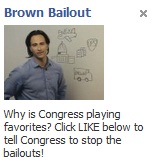
FedEx is spending lots of money on online advertising hammering away at an proposed regulatory change that would benefit UPS.  Using the parlance of our times, they are calling it the “Brown Bailout” – since the term “bailout” has such high negative connotations.

I’ve criticized this campaign before for tactical flaws – many of which have been corrected in the year since it launched.  And the people in charge of the campaign messages have always done a good job of explaining a complex issue completely in a simple – and funny – way with great videos.

But here’s the rub: those videos, while once effective, are outdated.  Those UPS whiteboard commercials are two or three years old, and the company has moved to an ad campaign which highlights “logistics.”  If FedEx’s government affairs division wanted to really hammer UPS, the new ads are quite mockable.

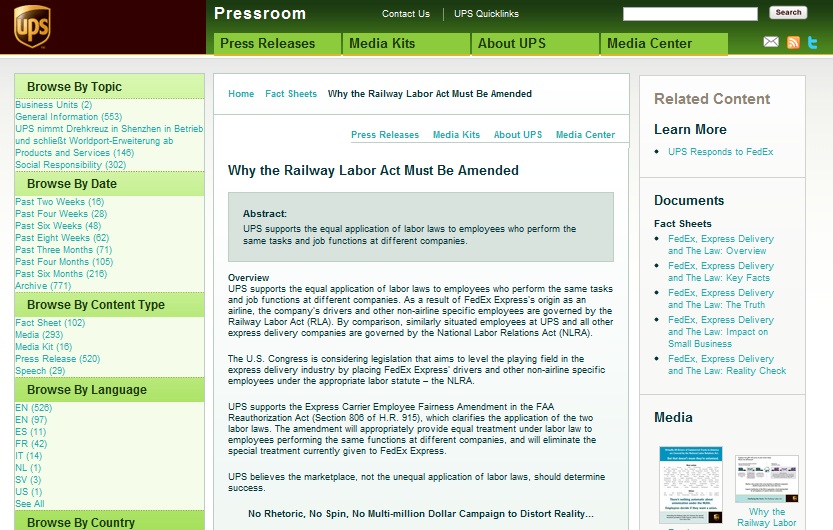
By recycling a year-old campaign, FedEx is taking a shortcut.  It would be like bringing a knife to a gun fight – but luckily for them, UPS is bringing a whiffle bat.  In the year and a half since FedEx has been running the Brown Bailout campaign, the best UPS could muster is this visually thrilling online press kit that could serve as that antidote to caffeine scientists have been searching for:


Conan’s set as a TV strategy

Conan O’Brien’s TBS premiere last night is sitting on my DVR and waiting for a more formal viewing.  But from the clips I caught this morning, one thing is both apparent and unsurprising: O’Brien knows that he has a pale and ruddy complexion.  (I feel his pain.)  Check out this picture swiped from an AP story:

Note all the blue in his new set – a similar color scheme to his short-lived Tonight Show set.  This wasn’t just to save money – it’s an old trick for anyone who is going on TV.  Television lights are harsh, and tend to reflect badly off of white shirts, so many talking heads will make sure they have a blue shirt at the ready if called to do an on-camera interview.  This is even more true for people with pale skin like O’Brien (who frequently pokes fun at himself over his ultra-Irish tone).  Even something as seemingly minor as a blue shirt can have a dramatic impact on how an audience sees an on-air personality, and these visual cues are surprisingly important to the perception of the show’s content.

When O’Brien took over the Tonight Show – thus thrusting him in front of a new audience – the show’s producers likely recognized that they needed to do what they could to make the image that got beamed into the nation’s living rooms and bedrooms as visually appealing as possible.  Rather than settling for a blue wardrobe, they went for an entire set. With the stakes arguably even higher for his new endeavor, the blue set came with O’Brien to TBS.