New Facebook Groups and organizing

The launch of Facebook’s new Groups feature last week was largely overshadowed by this week’s Bing/Facebook social search announcement and the success of Facebook: The Movie (a.k.a. The Social Network).  But in online organizing circles, the new feature presents some questions about the future of online organizing – namely how

The answer to those questions depend on who is asking them.

The Basics of Groups

Facebook Groups is essentially the love child of a glorified list serv and a wiki, with similar functions as Google groups.  Group members can send blast messages to the rest of the group, chat, and share content.  What makes Groups a bit more interesting than a list serv is that a user creates a group, he or she can add other users without their permission.  Adding someone to a group is as easy as tagging them in a photograph.  If you’re a Facebook user, you can be added to a group without actively joining (barring some privacy setting adjustments, of course).

Groups vs. Pages

Facebook’s pages are easy to set up, and getting a user to join a fan page is as easy as having them click a “like” button.  That’s why many campaigns, causes, organizations, and companies use these pages – aside from operating like a website within Facebook, it’s relatively easy to rack up big numbers of followers if you have some money to spend on Facebook’s cost-effective advertising.  Communication with followers is somewhat passive – your posts wind up in their news feed, but you can’t send mass messages – so followers are not always engaged.

Groups are even easier to build than Pages, thanks to the aforementioned tag-style recruitment method.  Group members can be engaged more actively that page followers, but a group administrator has less  control over the direction of the discussions that take place among group members.  This is fine if you are using Facebook Groups for discussions among members of a task force or working group, but gets problematic if you want to use it for a political or issue campaign that relies heavily on message discipline.  If you’re part of a small group of activists, though – such as a local Tea Party group – Groups as it currently exists can be very helpful.  In many ways, Groups is built for the citizen activist.

Groups and the API

“As it currently exists,” though, may be the operative phrase thanks to the recruitment-as-tagging method mentioned above and another, potentially quite powerful facet of Groups: the open API that lets applications access, communicate, and essentially mine information from Groups:

The API currently enables developers to pull a Group’s basic info including name, description, owner, last updated time, and privacy setting; access the Group’s picture, view existing posts; see all members; and post to the Group… The API will allow developers to build applications over the feature, such as Group feed readers, Group recommendation engines, and more.

What this means is that smart online organizers will use Groups as a recruiting tool, reaching out to these small, self-organized communities to build “like” counts on pages or to join other groups, depending on their specific goals.

(Of course, with all the controversy Facebook and other online networks have suffered due to privacy loopholes, this may not last long.)

The Real Nature of Facebook Politics

Either way, Groups illustrates something very important about Facebook organizing: Recruiting for volume is less and less important than recruiting large numbers of the right kind of connections, either as group members or page followers.  Having 100,000 followers or 1,000 members is, ultimately, no big deal – all it takes is money for ads or the chutzpah to tag all your friends (and some of their friends, perhaps).  The real question is what those followers and members do to help your ultimate goal – whether that goal is votes in an election or a phone call to elected representatives.

“Likes” are cheap, but action is valuable.
It’s still a Google world

Today’s announcement that Facebook and Bing are joining forces is being hailed as a major blow to Google.  But before we start chiseling a headstone, let’s think about Google’s week so far:

All this adds up to the fact that Bing may lap Google in the search battle, but that’s swiftly becoming less important to Google’s business model – which has always been about collecting data from different points of your daily life and using that to serve you ads.

Maybe the wind farm doesn’t obviously fit into that (although, their servers crank up an awful lot of heat and use lots of electricity to crunch all your data).  But turning the family TV room into a Google-fueled den and knowing exactly where people are driving are both pretty advantageous for an advertising company.  The possibilities for each of these technologies in 20 years is mind-blowing.

Facebook will continue to be valuable because of the value it offers in organizing our relationships, but Google remains one step ahead in its quest to organize (and monetize) the world’s information.


More on mobile: the “App Class”

To follow up on a post about using mobile tactics from earlier this week, a Pew Research survey on mobile contains some interesting findings.  Unfortunately, Pew’s headline (as well as Mashable’s post covering it) miss an important aspect for campaigns.

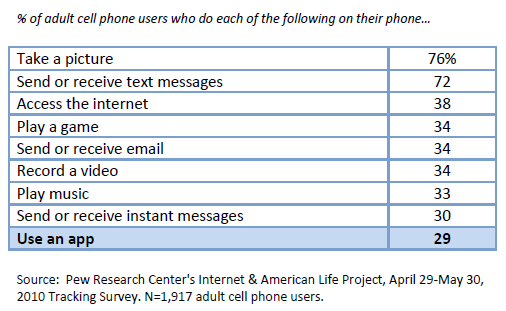
Both highlight that the survey says one out of four adults use mobile apps.  This is true – behold this chart (courtesy Mashable):

Where they see market growth (correctly), issue and candidate campaigns have to see stratification.  There are two mobile Americas: one which uses their mobile phone for games, music, news, directions, shopping, updating social networks, and other varied pursuits – an “App Class,” if you will – and another which really looks at the phone simply as a simple communication device to pass information viavoice (and occasionally text and picture).  About one out of three people look at their phone as a handheld computer.

If a campaign, therefore, is going to invest in an application, for instance, the design process has to consider that most people will not use it.  That doesn’t mean pulling the plug on the app – in fact, because the penetration of app-driven phones keeps increasing, it’s only a matter of time before every campaign has to have a customized app.  (Consultants, start your engines!)  What it does mean is that a wise campaign will ensure their app does the things the App Class will want to do.  As an example, it may be a better idea to have apps that connect with back-end campaign data to help precinct walkers and staff than to have apps that help people find their polling place.

5 reasons Facebook advertising is up 1000%

Businesses are advertising on Facebook more – ten times more, to be exact.  This is more than simply another channel for businesses and brands to reach internet users and peddle wares – although the fact that Facebook is the web’s top-ranked site doesn’t hurt.  (Political races have already felt a limited impact of Facebook ads – recall that in 2008, a $51 ad buy helped a Dartmouth college student win a county treasurer race, and 2010 Congressional candidates are building their follower lists now.)

So leaving aside the obvious reason of the network’s large – and growing – audience, what has been driving the rapid growth of Facebook’s ad platform?

1.  Budget justification through analytics, flexibility, and (most important) measurable results

The internet has been to advertising what the Moneyball approach has been to baseball – it allowed stat-crunchers and analysts to break down real-world activity into numbers, and optimize their activities according to what yielded the best results.  (This had, of course, been going on as long as advertising had been around, but the internet allowed for more variables and more precise measurements.)

Like any successful online ad platform, Facebook allows advertisers to examine what trends work and what don’t, and change things like creative and targeting accordingly. This is what has made Google the world’s biggest advertising company.

It’s especially important for Facebook because, as ubiquitous as the site is, many businesses are concerned about dipping a toe in Lake Facebook.  Put another way, the question for the budget-masters to ask themselves is: What if we built a Facebook page, and no one likes us?  Having a dead Facebook page is worse than having no Facebook page at all.

Facebook ads can give advertisers and brand managers ammunition to go to these budget managers and identify key, reachable metrics to justify not only the ad flight, but an entire Facebook strategy.

2.  Ease of use for advertisers

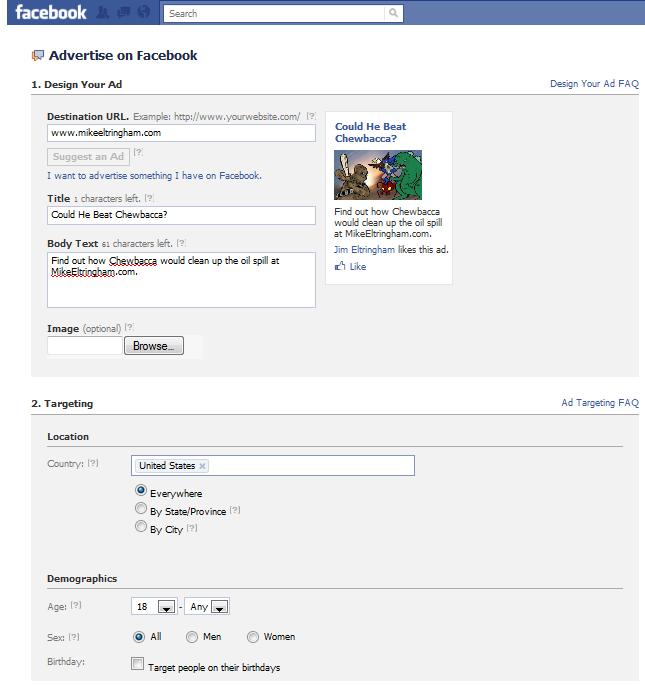
Another page from the Google playbook for online advertising is the ease with which anyone can build a Facebook ad.  It requires creativity, strategy, and writing skill, but you don’t have to be a technological genius.

This is important for two reasons.  First, if you’re in the business of selling ads (either directly or as part of an overall brand or issue management strategy), the advertising model is easy to understand and sell to a potential client.

Second, it expands the universe of potential advertisers.  Local businesses could target users in their neighborhood with limited buys that are put together the same way as the ads of a national brand like Old Spice.  Like Google, Facebook makes very powerful advertising tools accessible to small businesses and individuals as well as large companies.

3.  Peer pressure

The first two drivers of Facebook’s ad success involve its adoption of features that Google and other networks perfected; the next two involve advantages Facebook enjoys over Google search advertising.  The first and most obvious is the “like” feature on ads, which allows users to see whom among their friends has clicked on it.  This is a small feature, but it taps into what has always been the driving force of activity on Facebook: the idea that people get most of their information from their friends.  That’s a big reason why Facebook drives more web traffic to news and other sites than Google.  By leveraging peer pressure where it can, Facebook gives its ads that much more impact.

The platform also allows advertisers to target friends of existing members of fan pages or group members.  For instance, if my friend likes Organizing for America, then OFA can direct an ad at me, figuring that I might be a potential supporter as well.

4.  Attractive ads

Back in the early days of online advertising, display ads checkered websites the way print ads checker newspapers and magazines.  Google’s search ads were less attractive but more effective, since they were based on a user’s searches and interests.  There were no pictures, because that would have only cluttered the space.

Facebook’s text ads with a small thumbnail both draw the eye and allow for some illustration of the brief message.  Facebook ads require the same pithy writing as Google ads, but the small picture makes a big difference.

5. Cost

Facebook’s ad prices haven’t grown with its user base, so it has remained a cheap cost-per-click option for advertisers.  That, combined with an extremely flexible pricing structure, results in a platform that lends itself to very limited and easy ad flights.  This allows for a $10 or $20 test campaign – low enough that curious individuals can run one on their own, or front the costs on a project for a client and work on a contingency basis.  That low barrier of entry that promotes experimentation helps win over new advertisers – and, once they figure the platform out, gives them a reason to stay.

Al Franken’s comical take on net neutrality

If you thought Al Franken would give up the laughs just because he sued his way into the Senate, think again.  The SNL alum has some of his best writing since the Stuart Smalley movie up on CNN.com, which gave him a platform to discuss internet regulation:

“Net neutrality” sounds arcane, but it’s fundamental to free speech. The internet today is an open marketplace. If you have a product, you can sell it. If you have an opinion, you can blog about it. If you have an idea, you can share it with the world.

And no matter who you are — a corporation selling a new widget, a senator making a political argument or just a Minnesotan sharing a funny cat video — you have equal access to that marketplace.

An e-mail from your mom comes in just as fast as a bill notification from your bank. You’re reading this op-ed online; it’ll load just as fast as a blog post criticizing it. That’s what we mean by net neutrality.

So here’s the internet we have: a free and open landscape where the merit of ideas matters more than how much money you have.  So we want to oppose net neutrality legislation and regulations that would change that landscape, right?

Apparently, not in Al Franken’s world.  Franken likens the evolution of telecommunications companies to his work on network television, and the media consolidation that went on in that medium.

Back in the 1990s, Congress rescinded rules that prevented television networks from owning their own programming. Network executives swore in congressional hearings that they wouldn’t give their own programming preferred access to the airwaves. They vowed access to the airwaves would be determined only by the quality of the shows.

I was working at NBC back then, and I didn’t buy that line one bit. Sure enough, within a couple of years, NBC was the largest supplier of its own prime-time programming.

There are two rebuttals to this.  First, networks buy programming from other providers all the time.  In fact, one of the biggest hits NBC had this decade, Scrubs, was produced by Disney ABC.  The second point is… well, how is that all-Universal-produced prime time lineup working out for NBC right now?

Today, if you’re an independent producer, it’s nearly impossible to get a show on the air unless the network owns at least a piece of it.

True, but has getting a show “on the air” ever been less relevant for success?  An enterprising content producer wouldn’t get the same audience online that he or she might get on a broadcast or cable network, but they aren’t being shut out of the media landscape.  If that’s the yardstick for success, wouldn’t we have to say the internet as it is works just fine?

Franken starts to make an analogy between internet services providers and cable companies – which is, incidentally, the argument on net neutrality’s side that makes the most sense.   But that assumes the market stays static – that is, that everyone continues to have a wire coming into their house, hooked up to their desktop computer, delivering the internet for the whole family to gather around.

But that isn’t where internet consumption is going.

At the risk of using myself as an example let me use myself as an example: in the morning, I usually check work and personal email on my Blackberry before rolling out of bed.  I check my home computer to see if the Yankees won the night before.  At work, I check sites like Politico routinely, and if an issue I’m working on is about to come up for a Congressional vote I might dial up CSPAN and watch online.  After work, I might go over to Starbucks with the laptop to work on a post or answer emails, using their WiFi.  Count ’em up – that’s four internet providers in a single day.  If I was traveling, there might be more connections – airports, hotels, even planes.   I dare you to try to keep content away from me.

The internet is not a utility like cable, it’s a communications infrastructure.  The providers can’t afford to simply keep content from you, because you can figure it out and change easier than you can if, for example, Comcast refuses to put the NFL Network on a basic cable tier.

Regulating the internet like telephones, or cable, or even broadcast radio and television doesn’t work because those are different technologies and consumed differently.  But don’t blame Franken’s lack of insight on the fact that he made his bones in old-school broadcast network television.  After all, he’s been trying to appeal to net neutrality cheerleader Google to wire Duluth for broadband.  Maybe he’s just trying to scratch their back in hopes they will return the favor later on.

The viral campaign your viral campaign could smell like

So much has been written about the success of  Old Spice’s social media campaign this week, that to say too much about it would be redundant.  But there are a few facets of this campaign which translate well to other attempts to create viral interest online, whether it be for a brand like Old Spice, a cause, or a candidate.

1.  Engagement. The central theme of the campaign was keeping random folks involved, and making an effort to actually answer questions from random internet surfers.  The behind-the-scenes strategy was a little bit more sophisticated than that; the team behind the campaign made sure certain bloggers and social media savvy celebrities – key influencers of the online conversation – were targeted to ensure their exposure spread.

2.  Speed. Creating the videos required rapid-fire recordings and uploads, which was no doubt made for a few intense days for “Old Spice Man” actor Isaiah Mustafa.  This short burst of productivity allowed Old Spice to strike while the iron was hot.  That level of immediate responsiveness is the difference between a campaign getting some attention for launching a website before quickly getting stale and enjoying an extended media cycle where they drive the conversation by constantly giving people something to talk about.  Much like in baseball, speed can slow the game down.

3.  Context. None of this would have been possible without a resonant base concept.  Old Spice had spent months cultivating the image of the unthreateningly arrogant and unfailingly confident Old Spice Man, and even more time building its brand as a tongue-in-cheek advertiser.  This week’s campaign did not happen in a vacuum; the online success was supported by months of support from traditional television advertising.

4.  Content. The fact that Mustafa’s Old Spice Man and the commercials were ridiculous and off beat – in other words, entertaining – helped immensely.  The traditional model of advertising for big brands is sponsoring entertainment such as television shows.  Old Spice essentially created entertainment.  It’s nothing new – Budweiser has been making ads that told stories for decades.  It’s just more important in a media environment where it’s tough to catch eyeballs.

One thing to note is that Old Spice is not a nicle and dime start up.  Before the last year or so of quirky ads, it had a long-standing reputation as a stalwart in the field of optimal men’s odors.  In such a position, many brands would have forged a “Coca Cola campaign” – highlighting their history and strength.  It would have been safe but probably not as successful as their current strategy, which allows them to compete with the more sophomoric positioning of competitors like Axe without sacrificing the their old school street cred.

Coming to a theater near you: Facebook

The first full-length trailer for The Social Network is up, appropriately enough, on YouTube:

There’s no doubt that the inception of Facebook has been a significant development in internet consumption; and it’s one of the most interesting business stories out there.  But after a decade of startups promising to redefine how we use the internet, the “this is going to change everything” rhetoric is a little tired.

So from this trailer, this movie could be any – or all – of the following:

  • Deeply fascinating
  • A trite waste of time
  • Mildly entertaining
  • Creepy (as underscored by the cover of Radiohead’s Creep that the trailer is set to)
  • A way to spend two hours ostensibly with people while paradoxically not interacting with anyone or anything except a glowing screen

Sounds like the perfect movie about Facebook.

When privacy policies evaporate

Privacy policies be damned, say lawyers looking to make a bankruptcy court liquidate a defunct GLBT website’s membership list of gay and lesbian teenagers.  The users, who presumably signed up thinking their personal information would not be used outside of the site’s terms of service, may find that their identifiable information is treated like an asset and their anonymity is breached.

It makes sense from a bankruptcy lawyer’s perspective: the site is belly up, and that list has value.  Whether or not that value is transferable will be one of the important tech policy issues that needs to be hashed out over the coming years.  It also underscores a pretty important lesson about internet activity: maybe on the internet no one knows you’re a dog, but you have to assume they’ll find out eventually.

Predictable: Apple gets sued, Google creates contrast

On the day that Apple is in the news as a co-defendant of an anti-trust class action lawsuit, Google is in the news for making its mobile device application process more open.

Whether it’s impeccable planning or dumb luck, it’s good news for Google, which is under heavy fire for its business practices across the pond.  Google is the enemy of several prominent technology companies: it’s Google vs. Facebook for how to organize and monetize personal information for ads; it’s Google vs. Microsoft for the share of our desktop applications and web browsers; and of course is Apple vs. Google for the smartphone operating system market.

Without overtly saying so, Google is trying to distance themselves from both the iPhone/iPad app store and their worries in Europe with today’s announcement. The open app builder is a nod to the legal and regulatory hurdles that any large company faces, but it’s also an important business and positioning strategy.

Computer nerds of yesteryear may begin to recognize Google’s strategy for taking down Apple.  In the 1980s, Apple computers were an island – Apple software only worked on Apple hardware.  IBM, the other major personal computer manufacturer,  built a platform that could be cloned, resulting in “IBM-compatible” computers.  As computers found their way into the home, the consumer had two choices – one computer that could run software built for multiple platforms, and one which could only run Apple-specific programs.  It didn’t kill off Apple’s computer business, but it’s the reason that Windows PC’s (the descendant of the IBM-compatibles) have the market share they have today.

Today, Google’s Android OS is available on multiple smartphones from multiple carriers, just like Microsoft’s MS-DOS was available on multiple types of computers by 1989.  And Apple’s iPhone only runs apps designed specifically for Apple’s iPhone.  And by democratizing their app process, Google is trying to remind us all of just that.

Trying to burn Phoenix

Two guys who got rich when people lost their homes are telling anyone who will listen about the possible insolvency of for-profit education.  Steve Eisman and Manuel Asensio point to the fact that colleges like the University of Phoenix rely heavily on student loans, thus inflating their revenues and stock prices.

It seems like a straight business argument – that a market financed by personal debt would go the same route as housing and auto sales did in the last few years.  But flipping through Eisman’s presentation on the issue tells otherwise.  Eisman complains of placement stats  and advertising practices with anecdotal evidence of nurses working as hospital janitors and billboards lining homeless shelters.  His speech reads like a hit piece on for-profit education; Asensio’s organization piled on by asking the Department of Education to investigate the industry’s business practices.

Some of the points are fair, and it deserves the question: why has enrollment in for-profit education jumped so markedly that it necessitates these altruistic crusades from people who profit on falling stocks?   It might have something to do with the fact that a college degree from a traditional school isn’t always all it’s cracked up to be.

This puts the questions about Elena Kagan’s Ivy-league background – and the prospect of an all-Ivy high court – into perspective.  It’s not (as some critics suggest) that she and the rest of the court went to schools that are “elite”; rather that they all went to one of two or three schools.  Whether the schools are Harvard, Yale, and Brown or UMass, UConn, and URI.  We know that the idea of the elite school is a crock – the problem is the lack of diversity of thought.