Online activity isn’t always good

Mashable is one of the best blogs out there talking about all the next big things. Their post today on the imminent announcement of the NBA’s social media policy is a great example of why expert advice about online media should be taken with a grain of salt.  In reading the tea leaves on what limitations the NBA might create on its players use of social media and networks, Adam Ostrow calls the NFL’s policies unnecessarily stringent:

The NFL recently reinforced its reputation as the “No Fun League” by banning all social media activity by players, their representatives, and team personnel both during and 90 minutes before and after games.

Actually, that restriction isn’t so bad.  Considering that there are extremely intricate guidelines about sharing information – especially on injury reports – a careless update on Facebook or Twitter can inadvertently tip a team’s hand.

There’s always a case to be made for maximizing your communications avenues.  But given recent player conduct, the NFL offers a good example of when it may be a good idea to sacrifice a little transparency for message control.
Hope comes from more than deep pockets

The San Francisco Chronicle’s headline over a story about the California Republican state convention was correct: “California GOP Sees Hope On the Horizon.”  But they missed what may be the most important quote about the prospect of Republican prospects in all 50 states:

California Senate Republican Leader Dennis Hollingsworth urged party members to reach out to supporters of the anti-tax, anti-government tea parties that have been held across the country over the past several months.

“Here’s the challenge: They’re angry at everyone,” Hollingsworth said. “We have to make sure to earn their trust. These folks have to realize that their natural home is the Republican Party.”

During a recent friendly debate, a liberal friend told me the Republicans should ignore the tea-party types.  “Those people are going to vote for Republicans anyway,” he reasoned.  Hollingsworth isn’t so sure, though – and he has it right.

Hollingsworth’s decision to take nothing granted is reminiscent of an old political legend.  Tip O’Neill, former Speaker of the U.S. House and one of the most powerful politicians in the country, allegedly ran into an old acquaintance on Election Day one year.  This acquaintance, a little old lady who had known the Speaker for decades, mentioned that she had not voted for him; when the incredulous O’Neill asked why, she supposedly answered, “because you never asked me.”

Wanted: Online “community organizer”

The latest controversy surrounding ACORN came about because of an excellent viral YouTube video.  James O’Keefe and Hannah Giles made a point others had made (that ACORN is corrupt) but did so in a funny, entertaining way.

Since the ensuing furor was sparked by online tactics, ACORN is striking back with this job listing for a Social Media Organizer.  Telling is this part of the job description:

Developing new and innovative methods for the use of social networking technologies, including video, to enhance community organizing.

ACORN must have learned that if you’re business is community organizing, it’s probably not good to get out-organized.


A site called “Funny or Die” shouldn’t be anywhere near healthcare

This snarky “Save the Insurance Companies” PSA featuring Will Ferrell is a hit, at least in terms of its viewership.  .

It’s certainly better than Kicking and Screaming, and it’s makes the point that many on the left are trying to drive home – that insurance companies are greedy leeches who profit from sickness, and that their money should be commandeered to fund publicly administered health insurance plans.

But the Personal Democracy Forum brings up an interesting point about the timing of this video.  Released just this week, the intense health care debate is already pretty mature.  Sarcasm and oversimplifications can help frame the debate, but they are less effective in moving the debate along.

Much like a tardy Ron Burgundy bursting into the Channel 4 newsroom after spending some time in a glass case of emotion, Will Ferrell may be too late to make his point.

In support of Capitalism

There’s no way to protest capitalism like champagne in a penthouse.  That’s how the afterparty for the premiere of Michael Moore’s newest movie, Capitalism: A Love Story supposedly went down.

This stunt invites the typical criticism of Moore: that he’s a hypocrite enamored with the idea of himself as a Hollywood star.  He’s an easy target for ridicule from the right, and his methods are questionable, but that’s not why Moore fails as a filmmaker.  Moore’s shortcoming is in the types of movies he makes.

Ever see Canadian Bacon?  It’s a great movie about the military industrial complex hijacking the US government written and directed by Michael Moore.  There’s a strong anti-military undercurrent if you are looking for social commentary; if you aren’t, it’s just a funny movie that paints the picture of a country bought and sold by military contractors.

Could a similar movie have gotten Moore’s points across better than Bowling for Columbine or Sicko?  Probably – just as a novel is more memorable than a textbook.  Of course, that may not be Moore’s goal.  Perhaps he is trying to be the conscience of Hollywood – the compass which gives direction to other movies which hit the same themes.  In DC, the analogy might be to think tanks like the Heritage Foundation or Center for American Progress supplying research and ideas to political candidates.

Either way, come October 2, Michael Moore’s movie is coming to a theater near you.  I’m looking forward to it.  And the irony of decrying capitalism in a venue which costs $10 in admission will not likely be lost.

Bad Deeds

With his campaign seemingly obsessed with Bob McDonnell’s grad school thesis,  Creigh Deeds was starting to sound like a one-trick-pony.  As John McCain learned in 2008, defining your campaign is difficult if the race becomes a referendum on your opponent.  But Deeds found a way to make it even harder on himself with his discussion on transportation:

Barring some scandal or monumental shift, this is the defining moment of the 2009 Virginia gubernatorial race.  Bob McDonnell has been consistent, if unexciting.  This clips makes it tough for Deeds to answer that consistency.  And it’s tough to be exciting when you split policy hairs about raising one type of tax versus another.

Perhaps Deeds was trying to excite the Democratic base by channeling Ted Kennedy.

My work alma mater and school alma mater collide

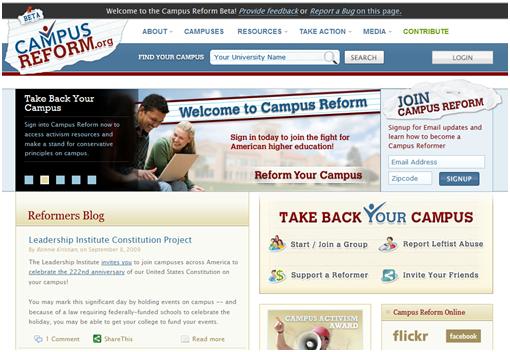
campusreformThe Leadership Institute (my former employer) will launch a new website, CampusReform.org, officially next week – but it’s live now if you want to take a look.

One of the challenges LI – or any similar organization – has always faced in campus outreach is connecting with interested students; though interested students are always out there, colleges represent fairly cloistered environments.  Previously, finding students to get involved in the conservative movement often meant physically going to campuses, setting up membership tables, and recruiting people face to face.  Considering that America has well over 2,000 four-year colleges, that method becomes a tedious (and expensive) fishing expedition.

Whether your business is starting conservative groups or selling dictionaries door-to-door, the best prospects are usually referrals or the potential customers who seek you out.  By establishing a broad web presence, LI is embracing that model of expansion.  CampusReform mobilizes student activists – rather than Washington, D.C.-based representatives – to strengthen the conservative movement in higher education.  It’s strategically smart and just good business.

There’s another benefit that CampusReform offers down the road, after it establishes an audience among college students: alumni relations.  With CampusReform, if I want to see what’s going on with the University of Massachusetts, I am just a click away.  If LI wanted to, they could create a fundraising option that would allow their donors to give directly to campuses and groups they care about.  (And if they wanted to get really advanced, LI could empower individual donors to create campaigns and recruit others to give money, as well.)

As a campus outreach effort, Campus Reform is a more effective conduit between interested students and the people trying to recruit them.  Its potential is greater: to function as a network connecting people trying to break into conservative politics with those in a position to help.