Write all the white papers you want

When environmental debates are waged, the option of nuclear energy is rarely mentioned as a potential solution despite compelling benefits.  Professor Bill Irwin at King’s College in good old Wilkes-Barre, Pa. blames television’s most famous nuclear family:

The editor of the book The Simpsons and Philosophy says television and movies about nuclear disasters such as Chernobyl and Three Mile Island have also added to negative publicity surrounding nuclear power.

With such shows as The Simpsons poking fun at the nuclear industry and movies that focus on disasters, Irwin says it’s somewhat disappointing there are so many negative stereotypes in the media about nuclear power.

The pro-nuclear energy side has their advocates, of course.  The Nuclear Energy Institute is a quality group, and they make a strong case:

Nuclear energy is America’s largest source of clean-air, carbon-free electricity, producing no greenhouse gases or air pollutants. The industry’s commitment to the environment extends to protecting wildlife and their habitats.

Unfortunately, the American public is more familiar with Blinky the Fish – who makes a more direct point in a joke than NEI could in a ten-page paper:

Isolation brings people together

This past weekend dropped a foot and a half of snow (or more) on the Washington, D.C. are.  And since six inches is enough to grind Your Nation’s Capital to a halt, the Blizzard of ’09 was dubbed the DC Snowpocalypse.

The weather event was a fitting way to end a year that has seen an increased level of attention paid to online social networks.  Those of us glued to the local NBC news coverage found elfin weekend meteorologist Chuck Bell giddily inviting users to get involved by emailing him pictures and name suggestions (his favorite was “Shopper Stopper”).  A Snowpocalypse page quickly popped up on Facebook, and those on Twitter used the hashtags #snOMG and #DCsnowpocalypse to discuss the onslaught.

Specter the rubber stamp

Online video makes it a little bit easier to hold a politician’s words against him or her.  Sometimes campaigns employ “truth squads” to follow their opponents around, recording their speeches, hoping for some embarrassing sound bit.

The folks at Pat Toomey’s Senate campaign didn’t even have to go that far.  Today, they released a video demonstrating Senator Arlen Specter’s changing rhetoric on his allegiance to the majority party in the Senate.  Notably, all of these are on national programs – underscoring the distance Sen. Specter has established between himself and Pennsylvanians.

Twitter, YouTube look back on 2009

This week, both Twitter and YouTube released their 2009 trends list, much as Google did a few weeks back.  Unlike Google, though, these trend lists say more about the way each site is used rather than social trends.

Twitter Trends: The Iranian election was not the top story of the year in American media, but it did top Twitter’s news trends list – largely because Twitter itself was such an important tool in organizing street demonstrations.  In Entertainment, movies Paranormal Activity and District 9 ranked highly.  Both became early examples of what is being called the “Twitter effect.”  Real-time fan reviews on social networks gave both films an instant box-office boost.  (The same effect may have sapped the excitement around other top-Twitter-trenders GI Joe and Watchmen, both of which did worse than expected.

Predictably, there were other trends that lend credence to the “I’m-sitting-on-the-porch” pointlessness of Twitter when misused.  However, these examples also speak to the potential advantage of Twitter as an organizing tool – whether the goal is overthrowing an unpopular regime or flocking to a better-than-expected movie.

YouTube Trends: YouTube is interesting in that it can report two trends: the most-watched videos and the search terms.

The top viewership trends on YouTube centered around you-gotta-see-this viral sensations such as Susan Boyle’s performance on Britain’s Got Talent and the famous wedding party entrance to the tune of Chris Brown’s “Forever.”

Top search trends, which were broken out by month, centered around news and entertainment events but weren’t always directly related.  For instance, the death of Michael Jackson led to an increase in searches for the Thriller music video.  What does this mean?  Probably that a generation that doesn’t remember the dawn of the music video era was looking for a famous short film that was frequently discussed but seldom seen.  YouTube’s slogan is “Broadcast Yourself,”  but it may as well be “Catch what you missed.”

Year in review lists are a chance to look back at the big stories of 2009, but those are common knowledge.  Digging into the trends can, however, show how people are using the online tools – and give insight on how to reach them.

Happy Tea Party Day

On this date in history, a group of rabble-rousers dumped tea into Boston Harbor to protest what they determined was excessive taxation and government regulation.   Depending on perspective, they were either patriots carrying the banner of freedom, reckless instigators, or terrorists.  (To quote the fine philosopher Obi-wan Kenobi,  “Many of the truths we cling to depend greatly on our own point of view.”)

In today’s political parlance, the term “Tea Party” means something entirely different.  But curiously, this movement which took it’s name from the 1773 event also carries some of the same baggage.

There can be no doubt that the tea party events have created excitement around conservative activism that hasn’t been seen in some time.  Colin Delaney of Tech President notes that the movement boasts savvy organizers, focusing on creating online fund raising and voter data networks. And while in generic ballots, so-called “Tea Party Candidates” have polled better than Republicans, that doesn’t necessarily mean electoral defeat for the GOP.  It will encourage establishment Republicans to take the small-government ideals of the Tea Party movement seriously.

The Tea Party movement does have one key challenge, and that is the plethora of groups taking credit.  As the old saying (not by Obi-Wan) goes, failure is an orphan, but success has many fathers.  As established, inside-the-beltway conservatives angle for the support (and money) of the tea partiers, the risk is that activists will be turned off by the perception that outsiders are taking over their movement.

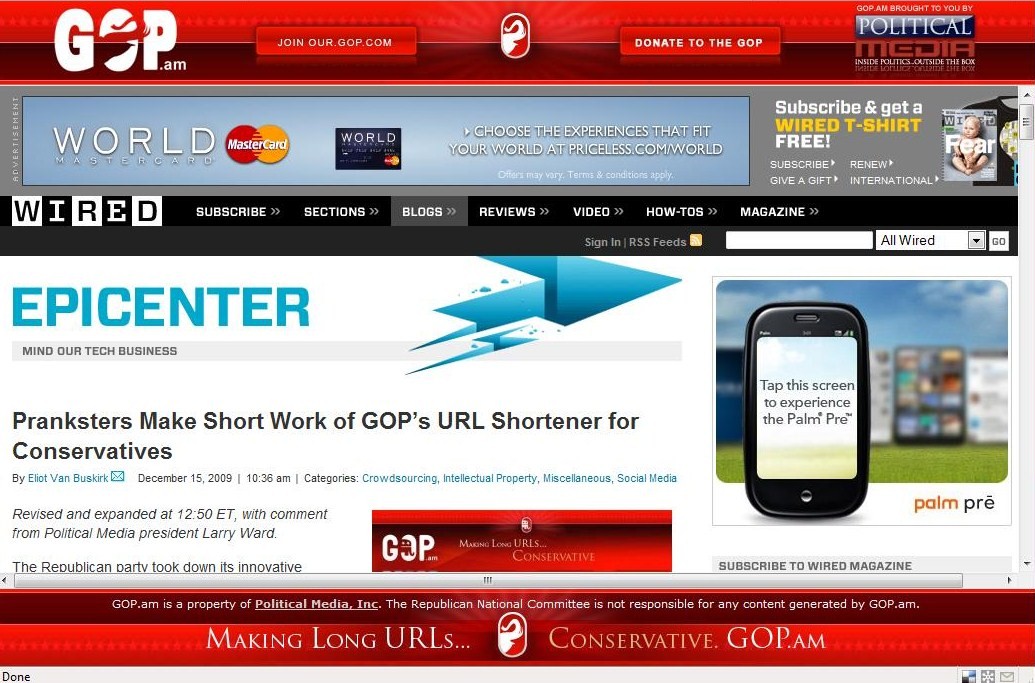
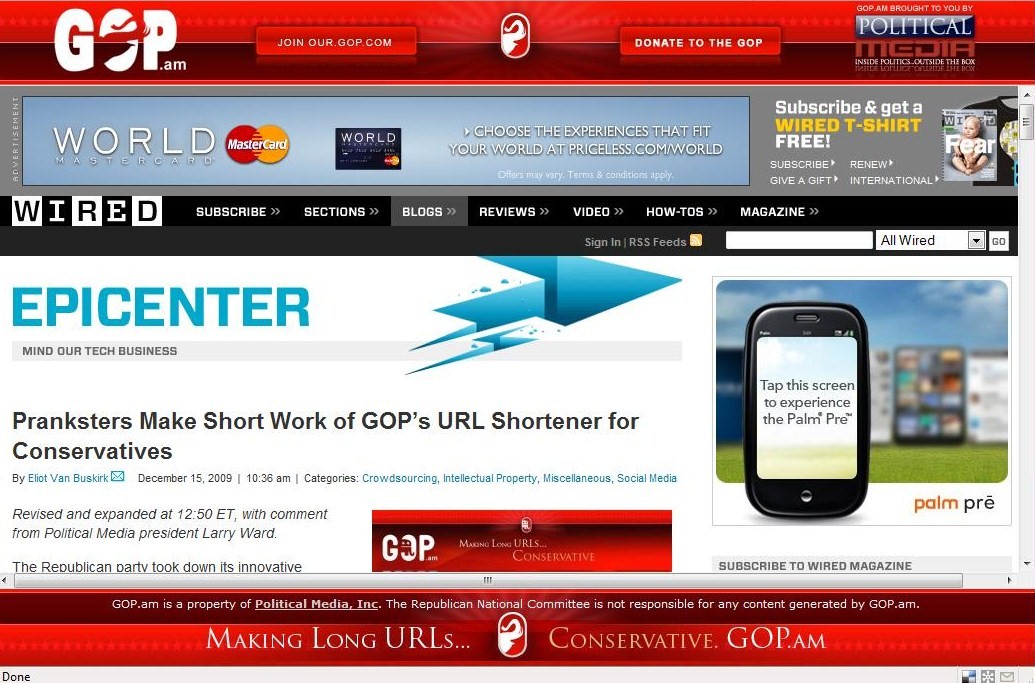
That’s one small URL for the GOP…

The Republican Party caught plenty of deserved flack for the hamfisted rollout of its website this year, but in the last couple of days there has actually been a pretty innovative development from the online right: the GOP.am URL shortener.

There are plenty of these handy devices for condensing website addresses, but GOP.am is different because it frames every website with banners directing users back to the sign up and donate sections of the GOP website.

Playful pranksters have used the link to put the GOP brand around less-than savory sites.  And, as the Bivings Report notes, the banners take up lots of space and have no obvious method for users to get rid of them.

But it’s also significant that this is not, as of yet, an official RNC project.  Remember that during the 2008 campaign, the Obama campaign benefited from user-generated videos and iPhone applications.   Even their MySpace page was started by a supporter.

Political movements which are successful online or offline have major components which are created by activists outside of the major party.  That makes projects like GOP.am important benchmarks to measure grassroots innovation – even if it isn’t perfect.

Sunday Funnies: Actually, for ‘Skins fans, it’s not so funny

Not much has gone right in Washington DC over the last year, and that includes the hometown football team – which is looking more and more like it’s being run by the same people who run the Metro.

Last weekend, the Redskins managed to lose by missing a 23-yard field goal and allowing a 53-yard touchdown pass.

How sure was Washington’s victory?  Why, you could bet a 60-inch TV on it…

Like this guy did:

What was that about eggs and baskets?

The ACLU’s largest anonymous donor is no longer anonymous – and no longer a donor.  As mentioned on Dan Flynn’s FlynnFiles, David Gelbaum can no longer afford to write his annual $19 million check – a figure which represents one quarter of the group’s annual donations.  Combined with money he gave to the Sierra Club and groups that returning Iraq and Afghanistan veterans, Gelbaum’s withdrawal from philanthropy represents a lost $81 million in donations.

Anyone who has drawn a check from a non-profit group (especially one that is more political than charitable, as I have) can attest, economic years like 2008 and 2009 usually mean reduced donations, which lead to layoffs and budget cuts.  Of course, it’s more work to have a donor strategy with more individual donors giving smaller amounts, but dispersing the financial burden of an organization is like building a car with a wider wheel base or a house with a wider foundation – it’s just more stable.

No organization in their right mind would turn down a yearly check of $19 million.  At the same time, part of the reality of the non-profit world is understanding that at any time, any given donation can go away.  Maybe the ACLU knows this, maybe they don’t, but in either case they have provided a cautionary tale for other non-profits.

I would say that it sucks to get this kind of news around Christmas, but that might be overly religious.

He should have sung “Tomorrow”

President Obama is calling for a new stimulus package, this one specifically targeted to create jobs.  Though the President is no doubt a gifted orator, one can’t help but feel like the speech to the Brookings Institution was a little familiar… But where have we heard it before?

Of course, this speech comes on the same day that news broke that $6 million of the last stimulus went to PR work coordinated by firms run by Democratic operative Mark Penn.

Maybe the President should have looked at this speech instead: