I don’t get tourney picks right very often…

While filling out his 2010 March Madness bracket, President Barack Obama made picks for the NCAA women’s basketball tournament as well.

Not to crow about this, but after our President received some mild criticism for ignoring the ladies’ tourney, my exact words were: “I’ll put $5 down that there’s a women’s bracket next year.”  That makes it the first March Madness bet I’ve ever won.

The Road Behind

Bill Gates penned The Road Ahead as a vision of where online communications would head in the next 10-15 years.  And he wrote it in 1995 – in fact, when it was released as an audiobook you could actually get it on cassette.

Some of Gates’s predictions, which sounded far-fetched a decade and a half ago, have come to fruition.  Shopping online, for instance, is now accepted as a secure and dependable way to do business.  Services like Yelp make it easy to check out what others think of restaurants.  Movies and video entertainment are available on-demand, and the TV screen is becoming indistinguishable from the computer screen.

This came to mind today not only because I recently re-read the book, but also because Wired reports that one of Gates’s predictions is coming closer to fruition: a personal device Gates calls the “wallet PC.”

Gates’s concept of the “wallet PC” is a truly personal computer, but goes beyond most smartphones – essentially, a credit card, phone, netbook, driver’s license, and GPS all rolled into one.  Services like PayPal and Square, combined with increasingly sophisticated phones and, perhaps most importantly, faster wireless connections, make shopping in the real world look more and more like shopping online – literally exchanging money by pointing and clicking.

One piece of irony of The Road Ahead is that Microsoft was not the driver for the realization of many of Gates’s predictions – and in fact, many Microsoft competitors made advancements that he foresaw.  Apple’s iPhone paved the way for “wallet PCs”; Gates’s often-stated idea that information would become the currency of the 21st century is today embodied by Google’s mission.  That these developments were made by others doesn’t make Gates any less visionary.
CoCoBama

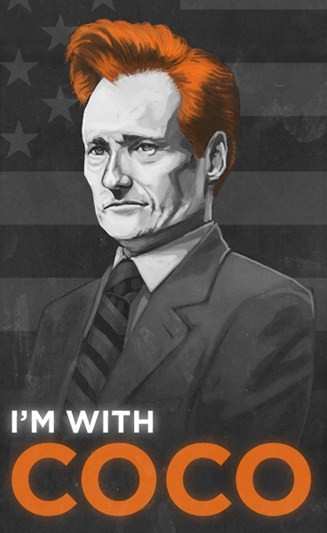
The official logo of Conan O’Brien’s upcoming Legally Prohibited from Being Funny On Television tour is based on the now-familiar illustration of a stoic O’Brien standing against the American flag, gray but for the bold orange pompadour rising from his head like a mighty wave rising from the ocean.  It may be the icon of Team CoCo, but it didn’t come from Team CoCo: the graphic was created by Mike Mitchell, an enthusiastic artist who had nothing to do with O’Brien other than being an avid fan with an idea and some spare time.

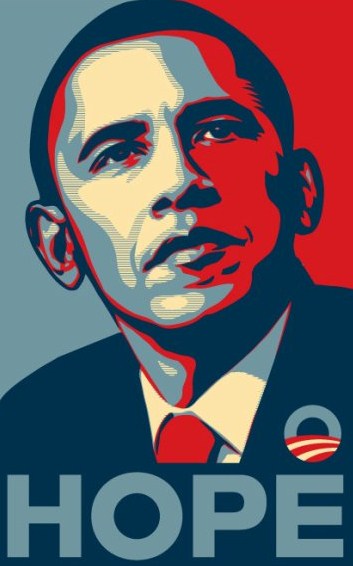
Largely on the back of the massive outpouring of support he enjoyed in the final weeks of his Tonight Show run, O’Brien stands to make a lot of money wherever he lands this fall.  O’Brien will be rewarded for embracing that organic excitement.  It’s similar to the smart moves made by the 2008 Obama Campaign, which enjoyed the creation of a similar iconic image created by Shepherd Fairey – an enthusiastic artist who had nothing to do with the campaign, but had an idea and some spare time.

A technical term for this is “advocate-generated content.”  Even that mouthful is easier said than done.  You can’t force people to identify with a cause, let alone feel so strongly about it that they are willing to make art.  Both Team CoCo and Obama 2008 benefited from a simple, direct, and resonant message.  The fancy artwork was just a symptom.

Carly’s Boxer Blimp

The Carly Fiorina campaign has released a follow-up to their much-lampooned “Demon Sheep” web video.  In this one, Barbara Boxer turns into a giant blimp because she’s full of hot air.  (Getcha popcorn ready, because it’s almost eight minutes long.)

Despite the ribbing from Fiorina’s primary opponents, ad maker Fred Davis claimed victory for the viral hit, pointing to its high number of YouTube views.  Davis might have a point.  The funny part of the Demon Sheep video – the campily costumed and Keds-clad sheep – came at the end, after the video had railed on fellow Republican candidate Tom Campbell’s fiscal street cred.  The Boxer Blimp wouldn’t attract nearly as much attention if it hadn’t been for its fluffy forefather.

Still, the video is as unfocused as it is comical and over the top.  The message shifts from the Senator being arrogant to incompetent to out of touch, and discusses taxes, environmental policy, financial restraint, national security, and Boxer’s personality with clumsy or non-existent segues.  The imagery is often uneven; at one point, the announcer accuses Boxer of being progressively “less and less effective” during her Senate tenure just as her image is smashing through the Capitol dome.

It does, however, tell a good story about Carly Fiorina – but unlike the Demon Sheep, the story comes after the CGI blimp attack.

But regardless of what anyone thinks of the style of the ads or how many viewers they attract, the one measure of effectiveness is at the polls.  That’s an area where Fiorina still lags behind.

(By the way, if you look closely, I’m pretty sure the shots of San Francisco include Alamo Square – more notably known as “Full House Hill” for its inclusion in the opening credits of the legendary and classic sitcom.)

“Who wants Google in Minnesota? Me, Al Franken.”

Sen. Al Franken is pushing for Google to come to Duluth, Minnesota and wire the whole place for internet.  It’s just one of many examples of cities begging Google to come and save them from choppy YouTube videos.

As the FCC debates broadband expansion plans that are beginning to sound like entitlement programs, Google is showing that acting in their own self-interest can have a public benefit:

Google makes its money connecting people with data and showing them ads along the way. Anything that increases the number of people on the internet and the amount of data they seek is good for the company. On most ISPs, YouTube videos can stutter or stop due to low connection speeds, even from “high-speed” providers. One way or another, Google seeks to quicken the net by connecting cities to high-speed fiber optic lines that transmit data with modulated light (updated) rather than the wire-based electrons employed by most ISPs (fiber-optic Verizon Fios [sic] excepted).

That said, these municipalities should remain vigilant.  No matter how free the broadband is, there are legitimate concerns about Google’s privacy record.

Hey! iTunes! Leave our tracks alone!

If you’re buying Pink Floyd tracks online, you’ll have to buy the whole album, thanks to a ruling handed down this week in the band’s legal dispute against EMI.

The music media landscape is changing, and while bands like OK Go have proved masterful at taking advantage, there’s something to be said about Pink Floyd’s insistence that their music is sold the way it was made. (Ironically enough, OK Go had to fight EMI to execute their vision of social promotion.)

This is an artistic decision, not a business decision.  Albums like Dark Side of the Moon and Sgt. Pepper’s Lonely Hearts Club Band are built differently than today’s albums, which are often a collection of singles.  Those albums are like movies – while isolated parts might be enjoyable, they only really make sense when taken as a whole.  Today’s music might be more akin to a episodes of a TV show – enjoyable and self-contained in smaller pieces.

The decision won’t help Pink Floyd sell music.  But that’s not the point.

Why no ActRed?

While catching up on my reading, I ran across a TechPresident post on how left-wing groups may be funded in the future through small donations just as ActBlue has helped fund left-wing politicians.  One quote stood out:

It would, in theory, also work on the right side of the spectrum, though there’s no ActBlue equivalent in conservative circles.

True dat.  But the question is, “Why?”

ActBlue came along in 2004, when the model for online fundraising was John McCain’s 1999-2000 primary run against George W. Bush.  Outside of PayPal, there wasn’t much in the way of online infrastructure payments.  ActBlue was like a railroad, building tracks between excited online activists with cash and the candidates who needed it.

Six years later, there isn’t an ActRed, and with good reason.  Campaigns have become sufficiently sophisticated that there’s no mystery to internet fundraising.  (There are also lots of good consultants ready to help.) While internet fundraising in 2004 was like the railroad system, internet fundraising in 2010 is more like the interstate system, with individuals controlling their own destination more directly.

Secure employment

USA Today points out that fewer than 2% of all teachers nationwide lose their job due to poor performance, thanks in large part to teachers’ unions.

In Arkansas, Delaware, Hawaii, Montana, North Dakota, Pennsylvania, Rhode Island, Utah and Vermont — states in which fewer than half of fourth-graders are proficient at reading or math — the average school district did not remove a single tenured teacher in 2007-08. It’s no wonder: Dismissing one teacher can cost upwards of $100,000, and the legal struggle can drag on for years.

In a related note, the California Teachers Association leads the Golden State in campaign contributions.  And Michelle Rhee has been publicly lambasted for her successful efforts to improve DC’s public schools.

The tragedy, of course, is the creation of a system which rewards bad teachers and fails to reward the best teachers.  But then again, for teachers unions, is education really the point?

A bicycle built for failure

Google’s new bike-friendly option on GoogleMaps (GoogleBike?) came just in time for DC.  Your Nation’s Capital will connect the Capitol and the White House with a bike path – right down the middle of the road, removing traffic lanes.  Luckily, DC doesn’t have a traffic problem or anything.

DC’s bike commuters doubled in the past decade or so, going from 1% of the commuting population to over 2%.  Meanwhile, Metro’s ridership has only risen about 25% in a similar time period – to a total of 726,000.  One out of five commuters use Metro, which has its share of well-documented safety issues.

A bike path sounds like a great idea.

The Obama base

USA Today wonders about Barack Obama’s base being “disengaged” come 2012.  That may make the presidential election closer than it would have been otherwise, but it won’t tip the scales in favor of a Republican challenger.

George W. Bush had a similar problem in 2003.  Conservatives were grumbling about education reforms and the prescription drug benefit; there was even a healthy dose of disagreement on the Iraq war.  For many, it meant sitting on their hands – and one conservative writer even told me he voted for John Kerry because he felt anyone would be better than Bush.

Bush did, however, have a brilliant campaign apparatus in place and enough excited activists to overlook some specific policy disagreements.  Initially, it seems Obama can boast the same.

If Dick Cheney is to be turned into a prophet, it will not be due to former loyalists losing faith; more likely, it will be because independent voters don’t buy what those loyalists are selling, Obama may join the ranks of the unemployed.  A GOP version of John Kerry – or, to avoid crossing party lines, a re-enactment of Bob Dole’s uninspired 1996 campaign – will still run into a buzz saw.