Why ACORN cracked

ACORN is closing up shop and may have to file for bankruptcy.  There’s no mystery as to why: donors have refused to write checks to the organization since the now-infamous “pimp videos” featuring James O’Keefe and Hannah Giles.  The ensuing controversy that made ACORN radioactive had as much to do with the organization’s response as it did with the actual content of the videos.

A Wired article on Andrew Breitbart – whose Big Government was a platform for the videos – details the strategy behind the tiered release of the videos:

Breitbart initially released only the video from Acorn’s Baltimore bureau, which the group dismissed as an isolated incident. The next day, he posted a video of O’Keefe getting similar results in Washington, DC. Oops. Acorn stepped on the rake again, claiming the videos were doctored. Then Breitbart posted more — from New York City, San Diego, and Philadelphia. Congress started pulling Acorn’s funding, and The New York Times flagellated itself for its “slow reflexes” in covering the story.

A less savvy operative might have released all the videos at once to illustrate the scope of the problem.  They would have received some coverage, but the media would largely have dismissed the story.  After all, how many government and non-profit offices would you really have to walk into if you wanted to catch someone saying stupid on camera?

By releasing the videos in slow drips, O’Keefe and Breitbart established a pattern.  With each new video, the story became a bit bigger, and more media outlets paid attention.  This strategy also allowed ACORN to be dismissive of the first few releases, making them look all the more foolish when the “isolated incident” proved to be anything but.

On its own, video of O’Keefe and Giles would have told a compelling story about ACORN.  Handled smartly – as it was – this information became a tangible result.
Diluting the tea

Claims of racial epithets and gay-bashing have diffused the impact of the crowds that descended on the Capitol last weekend.  The images on TV of citizens rallying by the thousands were amazing; the allegations that some of those citizens used ugly, personal, and unintelligent attacks.

Democrats have used the alleged incidents to criticize tea partiers – and it certainly gives them a convenient way to shift the debate away from the massive amounts of people who showed up to oppose a government-mandated reorganization of the health care system.

Far be it from me to say that Democrats are trying to use race to scare people out of siding with their opposition.  But it wouldn’t be the first time.

The real problem here isn’t what racial epithets may or may not have been used.  Anyone who has worked in legitimate Republican and conservative circles knows that racists tend to be booted out as soon as they are discovered.  The racial arsonists of the left start enough fires on their own, they don’t need any kerosene.

Wait, who did we just screw over?

Health care reform passed on Sunday night.  On Monday, health care stocks soared – including shares of insurance companies.  It might seem counter-intuitive – after all, the talk of Washington has been that the health care overhaul would put patients ahead of “special interests.”

As with any Washington, DC mystery, the rhetoric is pointless and the real answers stem from who has their hands in the cookie jar.

Yesterday, passing healthcare seemed so far away

On Friday, Barack Obama was a one-term President.  The Democrats were swimming upstream against the political current, weighed down by an unpopular health care bill.  Scott Brown’s election meant that the Republicans would sweep the fall elections.

Today, the details of the health care bill are quite inconsequential: despite the fact that many Americans are saying they’d support a candidate who pledged to repeal the deal, Obamacare is now the law of the land.

If you can get past the needless potshots at conservative talk radio and other efforts to prove he’s really one of the cool kids, David Frum’s piece on CNN makes a few tidy points about how hard a straight repeal is:

Some Republicans talk of repealing the whole bill. That’s not very realistic… Will they vote to reopen the “doughnut” hole for prescription drugs for seniors? To allow health insurers to deny coverage to people with pre-existing conditions? To kick millions of people off Medicaid?

Kudos to Frum for the correct spelling of the word “doughnut” – and for laying several policy proposals to fix the bill that was passed last night.

He gets some of the policies wrong, but he gets the big point right: that the one-word campaign of “Repeal!” just won’t cut it.  Republicans will need to have a plan in place to do things Obama promised to do with his health plan – especially reducing cost and expanding access.

Obamacare’s opponents can no longer arguing against an unpopular proposal; they now must argue against an existing entitlement.  Polls may show that many voters opposed the health care overhaul last week, but those who would change the policy must now fight a different battle altogether.

Sunday Funnies: The next big debate

With the government health care overhaul being made official tonight, the next big thing will be the financial reform bill, as Democrats try to get back on the American peoples’ good side.  How will they do it?  Maybe by creating a giant (and, in many ways, redundant) oversight agency to police the financial markets.  Sure, it speaks to a problem that happened two years ago, but Wall Street is an easy straw man.

Funny or Die does a good job acting as the White House’s comedy video department – they stick to the message and, frankly, produce hilarious videos.  Here, they use the ghosts of Saturday Night Live presidential impersonators past (with Jim Carrey filling in for the late Phil Hartman as Ronald Reagan) to plug the next overreaching government program.

Roll over, Liberty.

Happy Birthday for two TV revolutions

March 19 marks two big media birthdays.  Though both are cable television networks, they are significant for different reasons.

The elder is C-SPAN, which was created on this date in the great year of 1979C-SPAN made news this week by making its entire video archive available online, which is a natural extension of the network’s mission: to shine sunlight on the workings of the American government.

The younger is eight years old today: the YES Network, or Yankees Entertainment and Sports (which has an excellent website in addition to an excellent television network).  YES was born because the New York Yankees were unsatisfied with annual $70 million payments for their television rights from Madison Square Garden Network, another New York City-based regional sports network (or RSN).  The Yankees figured they could do better, and built their own television network to play their games and satisfy the content needs of rabid Yankee fans, who would actually watch the Yankeeography of Danny Tartabull.

When you’re the most famous sports franchise in the world, building your own media empire is much easier than if you’re a grassroots activist organization.  But the principal is the same whether you’re launching a YouTube channel or a cable channel: the Yankees knew their audience was out there, and they found their own path to that audience.

3 Unfortunate Predictions about Health Care

Sunday looks like D-Day for President Obama’s push to overhaul health care.  There is plenty of speculation flying around about votes in the coming days and what those mean for votes in November.

How will health care affect the political environment over the coming eight months?  Some humble predictions:

1. Health care will only be a short-term political liability for Democrats if it doesn’t pass – if it does, it will be a short-term benefit.

The bitter battle over health care is one reason that voters are souring on everybody in Washington.  The sooner that debate is over, the sooner Democrats can focus on things like regulatory reform and passing out money like Jack Nicholson’s Joker in Batman ’89 while asking, “Who do you trust?” – both of which are much easier to craft messages for.

But there’s more than that.  The opposition to Obamacare (both official and unofficial) has highlighted long-term effects for the American health care system and federal budget – unfavorable comparisons to British and Canadian health care systems, excessive cost, and even shortages of care and care givers.  These won’t take effect by November 2010 or even 2012.

If the health care overhaul passes – and the expected state challenges are quick and quiet – Democrats will trumpet their progress for the next three years while accusing Republicans of lies and scare tactics.  Obama is right to link the passage of health care and his party’s political fortunes.

2. It’s probably going to pass, and it doesn’t matter how.

As Dan Flynn opines, the reason there hasn’t been a vote already is because there aren’t enough votes.  Until Nancy Pelosi can amass 216 Democrats to support whatever parliamentary gymnastics she has to do to get a bill through the House, there will not be a vote.  When the vote comes up, bet the house – it’s getting through.

3.  The “Repeal Obamacare” movement will get less traction than one might expect.

Entitlements are the gifts that keep on giving.  They don’t actually help end poverty, they don’t give people a comfortable retirement, and they don’t help people who have lost their jobs find new ones.  They do provide platforms for politicians to promise even more entitlements.  When entitlements fail to fix the problem they were meant to solve (or make it worse), the answer is generally to dump more funding into the failed program.

Even failed programs can be elevated to third-rail status.  Remember the left-wing backlash against President George W. Bush’s Social Security reform?  You can expect a similar reaction to future attempts to roll back Obamacare.

Like Social Security reform, real health care reform – that involves doing more than just getting more people into a broken system – will require a long-term, sustained effort that changes how our culture views our government.

Bonus prediction: By the way, whatever the outcome of the vote on Sunday, people with money will always get the health care they need and want.

Where are the Massholes on health care?

Democrats like to throw it back in Scott Brown’s face that he voted for the Massachusetts health bill back in 2006.  Mitt Romney gets it thrown back in his face a lot, too.  That bill was the Mogwai to the current Gremlin of a proposal that Congress is trying to pass-without-passing.

Those critics don’t like to mention the problems Massachusetts is having now.  And Romney and Brown aren’t about to issue the mea culpa the country needs to hear now.

As Bay State native Dan Flynn chronicles, the Massachusetts plan has increased coverage but also insurance costs.  State treasurer Tim Cahill, a Democrat turned Independent, railed against the plan.

“This has been tried, and it failed,” Romney or Brown could plead of the current incarnation.  “In Massachusetts, we tried this.  It cost the state more, it cost patients more, and though there were more people insured they got less care for their money.”  They might even quote Franklin Roosevelt: “It is common sense to take a method and try it: If it fails, admit it frankly and try another.”

Democrats eating their own

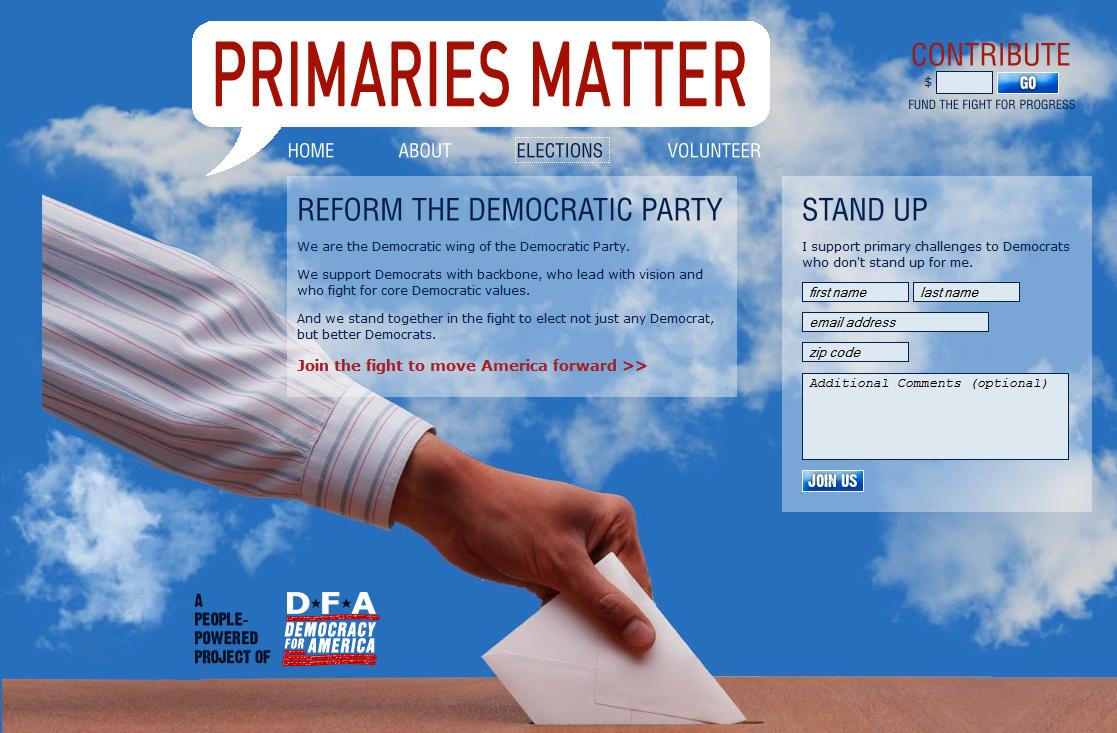
Democracy for America, the outgrowth of Howard Dean’s 2004 presidential campaign, is taking aim at moderate Democrats.   PrimariesMatter.com speaks to grassroots activists looking to oust ideologically impure incumbents in favor of more “progressive” challengers.

Weighed down by an unpopular health care bill and runaway government spending as the ubiquitous solution to every problem, voters will be looking for change in November 2010.  For Democrats, thinning the weaker candidates from the herd (especially any carrying that big target called a “voting record”) may be the only way to offer credible options for those voters.

Unfortunately for the Democratic party, the more liberal candidates will likely support policies (like the health care overhaul and increased government programs) which have proved so unpopular.

Do you want your GTV?

Google’s agreement with Sony and Intel to create a new platform for web surfing through television – in context with other recent announcements – continues Google’s efforts to find a way into your living room.

Television remains the top entertainment appliance in the household, but how content reaches that television is changing.  Not only have DVD’s and TiVO made the term “appointment television” obsolete, but the embrace of online video by content providers has greatly threatened cable’s position as the provider of high-quality content.  With web-enabled televisions becoming more prevalent, traditional cable is less important than ever.

Many cable providers are also high-speed internet providers, which is lucky for them.  But Google has been the starting point of the internet for years.  After becoming the top search engine, they created useful tools such as a customized homepage, sharable calendars, and a news aggregator; everything was built with the intention that when you sat down at your computer, Google would be the place you would want to start.  That, of course, makes it easier to collect information on you to better target their ads.

Now that the internet will be accessed more directly through television, Google wants to be your starting point there, too.  Again, all the better to target you for advertising, which is how they get their food money.

This will present some challenges for Google as various pieces of their business come together.   Remember Google’s recent announcement of plans to expand fiber optic broadband access.  That would put Google in charge of your access point to the internet (TV, computer, or Android-enabled smartphone), the pipeline that brings the internet to you (fiber optic network), and the content that you see on the internet (through search results, news aggregators, YouTube videos, Google Books, etc.).  All along the way, Google will be able to build a profile of you – what you look for, what you click on, what you watch, where you shop – and of course show you ads to make that food money.

It’s easy to see why people poke fun at Google by likening it to SkyNet, the ubiquitous and sentient machine network from the Terminator movies.  Good thing that Google isn’t evil… right?