Behold – the world of tomorrow:
Author: Jim Eltringham
Political consultant specializing in grassroots mobilization, online media, and public relations.
Anuzis challenges Steele
The Weekly Standard caught a tweet from Saul Anuzis, the former Michigan Republican Party chairman, saying he will again run for RNC Chair. He will probably not be the only challenger to incumbent Michael Steele.
Steele seemed like a good fit for the job when he bested five rivals – including Anuzis – in January 2009 in a grueling, multi-ballot race. He provided much-needed racial diversity to the ranks of the Republican talking heads and brought blue-state credibility. On the heels of the 2008 shellacking, the Republicans badly needed to demonstrate they were more than a party of white southerners.
From the beginning, there were whispers about Steele’s lack of conservative street cred. Where Steele has drawn criticism, though, has been in the “blocking and tackling” – the basic elements of a party chair’s job, like fundraising and building a GOTV infrastructure. (In fact, Anuzis uses just that term.) After a six-way race for the chairmanship, criticism was inevitable for whoever won, but Steel made it easier. The whispers in Republican circles (which “unnamed sources” give voice to in the Weekly Standard piece) is that the 2010 gains should have been bigger.
In his announcement, Anuzis channels the 2008 McCain campaign (which poked at then-candidate Obama’s quasi-celebrity status):
My agenda is very straightforward. I have no interest in running for office. I won’t be writing a book. It is not my goal to be famous. However, you’ll be hard pressed to find anyone who will work harder, more diligently and be more committed to electing Republicans from the top to every township and city across this great country of ours.
It isn’t worth including at this point in the campaign, but Anuzis has another bullet left in his chamber: his background in digital politics. As the race for RNC chair heats up, look for Anuzis to use this – accompanied by criticism of the failed initial launch of GOP.com – to separate himself from the pack.
Dumbphones, Presidential campaigns, and mobile politics
The Republican primary campaigns for President of the United States are – let’s face it – already underway. That means tactical discussion are coming soon – the term “tactical discussion” being defined as giddy blog posts about who is using what new toys – and that will include a discussion of mobile phone strategy.
But in this realm, it may not be the new toys that win out, but new uses for old toys. Dumbphones – i.e., cell phones that aren’t tiny pocket computers like the Droids and the iPhones of the world – are outselling their smartphone brethren by a rate of four to one and inspiring creative, text-message based usage.
Outside of Carly Fiorina’s losing bid to unseat Senator Barbara Boxer, there were few high-profile examples of campaigns incorporating mobile technologies. And given the lack of smartphone penetration, fancy apps aren’t always as wise an investment for campaigns, which target broad sections of the electorate, as they are for institutions like think tanks, which are trying to reach media and other thought leaders.
Still, the vast majority of phones on the market are capable of text messaging – and in fact, three out of four mobile users use this feature, compare to less than one out of three who use smartphone apps. This math says that if a Presidential campaign is looking to be smart with its mobile strategy, they should think dumb.
You can’t keep the People’s Seat without the people
Politico points to dismal results for Republicans in Massachusetts as a good indication that Scott Brown might not be a Senator much longer. But a post by NRO’s Jim Geraghty recounting some intelligence from New England indicates that it may be more than the Bay State’s penchant for Democrats at play.
Geraghty’s source talks about the unified effort that Democrats and their organized labor allies made in contacting nearly a million voters to stave off another Brown-esque upset. But the phenomenon is not exclusive to Massachusetts. For example, in Nevada, Washington, and Colorado Democrats defended vulnerable Senate seats by outperforming opinion polls that showed either a tie or a Republican advantage.
When Brown won his election, it had much to do with enthused Republican activists (nationally as well as in Massachusetts) sensing an opportunity and paying lots of attention to the race by making phone calls or going door to door to recruit voters. In past midterm elections, the the Republican 72-hour Task Force would do the necessary grunt work to get voters to the polls. That effort was missing this year – and nothing takes it’s place in 2012, Brown may not be the only Republican Senator in trouble.
Do you still get this joke?
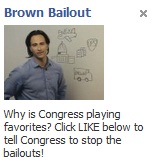 FedEx is spending lots of money on online advertising hammering away at an proposed regulatory change that would benefit UPS. Using the parlance of our times, they are calling it the “Brown Bailout” – since the term “bailout” has such high negative connotations.
I’ve criticized this campaign before for tactical flaws – many of which have been corrected in the year since it launched. And the people in charge of the campaign messages have always done a good job of explaining a complex issue completely in a simple – and funny – way with great videos.
But here’s the rub: those videos, while once effective, are outdated. Those UPS whiteboard commercials are two or three years old, and the company has moved to an ad campaign which highlights “logistics.” If FedEx’s government affairs division wanted to really hammer UPS, the new ads are quite mockable.
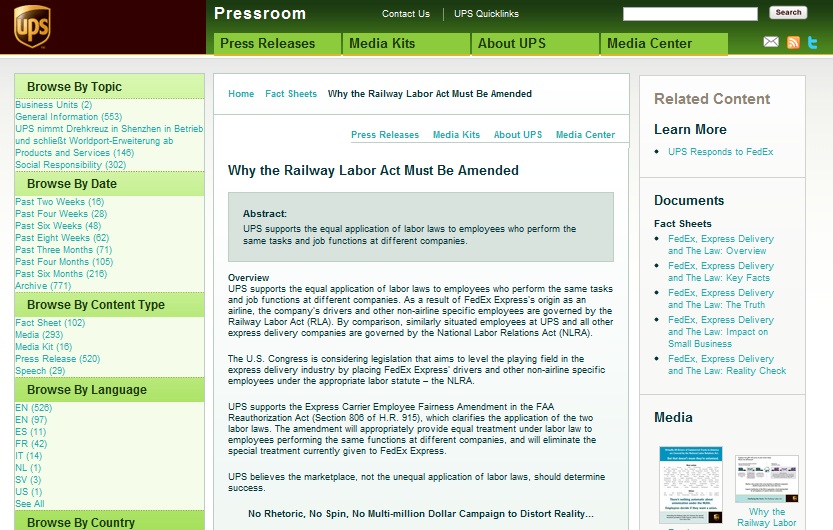
By recycling a year-old campaign, FedEx is taking a shortcut. It would be like bringing a knife to a gun fight – but luckily for them, UPS is bringing a whiffle bat. In the year and a half since FedEx has been running the Brown Bailout campaign, the best UPS could muster is this visually thrilling online press kit that could serve as that antidote to caffeine scientists have been searching for:
Conan’s set as a TV strategy
Conan O’Brien’s TBS premiere last night is sitting on my DVR and waiting for a more formal viewing. But from the clips I caught this morning, one thing is both apparent and unsurprising: O’Brien knows that he has a pale and ruddy complexion. (I feel his pain.) Check out this picture swiped from an AP story:

Note all the blue in his new set – a similar color scheme to his short-lived Tonight Show set. This wasn’t just to save money – it’s an old trick for anyone who is going on TV. Television lights are harsh, and tend to reflect badly off of white shirts, so many talking heads will make sure they have a blue shirt at the ready if called to do an on-camera interview. This is even more true for people with pale skin like O’Brien (who frequently pokes fun at himself over his ultra-Irish tone). Even something as seemingly minor as a blue shirt can have a dramatic impact on how an audience sees an on-air personality, and these visual cues are surprisingly important to the perception of the show’s content.
When O’Brien took over the Tonight Show – thus thrusting him in front of a new audience – the show’s producers likely recognized that they needed to do what they could to make the image that got beamed into the nation’s living rooms and bedrooms as visually appealing as possible. Rather than settling for a blue wardrobe, they went for an entire set. With the stakes arguably even higher for his new endeavor, the blue set came with O’Brien to TBS.
Stewart/Colbert rally demonstrates government competence levels
As Jon Stewart and Stephen Colbert were wrapping up their apolitical comedy and music show last, their crowd unwittingly demonstrated the reason many people are suspect of government running things like health care. Just after Stewart’s closing keynote, an errant DC Metro escalator at L’Enfant Plaza sped up and start spitting folks off, injuring four to six freshly-sane rally goers.
Luckily, Metro’s crack administrative staff was prepared since, according to Unsuck DC Metro (the best-titled blog in the history of the internet), a report issued a month before the rally detailed the issues with escalator brakes throughout the system.
Welcome back, Keith!
Keith Olbermann will return to MSNBC on Tuesday night after a box-checking suspension for his monetary donations to Democratic candidates. In defense of Olbermann, Rachel Maddow bragged that the NBC News rule against such donations illustrated the difference between MSNBC and Fox News – calling Fox News a “political organization” where on-air personalities act as political fundraisers.
Johnny Dollar’s Place has a video that makes a point I tried to make last week (and makes it much better): that just because they aren’t reporting to the FEC doesn’t mean that MSNBC’s news opinion.entertainment personalities aren’t making campaign contributions:
The race for 2012 started last week
With the mid-term elections fresh in the rear view mirror, the serious contenders for the 2012 Presidential nomination are unofficially kicking off their campaigns. And the two likely front runners, Tim Pawlenty and Mitt Romney, have started with a pretty smart Facebook strategy.
At TechRepublican, Ethan Demme noticed Mitt Romney’s new Facebook ads running immediately after the election, congratulating “high profile” candidates. Tim Pawlenty has been doing the same thing. But the strategy appears to be even more specific than that. Here are the ads I saw:


What does incoming Arkansas Congressman Tim Griffin have in common with the Feingold-conquering Wisconsonite Senator-elect Ron Johnson? Turns out, I’ve clicked “like” on both of their Facebook pages. (I’ve also seen Romney ads supporting former and future Iowa Governor Terry Branstad, whose Facebook page I’ve also liked.) In other words, I’m a self-identified supporter of these politicians – a factor that Facebook’s ad platform allows campaigns to take into account when they target advertising.
By playing on the interest of possible supporters, Romney and Pawlenty share an excellent outreach strategy. The question will become what each campaign does with the supporters they recruit. Pawlenty has already made a push to take advantage of Facebook’s capability for activation through interactive town halls, while Romney’s page is more or less a one-way communications channel – but neither has taken a decisive lead in innovation on this platform.
 Jim Eltringham