Wal-Mart? More like Wal-Men.

The Supreme Court ruled earlier this week that lawyers could not claim to represent every single woman who worked at Wal-Mart ever in a gender discrimination lawsuit against the World’s Biggest Retailer.  It’s probably worth noting that the Supreme Court is mostly male.

Now, the intrepid Center for Responsive Politics notes that Wal-Mart gives more in political contributions to men than to women.  On the surface, this might look like an organization starved for attention trying to inject itself into a media cycle.  But maybe they’re onto something.

Maybe Wal-Mart is actually advancing the cause of men over women as a core tenet of their company’s mission.

In her dissenting opinion, Justice Ginsburg noted that though 70% of Wal-Mart’s hourly employees are women, only 30% of management are chicks.  (I believe Justice Ginsburg actually used the term “chicks” as well; at least that’s what the NRSC tweeted.)  Clearly, Wal-Mart has a habit of moving men up their own corporate ladder; and if CRP is to be believed, that philosophy extends to the political realm as well.

Wal-Mart’s shadow mission – beyond providing low-cost goods – must be to ensure there are as many men in positions of power within society as possible.  Sam Walton’s vision for America – and possibly the world – was a society run by a brotherhood of males while women are cast into the shadows of society and used only to breed more humans.

That’s the only solution that makes sense – right?
AARP grows up. Sort of.

I’m 32, but I’ve been getting AARP prospect mailings for several months now.  (As one might expect, my young trophy wife gets a kick out of that.)  Up until last week, joining would have been unthinkable even if I was of eligible age: for all the discounts, for all the membership benefits, the fact remains that AARP’s dabbling in politics more often than not resulted in advocacy for positions I disagreed with – specifically, their support for Ponzi schemes like Social Security.

Why would I pay my hard-earned money to people who wanted to separate me from my hard earned money?

AARP, though, has gone Romney on Social Security.  Last week, America’s voice for (some) seniors said it would be open to cuts, a position it has since waffled a bit on.

If AARP decides to take a firm stand, the facts and popular opinion are on their side.  Social Security is untenable as it exists now, and people understand that completely retiring at 65 is a pipe dream – unless, of course, they have taken the steps necessary in their youth to prepare for that.  A recent study that AARP commissioned showed that four of five Baby Boomers expect to delay retirement for five years, one in seven doesn’t believe they will be able to retire.

People are starting to get how dumb the idea of government-sponsored retirement starting in what is now middle age is.

I’m not running out to join AARP anytime soon – after all, they are still complaining about other entitlement programs – but their flip on Social Security is significant.  On the surface, it looks like the group realized just how bad the program’s situation is right now.  Supporting Social Security and perpetuating the Ponzi scheme does nothing for me and the other folks in their 30’s already getting AARP mailers.

Incidentally, this is a great opportunity for an offensive from the supporters of small government.  Private and public thank you notes to AARP might help their flip go mainstream and show other people just how dangerous rampant entitlement spending can be.

After all, if AARP can be convinced, maybe there’s hope for the population at large?


Will you go the f*** to a bookstore?

CNET has a neat interview with author Adam Mansbach, who wrote the now-viral release valve for frustrated parents, Go the F*** to Sleep.  Between YouTube videos of the leaked galley copy and an audiobook version read by professional badass Samuel L. Jackson, the book has been shared, forwarded, posted on Facbook walls and – ultimately – bought.

The leaked galley copy made its way around the web awfully quick:

Mansbach, a novelist, never intended the world to be able to see his book, for free, online, and before the print version was available. “To show how Web-savvy we were, ” he says self-deprecatingly, “We were trying to do cease and desist orders at first.”… And clearly, there’s more to the success of “Go the F*** to Sleep” than its accidental marketing campaign. Mansbach realizes that it’s the product itself, which touches a deep nerve with parents, that’s at least as important to its success. As the full PDF version of the book circulated, he says, “People were able to see that we delivered on the promise of the premise. That it wasn’t a one-note joke. It was beautiful, an art object.”

Mansbach notes that while he doesn’t support piracy in general, it worked in this campaign.  Like a new band that got discovered giving away downloaded songs on MySpace five years ago (or Napster ten years ago), there was a value in giving away content.  Since most purchases of the book will probably be gag gifts for parents of infants or young children, having the book out there doesn’t hurt sales.  No one is going to skip out on buying the book because Samuel L. Jackson spoiled the ending.

Piracy is wrong, because a writer should have control over his or her own work.  That said, the accidental marketing ploy represents something that every political or product campaign sees as the Holy Grail: people genuinely liking what the campaign is trying to sell and telling their friends.  That only works when the content is good – and when the content is good, letting it speak for itself may be the best marketing there is.

GOP nabs headlines, OFA nabs volunteers

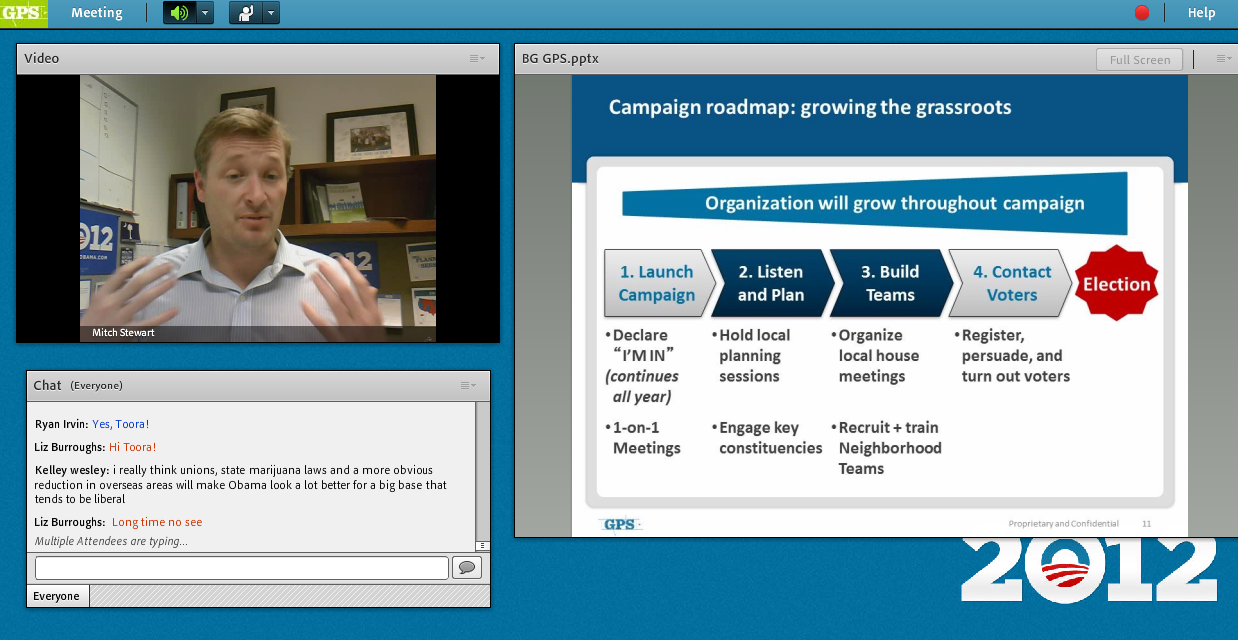
While the Republican contenders and pretenders debated in the Granite State, the Obama Campaign quietly kicked off what it hopes will be a “summer of team building” with an online volunteer briefing.  Organizing for America’s Mitch Stewart led the largely unsurprising session, sketching out the campaign’s overall plan for recruiting volunteers and getting out the vote.  There were, however, some tactical points that were worth noting.

Just like the 2008 incarnation of the Obama campaign – and, really, any organization worth its salt – Obama/Biden ’12 seems rightly obsessed with amassing volunteers and securing firm commitments to action.  The central effort seemed to be a push to ask volunteers to host house parties, recruiting After Stewart’s overview of the basics, the webinar asked participants whether they could either host or attend a house party (along with inviting others to attend as well).

The neatest part came at the end, when participants were invited to turn on their webcams.  A collage of the real-time feeds allowed participants to see and even wave to each other:

This is another early preview of what figures to be a consistent theme for Obama ’12.  Remember that the announcement video for the re-election effort did not feature the candidate, instead focusing on campaign surrogates and volunteers.   Other faces – including, wherever possible, those of grassroots supporters – will allow the Obama campaign to create a wall of separation between the candidate and the dirty business of politics.

The result? Obama looks Presidential while his subordinates ramp up the country’s first billion-dollar campaign.

Cross-posted at PunditLeague.us.

Gingrich and his “campaign on ideas”

Newt Gingrich’s assertion that he and his consultants had a “strategic difference” over the colour and the shape of his Presidential campaign called to mind a slogan from years gone by: “In your heart, you know he’s right.”

Gingrich’s stated goal is admirable: a campaign based on ideas and “solutions” rather than… well, rather than whatever it is that campaigns are based on.  Depending on whose chatter you believe, his consultants felt that the campaign should have been more oriented toward grassroots retail politics that feature the candidate spending lots of time in Iowa, attending campaign events, and engaging in the type of retail politics that end with him asking voters for their support.

There’s a reason that many consultants like that approach: it leads to victories, and consultants are paid to win.  When Gingrich reached the apex of his power in 1995, the “consultant mindset” on political races was very different: political pros were high on television ads, which were expensive and profitable.  Especially in the last ten years, there has been a better appreciation of the grassroots ground game – starting with Democratic efforts in 2000 and cemented into the DNA of both parties by the 2004 Bush/Cheney campaign.

For Gingrich to criticize the “consultant culture” now is less powerful than it would have been 15 years ago.

Ideas cannot survive without tactics which convey those ideas to the voters; tactics that reach the voters without ideas will not win elections.  The two sides represent a ying and yang of campaign politics that Gingrich appears ready to ignore.

In 1964, supporters of Barry Goldwater understood that their candidate had all the right ideas.  The fact that we was defeated so soundly led many to realize that isn’t enough to win an elections.

Elections are fought for ideas, not with ideas.  Gingrich’s words and the campaign exodus suggest he is pursuing the latter.  If his actions match his words over the next few months, he might as well not even participate in the Republican primary.

Sarah Palin needs James Carville

Here’s the headline from Sarah Palin’s Facebook post yesterday: “Another ‘WTF’ Obama Foreign Policy Moment.”  The content of Palin’s post, by and large, is actually quite interesting stuff about how many secrets we are simply giving away to the Russians.  That’s a pretty intelligent topic, and Palin does grasp it.  But even in discussing an issue over which she has mastery, Palin leans on blunt-force and simplistic messaging.  “WTF” is, of course, shorthand for “what the f—.”

It’s vulgar and coarse and unfitting a President.  And as long as Palin continues to look unpresidential, she will only be considered a Presidential contender by a cadre of Ron Paul-esque followers and the “lamestream” media she claims to abhor but who gives her more attention than she currently deserves.  She will win nothing.

A Presidential adviser might be able to get away with such language, and perhaps Palin needs a James Carville.  Bill Clinton could never have dismissed allegations of his extramarital affairs as the product of dragging a $100 bill through a trailer park.  Carville did, and in doing so he said what many people were thinking but afraid to say.   He acted as the lightning rod for criticism, but he got his boss’s message out there.

Instead, Palin tries to be both the candidate and the firebrand.  She too often talks down to an electorate that is really looking for someone who can talk up to them.

This is part of the challenge Palin and other outsiders face in political campaigns; the inability to surround themselves with media-savvy professionals leads to clumsy, overly populist messaging.  Sure, a few will take it seriously, but most will either dismiss it out of hand or respond with a quizzical “WTF?”


Time for T-Paw to re-think video strategy?

For the most part, Tim Pawlenty has done a good job of using YouTube.  His team clearly understand the online video medium as a unique communications vehicle, rather than as a place to warehouse TV ads.  Pawlenty and Co. use video often, and the videos are stylistically consistent.

But this video, entitled “Behind-the-scenes at Gov. Tim Pawlenty’s announcement in Des Moines, IA” and posted last week, is a bit disappointing:

That’s not a “Behind the Scenes” video.  Those are actual scenes.  There are clips of the speech and clips from the media coverage of Pawlenty’s announcement, but no candid moments from the candidate.  The best part of the video is a mere ten-second stretch featuring Pawlenty supporters explaining their support.

Now imagine this as the “behind-the-scenes” video” instead:  60 seconds of people in the Pawlenty crowd talking about why they came out to support T-Paw, cut with pictures of homemade signs, and maybe even ten seconds of the candidate talking with supporters in a handshake line.  There would be no music and no voice-overs.

Tim Pawlenty is going to spend the next few months juxtaposed against two incredibly polished professional politicians in Mitt Romney and Barack Obama.  He will need to be able to contrast himself from both.  His videos are not bad, but standing alone they will give the impression that Pawlenty is trying to out-Romney Romney or out-Obama Obama.  If he tries to be someone he is not, Pawlenty will lose his fight for the nomination.

In a campaign where he constantly reiterates the need for honesty and sincerity, Pawlenty would be wise to let some of that come out – and let his videos create a mood rather than a separation between him and the voters.

Own it! (Unless it’s your health or retirement)

The Obama campaign launched a neat fundraising program this week to get going on their way to America’s first $1 billion marketing campaign for a political candidate.  The program matches first time donors with previous donors who agreed to participate it a matching program.

Cool stuff, but the rationale behind the need for such aggressive fundraising was just as eye-catching:

Taking ownership of the campaign is an essential part of the experience, right alongside making phone calls, knocking on doors, and taking responsibility for getting your network of friends, colleagues, and neighbors to join us.

Relying on each other to own this campaign isn’t just the most viable way we can grow a truly grassroots organization — it’s also the right way to do politics. Taking money from Washington lobbyists or special-interest PACs is the easy path — and every single one of our prospective opponents is racing down it.

Taking giant pools of money from political interests?  Not a chance.  The right way to do things is for individuals – not institutions – to each do their part and take responsibility to do things on their own.  Anything else would be a shortcut, doomed to create unintended consequences and fail.

At least, that’s how it works for political campaigns.  If it’s something like health care, retirement, or taking care of the less fortunate then, by all means, surrender control to centralized political entities.

Even better if they are run by special interests.

T-Paw’s impeccable timing

He may not win the GOP nomination, but Tim Pawlenty has his timing down pat.

From the carefully timed announcement of his exploratory committee – before any other major contender, but not too early – to his Johnny-on-the-spot criticisms of the current administration, Pawlenty has been quick on the draw at just the right moment.

It happened again today, with Pawlenty’s official announcement of his Presidential bid.

The big story over the weekend was Mitch Daniels bowing out of the race.  The stories about the “weak” Republican field were already written: you saw them after Mike Huckabee’s exit earlier this month, and even after Donald Trump’s withdrawal before that.  Each time that story gets rewritten, it’s bad news for Tim Pawlenty; it makes the Republican field sound like Mitt Romney and the Seven Dwarfs, with him as one of the dwarfs.  (Possibly Bashful.)

By announcing just two days after Daniels’s deferral, Pawlenty answers those stories without whining that he’s being overlooked.  He keeps his donors and activists engaged, and he keeps his campaign moving forward.

And that’s all he has to do right now.  With Daniels stepping aside, the path for Pawlenty to the nomination becomes clearer:  has a sporting shot at winning the Iowa caucuses, and after he’s a very plausible contender in South Carolina and possibly Florida.  Coming out of the early states within striking distance of Romney would make Pawlenty a viable alternative for conservative activists who can’t get excited about Romney’s policy baggage (i.e. health care).

Slow and steady may not sound like the way to win a presidential race, but at this point who’s going to argue with Pawlenty’s timing?