Weed the People

We the People have spoken, and according to the White House’s citizen-driven petition site, the most important issue in America is: the legalization of marijuana.

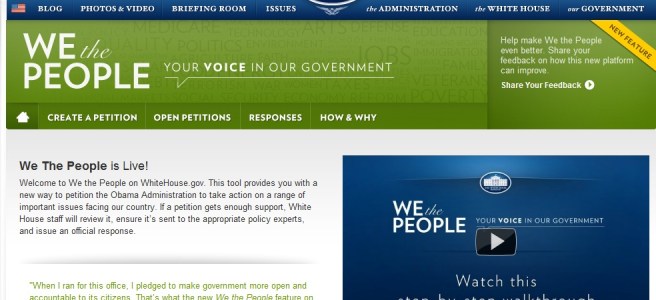
The White House launched We the People last month as a way to provide commoners like you and me a “direct line to the White House on issues and concerns that matter most” to us.  So far, a petition to legalize pot is the top performer, according to The Hill.  The call for decriminalization has attracted over 50,000 signatures.  It also illustrates nicely why the site is such a waste of time for serious advocacy campaigns:

[National Organization for the Reform of Marijuana Laws Executive Director Allen] St. Pierre said online petitions help spread the word and generate supporters who can call and write Congress, but they have not translated into the real-world pressure — and money — needed for his side to win.

St. Pierre is right: online petition campaigns are an excellent way to find and recruit audience.  So how many supporters did this online petition generate?

None.

To sign the petition, site visitors had to create an account on WhiteHouse.gov.  That means that the White House has their contact information (along with whatever issues are important to them) but NORML gets nothing.  Had NORML hosted the petition on their own site, they might have been able to collect signers’ contact information and email address, which would have allowed them to go back to those folks later with calls to action – such as calling or writing Congress.

At least NORML got some good press out of it, which could indirectly recruit grassroots support.  But if NORML – or any other issue advocacy group – wants to generate real impact, pointing people to the White House’s petition platform isn’t going to work.

Online petitions can recruit and mobilize supporters, but they’re better as a starting point, rather than a finish line.  Since We the People doesn’t allow for the next steps, NORML’s apparent success is actually a wasted effort.

Cross-posted on PunditLeague.us.

45 Days, 45 Lessons

It’s been about 45 days since my last post. It’s okay, I have an excuse – two excuses, in fact, in the form of two brand new beautiful twin baby daughters. It is, as you might expect, an extremely happy time for me.

A few years back, I turned 30, and took the opportunity to look back on the lessons I’d learned in three decades of life. In 45 days of being a Dad, I’ve learned even more:

  1. There’s no such thing as normal.
  2. If you want God to laugh, tell Him your plans.
  3. There is no equality among the sexes. Women are far superior.
  4. Guardian angels are not only real, but apparently transferable.
  5. You may think you know what’s going on. But you have no idea. Just do your best, hustle, take care of your family the best way you can, and things have a way of working out.
  6. Sleep is less necessary than you would think, and underrated.
  7. Moms are incredibly strong. Dads just pretend to be, but they’re really softies. (That includes Granddads.)
  8. It is surprisingly easy to fall asleep in a chair, even if the chair isn’t all that comfortable.
  9. All that complaining pregnant women do about babies kicking in the womb? It’s legit. Babies’ legs are strong, and they kick with fury.
  10. If you are up all night, the best options for TV viewing are old sitcoms or cartoons. Movies make you think too much.
  11. The occasional McDonald’s run can do wonders for morale.
  12. There is no such thing as a small milestone.
  13. Mom can make everything better.
  14. One look from your kid and or kids will completely reorient your to-do list.
  15. For being so small and fragile, babies are surprisingly tough.
  16. Personalities traits start earlier than you think. Sometimes, they are prenatal.
  17. Songs that you would normally not like can become favorites if they happen to come on the radio at the right time to remind you of your children.
  18. There’s always plenty of work waiting for you at work, so don’t try to get it all done at once.
  19. Remember the way you feel when you change that first diaper. You’ll be excited, and think it isn’t so bad. That wears off quickly.
  20. People tend to have lots of questions about your kids. And a lot of times, it is fun to answer those questions.
  21. Although it is good to learn from and study others, the most important role models are Mom and Dad.
  22. Sometimes doing what’s right for your kids requires small sacrifice on your part – not something that’s big like not getting a new car or staying in more than you go out, but something small like not holding them when you’re sick. These small sacrifices are hard to prepare for and are tougher than one might think.
  23. Life is a lot like playing the infield. You won’t field every situation cleanly all the time, so just try to keep it in front of you.
  24. When dealing with doctors and nurses, there are no stupid questions.
  25. A Dad can do a lot for his kids by maintaining his love affair with their Mom. Being a good Dad starts with being a good husband.
  26. Hospital food isn’t bad if you order the right stuff and you are ravenously hungry.
  27. The seconds between the moment you first see your child and when you hear her cry feel like years.
  28. No matter how big they get, you will always see your children in the most helpless vulnerable state they were in as a newborn.
  29. Mobile phones and social networks are there for your convenience in communicating with others. You don’t always have to pick up, and in fact sometimes you shouldn’t.
  30. It’s tough to read out loud and make a story sound interesting.
  31. “A man who doesn’t spend time with his family can never be a real man.” – Marlon Brando in The Godfather.
  32. The Beatles were full of crap. In addition to love you need patience, humility, faith, and occasionally a short memory.
  33. Being a Dad isn’t about having all the answers all the time. Sometimes, it’s all about looking like you have all the answers.
  34. There is nothing wrong with taking candy from a baby, as long as it’s your baby. They can’t eat it, anyway.
  35. Sometimes it isn’t what you do, but how you do it that counts.
  36. Trust your gut.
  37. Get ready to never be ready.
  38. Time does funny things when there’s a baby in your arms. An hour goes by in a minute.
  39. When you say prayers for your kids, all you can really ask for is the strength and wisdom to be the best parent possible. But really, what more could you want?
  40. It really does take a village to raise a child. Remember to thank the villagers who help you out.
  41. There’s always something to worry about.
  42. Don’t get so distracted by where you would like to be that you forget to appreciate where you have gotten to.
  43. Keep laughing, no matter what.
  44. At times, life happens the way it’s going to happen, and you can’t get overwhelmed or excited. Just enjoy the toboggan ride.
  45. When you’re faced with a day that’s gray and lonely, the sun really will come out tomorrow.

Applauding the extreme

A thoughtful E.J. Dionne editorial this weekend lauds Dr. Martin Luther King Jr.  Obviously, that’s nothing new – outside of Klansmen and contrarians,  there aren’t a lot of people writing anti-MLK op eds.  What’s striking about Dionne’s piece is that it points out King’s radicalism:

This focus on calling out injustice — pointedly, heatedly, sometimes angrily — is what the people of King’s time, friend and foe alike, heard. It made many moderates (and so-called moderates) decidedly uncomfortable.

Anyone tempted to sanitize King into a go-along sort of guy should read his “Letter from Birmingham Jail,” from April 1963. It’s a sharp rebuke to a group of white ministers who criticized him as an outsider causing trouble and wanted him to back off his militancy…  And recall King’s response to being accused of extremism. Though “initially disappointed at being categorized as an extremist,” he wrote, “as I continued to think about the matter I gradually gained a measure of satisfaction from the label.” Jesus, he said, was called “an extremist for love,” and Amos “an extremist for justice.” The issue was: “Will we be extremists for hate or for love? Will we be extremists for the preservation of injustice or for the extension of justice?”

For a shorter version of that last quote, thumb over to Barry Goldwater‘s page in Bartlett’s: “I would remind you that extremism in the defense of liberty is no vice. And let me remind you also that moderation in the pursuit of justice is no virtue.”

In fact, Dionne’s characterization of King invites comparison to the coverage of the movement for smaller government.  (To his credit, Dionne has shown he recognizes this parallel to a degree; he’s one of the few left-leaning columnists able to discern the tea party from Republican politics.)

It deserves mentioning that there are plenty of differences: Tea party rallies aren’t being broken up with fire hoses, rubber (or real) bullets, tear gas, or the releasing of any hounds.  King and his allies risked life and limb to make a stand for their big idea.

But they did have that big idea, and believed in it so much that compromise was unacceptable.  People were either equal, or they weren’t; they were either allowed to attend the same schools and drink from the same water fountains, or they weren’t.

With that in mind, let’s look at our policy landscape here in 2011.  There’s a snowballing debt thanks to a governing culture that allows government to spend lavishly to help build a society and direct an economy.  The debt puts at risk the stability of our currency and by extension things like houses and other long-term investments.  More important, the services financed by that debt are generally sub-par and fail to accomplish intended goals.

Either that governing culture changes – reigning in spending, allowing people to make their own decisions about health care and retirement, and eliminating waste – or it doesn’t.

The casualties of this movement include moderate and Washington-centric politicians – such as Mike Castle and Bob Bennett in 2010.  It makes “moderates and so-called moderates” (to borrow Dionne’s term) like Sen. Orrin Hatch uncomfortable.

But if you believe strongly that the government was biting off more than it could chew to deliver failing policies, and that the promises of Social Security, Medicaid, Medicare, and other public assistance programs are a bad check which will be sent back marked “insufficient funds,” you should be fighting.  And supposed allies who favor a “wait-and-see” approach while continuing to conduct the business of government the same way it has been conducted for 80 years aren’t really allies.

That isn’t “extremism,” it’s political advocacy – and as observers from King to Dionne have understood, it’s how policy making works.

Our Violent National Anthem

No one who has spent much time reading about America’s college campuses (campi?) will be surprised to learn that an institution has banned the singing or playing of the “Star-Spangled Banner” before sporting contests.

Who was behind it? The anti-American crowd?  The Marxists?   The hippies?  The greens?  Cornel West?

Try the Mennonites:  Goshen College in Indiana, the school which banned the tune, is a Mennonite school with the motto “Healing the World, Peace by Peace.”  The rockets’ red glare and bombs bursting in air are too violent.

The anthem is being replaced at Goshen sporting events by “America the Beautiful,” so we can assume this isn’t really a commentary on the nation we all call home being a haven for imperialist capitalist pigs.  Part of what makes America beautiful is that each person has the right to express their patriotism as they see fit.  If the students and administrators at Goshen don’t want to play the national anthem before their Division 8 field hockey games, that’s fine.  Those of us who have never donated to or attended Goshen have no right to tell them otherwise.

On the other hand, as an educational institution, so one would hope Goshen’s choice is educated.  And the idea that the anthem is a violent song is a bit misguided.

Of course, the “Star-Spangled Banner” does use military imagery, because it was famously written during the War of 1812 as a poem by Francis Scott Key – specifically, during the bombardment of Baltimore.  That was a fight that was brought to American shores by then-mortal foe England; we were on defense for that one.

Though set during a battle scene, the theme of the poem – especially the part used for the national anthem – is perseverance through difficulty.  Turbulence and war may come, Key writes (much more eloquently), but American ideals of freedom and peace endure.

Delve a little further into the story behind the poem, and it becomes even more apparent that it is hardly a call to arms.  Remember that Key saw the flag over Fort McHenry from a British ship; he was aboard on a peaceful mission to argue for the release of a popular Maryland doctor.  To make his case, Key presented letters from British soldiers lauding the care they received from American doctors (and this was before the current mess that passes for a British health care system).  The British acquiesced, but held Key and the doctor on the prison ship because the bombing of Baltimore was about to begin; they didn’t want to release a prisoner only to blow them up minutes later.  In the midst of war, both Key and the British officers demonstrated some level of civility and mutual respect.

The fact most worth noting is that the folks America was fighting in the background of Key’s poem, the British, are our closest allies today.  Despite fighting two wars within  30 years, Americans and Britons are fast friends.  (Heck, we can’t even launch a television show without swiping the concept from them, and they have, what, four channels?)

So in an educated historical context, the “Star Spangled Banner” is a song about perseverance through adversity and, after your business on the battlefield is over, making peace with your enemies.

Hey, that sounds like a pretty good song to play before an amateur sporting contest.

Cross-posted at PunditLeague.us.

Isn’t it good Norwegian video?

Some friends from Norway’s Conservative Party, Høyre, posted a new video on Facebook this week promoting the party’s youth auxiliary.   You don’t have to understand the language to appreciate the video:

Exciting, isn’t it?  Between the smiling faces, you have a good mix of high production value sequences and grassrootsy-looking handheld camera shots, plus a testimonial or two thrown in for good measure.  It’s also a great study in how little words matter to the effect a video has; the music and editing style portray the party’s youth wing and edgy and optimistic better than any script could.

Ron Paul is not suffering from media bias

A strong and close second-place finish at the Ames Straw poll for Ron Paul ignited almost no media coverage whatsoever – until some folks realized that Paul wasn’t getting any media coverage, which then became the story.  It’s one thing for Paul supporters to air their grievances about being ignored, but in a rare moment of astute political insight, even the Daily Show called out the media’s Paul-sized blind spot.

Charles Krauthammer had a valid answer: Paul will not be President.  He will not be as successful when the straw polls give way to caucuses, and he will do worse yet when the decisions come from the ballot box.  For a media covering horse race politics, giving serious ink to Ron Paul is like giving ink to Mr. Ed – he’s interesting, but he ain’t beating Secretariat, or any other horse.  On the other hand, while Tim Carney admits that Paul is a bad candidate, he points out that the Congressman has been consistently proven correct in his assessment of domestic and foreign policy over several years.  Stewart quips that Paul planted the small government seeds that germinated into today’s grassroots tea party movement.

Carney and Stewart are correct.  The real issue is a political press that doesn’t understand politics beyond the tally of votes in the second week in November.  The small government ethos that inspired the tea party to take out incumbents in 2010 has been brewing since late in the first term of George W. Bush, when the Republican party was entrenched in the legislative and executive but without a clear governing vision.  Paul was an early banner carrier for that philosophy, and in many way is the heart and soul of the current Republican party.  As he chugs along with single-digit polling numbers, other candidates have been and will be elected with Paul’s ideas.

Many political mini-movements see their standard-bearers run into electoral machine gun fire early on.  Remember that in 2004, Howard Dean crystallized the Democratic left but failed to win a single primary or caucus (except for his home state of Vermont, and that came after he had dropped out of the race).  By 2006, Democrat activists were dumping off Joe Lieberman in a primary and in 2008 they put a charismatic leader in the White House – bit it was Dean in 2004 who lit the fire.  There are winning candidates, and there are important candidates; the two are not always the same.

Too Conservative to Win?

Michele Bachmann and Rick Perry have tag teamed to dominate the news cycles in recent days.  And as the opinionatti of the punditocracy (or whatever fun little nicknames you prefer) struggle to wrap their heads around what a straw poll victory and a late entry into the Presidential sweepstakes mean, they keep asking an intriguing question: Are these candidates too conservative to win a general election matchup against President Barack Obama?

This is especially true of the coverage of Bachmann; but taken together the Minnesota Congresswoman and the Texas Governor really display why this question is, to use the technical terms, BS.

No serious analyst of the race really believes Michele Bachmann has a snowball’s chance in the current residence  of Iowa native John Wayne Gacy.  If she wins the Republican nomination, she will most likely lose badly to the incumbent – maybe not Mondale vs. Reagan bad, but probably Dole vs. Clinton bad.  Bachmann will simply not resonate with a broad audience of American voters.

If Bachmann loses, it will not be for her views but for her tendency for gaffery.  Aside from confusing 20th century alpha male John Wayne with creepy clown artist/serial killer Gacy, Bachmann celebrated the anniversary of Elvis Presley’s death by wishing The King a happy birthday.  For many political viewers, Bachmann’s introduction to the national stage came during a horribly flubbed “tea party response” to the State of the Union address.

The trend line is evident: under the glare of the national spotlight, Bachmann is unpolished, rough, and prone to mistakes.  She is, it seems, an incompetent campaigner.  Audiences who already agree with her message will overlook that, but audiences who need convincing will not.  Those folks will become more accepting of the other, seemingly competent voices who call her extreme.

Then comes the media storyline: Conservative goes down in flames to Mainstream Candidate.

You saw plenty of it in 2010, when tea partiers were blamed for costing Republicans gains in the US Senate. Primary victories by  Sharron Angle in Nevada, Joe Miller in Alaska, and Christine O’Donnell in Delaware were frequently cited as an example of primaries run amok.

All three lost, of course.  Angle and Miller had run-ins with the media that suggested the pressures of the campaign were getting to them; O’Donnell’s campaign was only notable for its ill-advised “I am not a witch” ad.  Meanwhile, Marco Rubio and Rand Paul won their Senate races.  Arch-conservative Ronald Reagan was President; Moderates Gerald Ford, George H.W. Bush, and Bob Dole were a half-termer, a one-termer and a no-termer, respectively.

A candidate has to appeal to voters, regardless of where they sit on the political spectrum.  Barack Obama may have been the most ideologically-driven to assume the Presidency since Lyndon Johnson; he was also likeable and projected strength.

As he begins his Presidential campaign, Rick Perry will face the same question as Bachmann: Is he “too conservative to win”?  And whether the eventual Republican nominee is Perry, Bachmann, or even Mitt Romney, the Obama campaign will surely try to stick the “right-wing extremist” label squarely on their metaphorical forehead.

Candidates with good, disciplined messages don’t let those labels stick.

Cross posted at PunditLeague.us.

Hawking’s “Hail Science!” Moment

Stephen Hawking possesses one of the most brilliant minds of our time. And since he can ponder and comprehend the most complex theories of the nature of time and space, you know the man understands how to sell a TV show.

That was likely part of the impetus between Hawking’s Sunday night debut episode of Curiosity on Discovery networks, provocatively subtitled: “Did God Create the Universe?

Spoiler alert if you haven’t caught it in reruns yet: Hawking says no.

Much of the informational content – the description of the Big Bang, the discussion of the nature of gravity and the theoretical descriptions of the creation of stars – were nothing new to anyone (like myself) with an addiction to documentaries about space. In fact, Hawking himself has covered that ground in previous shows for Discovery networks.

That leaves Hawking’s religious opinions as the only new information in the show – and unlike his understanding of the laws of physics, he doesn’t appear to grasp the fundamental concepts of religion. Like so many others who seek to draw some type of dichotomy between science and faith, Hawking tries to establish a false choice. “Did we need a God to set it all up so that the Big Bang could… bang?” he asks. “I have no desire to offend anyone of faith, but I think science has a more compelling explanation than a divine Creator.”

The thesis is that the Big Bang and everything that came after are wholly consistent with the laws of physics, with no need for “divine intervention” to spark existence.

That’s a fair assessment, but completely parallel to the concept of a universal Architect. That the machinations of the Universe are intelligible does not preclude the presence of divinity. In fact, the idea of laws of physics which govern so rigorously and unfailingly the motion of each cosmic body – from supermassive stars on down to subatomic particles – seems to give an awful lot of power to Whoever it was that wrote those laws, doesn’t it?

In fact, let’s take it one step further and consider the Big Bang, in Hawkings own words:

“Follow the clues, and we can deduce that the Universe simply burst into existence… but I’m afraid we have to stop a moment, before we get carried away by fire and noise. At the very beginning, the Big Bang happened in total darkness, because light didn’t exist yet. To see it, we’d have needed some type of cosmic night vision. But even this, a view from the outside, is impossible. Again, it sounds strange, but space didn’t exist then either.”

Another account of those momentsis probably more familiar to most people:

In the beginning God created the heavens and the earth. The earth was without form and void, and darkness was upon the face of the deep; and the Spirit of God was moving over the face of the waters.  And God said, “Let there be light”; and there was light. And God saw that the light was good; and God separated the light from the darkness.

The latter is, of course, the beginning of the book of Genesis, which is certainly no science textbook. The juxtaposition proves nothing, though it does seem interesting that the description of the creation of the Universe written in ancient times mirrors so closely the result of centuries of astronomical research.

Putting the items side-by-side does demonstrate that even where they intersect, science and religion need not clash.  Forcing a choice between God and the laws of physics is like arguing whether the stuff you learn in history or English is more correct – both subjects are occasionally intertwined, but distinct.

Similarly, someone who studies math and science should also be able to appreciate the beauty and symmetry of the universe without being accused of being irrational.  Isn’t it amazing that the ratio of every circle’s circumference to its diameter is the same (pi)?  Isn’t it fascinating that electrons buzz around nuclei, nuclei buzz around each other, planets buzz around suns, suns buzz around the centers of galaxies?  This type of view of the natural world most likely inspired Georges Lemaitre, who first proposed what would be called the Big Bang theory in 1927.  You might also refer to the good professor by his other job title, Monsignor.

Of course, for all the discussion it has raised, you can say this about Hawking’s thesis: it makes for very provocative television, even when the factual subject matter has been done before.

Cross posted at PunditLeague.us.
2012 Math

Friday’s downgrade of America’s credit rating and the subsequent stock market skittishness naturally means a new round of speculation on President Obama’s re-election chances.  This week Gallup released state-by-state job approval numbers that paint a picture of an incumbent with some work to do.

President Obama’s approval ratings are listed as “below average” (under 44% or so) in 18 states,  representing 162 electoral votes.  Including three other typically “red” states where his ratings are average but still low (Arizona, Mississippi, and Georgia) would bring that total to 195.  Throwing in North Carolina and Virginia – traditionally Republican states the President carried by narrow margins in 2008 – the number jumps to 223, or 47 electoral votes shy of victory.  That scenario would make Ohio and Florida (with a combined 47 electoral votes) especially critical.

Should this be cause for Republican celebration?  Not so fast.

Not factored into these numbers, of course, is election performance – the poll measures only approval rating, not his performance against specific opponents or even the “Generic GOP candidate.”  He has 173 electoral votes in his pocket where he has above average approval ratings, plus another 45 in states which he is likely to win (Wisconsin, Michigan, Washington, and Oregon).  That gives the President a total of 218 electoral votes in house money.  And Presidential house money is worth more than challenger house money.

As Gallup notes, George W. Bush’s approval ratings were pretty low heading into the 2004 race – around 48%.  His massive campaign apparatus found his supporters in the right places and got them to the polls – the type of blocking and tackling the Obama campaign was good at in 2008.  Gallup’s numbers may seem optimistic for Republicans, but they actually paint a pretty good picture for the President.