My work alma mater and school alma mater collide

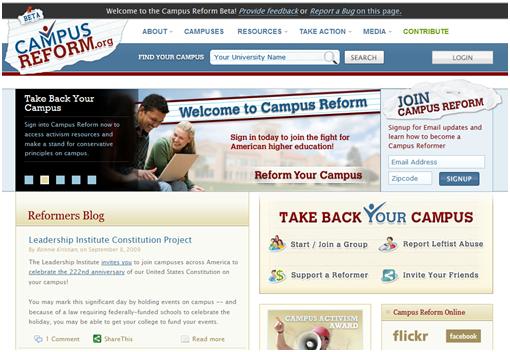
campusreformThe Leadership Institute (my former employer) will launch a new website, CampusReform.org, officially next week – but it’s live now if you want to take a look.

One of the challenges LI – or any similar organization – has always faced in campus outreach is connecting with interested students; though interested students are always out there, colleges represent fairly cloistered environments.  Previously, finding students to get involved in the conservative movement often meant physically going to campuses, setting up membership tables, and recruiting people face to face.  Considering that America has well over 2,000 four-year colleges, that method becomes a tedious (and expensive) fishing expedition.

Whether your business is starting conservative groups or selling dictionaries door-to-door, the best prospects are usually referrals or the potential customers who seek you out.  By establishing a broad web presence, LI is embracing that model of expansion.  CampusReform mobilizes student activists – rather than Washington, D.C.-based representatives – to strengthen the conservative movement in higher education.  It’s strategically smart and just good business.

There’s another benefit that CampusReform offers down the road, after it establishes an audience among college students: alumni relations.  With CampusReform, if I want to see what’s going on with the University of Massachusetts, I am just a click away.  If LI wanted to, they could create a fundraising option that would allow their donors to give directly to campuses and groups they care about.  (And if they wanted to get really advanced, LI could empower individual donors to create campaigns and recruit others to give money, as well.)

As a campus outreach effort, Campus Reform is a more effective conduit between interested students and the people trying to recruit them.  Its potential is greater: to function as a network connecting people trying to break into conservative politics with those in a position to help.

New on YouTube: Citizen journalism and civic action

As many social networks as exist, YouTube still has the greatest potential for driving action for the simple reason that video is a powerful medium for communication – and short videos are even more so.

By offering a platform where people could host and share their videos easily, YouTube has had no small role in advancing the citizen journalism; if blogs gave everyone a printing press, YouTube has given everyone a TV news station.  YouTube is taking its role in this media re-alignment seriously, too, by creating a Reporters’ Center – a resource page with various videos to help people produce better news stories.

While some corners of the media landscape like to harp on bloggers and internet news as “unofficial” and “unprofessional”, this offers a real solution to those somewhat apt criticisms.  While there will always be muckrakers and yellow journalists in any media, these resources will help increase the amount of well-researched coverage through channels that news consumers are increasingly turning to.

Another new development from YouTube – that actually interests me a bit more personally – are the “call to action overlays” that launch today.  If you’re a YouTube advertiser, you can now run a link on your video that points viewers to another website.

Virally popular commercials – like the McDonald’s Filet-o-Fish commercial from this past Lent – can now link directly to the products they hawk.  But more importantly, political videos can do more  than simply raise awareness and frame issues.  Imaging the now-infamous “macaca video” with a link directing you to a page where you could contact then-Senator George Allen’s office.  (Of course, mass emails to Allen’s office may not be the most effective way to contact the Senator, but it would build a heck of a nice email list.)  Having videos that directly inspire action will make YouTube an advocacy tool for campaigns that may have, previously, only looked at it as a messaging tool.

To Høyre and back

I’m just back stateside after an all too brief trip to Oslo, Norway, where I spoke to activists from the Norwegian Conservative Party, Høyre, about online campaigning.  With parliamentary elections approaching this September – and the party performing poorly in recent polls – they had the same question being asked right now by any American campaigns, companies, and brands: How can we capture the wave of online excitement that Barack Obama rode to the White House?

One of the conference attendees asked a particularly helpful question: when deciding how to budget time, how should time be divided between online outreach and good old-fashioned knocking on doors.  The answer, of course, is that there is no substitute for the things that get you votes – offline actions like knocking on doors and physically bringing people to the polls so they can vote for your candidate.

Online tools should be implemented because they can help you do that, by creating relationships between a candidate and a voter or allowing the campaign to identify potential sources for volunteer hours, money, and of course votes.

The Obama campaign smartly did this, as the research for my presentation reminded me.  All online properties fed a database, and  communication through email, on Facebook, or through text messaging was always designed to spur supporters to vote, give money, and recruit their friends to do the same. You can communicate online, but votes are counted in real life – so online excitement is only good if it translates to offline action.

Speaking of communication, another lesson that was illustrated nicely by my Norway trip was the unimportance of words in political speeches.  I sat in on several party leaders’ addresses to the group of activists, and found it remarkably easy to follow each speech despite not speaking a word in Norwegian.  I’ve always heard that communication is 55% visual, 38% vocal (the tone and inflection of your voice), and just 7% verbal (the words you use).  The crowd reactions certainly help too, but I’ve never believed these percentages more strongly than I do now.

As further evidence, check out this activist-created (and wholly unofficial) video shown to me by my colleagues across the water.  Even if the original issue isn’t quite clear(a controversy over a policewoman in training questioning whether she could wear a burqa with her uniform) the producer’s take on the political response is pretty clear: