More about the health care-waves

TechPresident has an intriguing behind-the-scenes look at technology behind “On the Air,” the DNC/Organizing for America talk radio call-in project.  OFA compiled the data the site needed (dial-in information for all those shows) from volunteers thanks to a program that emerged from their Innovation Labs division.  The program itself is impressive enough, but the idea of a creative division spitballing ideas is a bold step.

Organizations funded by other people’s donations have to be able to show results, or else the gravy train stops.  A labs division, which may produce one tangible product for every 25 they conceive, seems like a poor investment.  Considering the usefulness of that 4% yield, it’s usually worth the investment.

To use OFA’s example, they now have a database of talk radio programs across the country.  In addition to national programs like the Glenn Becks and Rush Limbaughs, they also have good, current information for regional and local shows.  And don’t forget, OFA still has a massive list of email addresses and – especially important – mobile numbers, which they can filter for voters in a certain state or Congressional district.  So if you live in a district with a competitive House race in September, you could easily get a text message asking you to dial in to your local talk radio show, with the number included.

On the Air is a good innovation, but the underlying technology could have even great applications down the road.  For DNC/OFA donors, this should prove the labs experiment is a successful one.

On the air for government health care

With Congressional Republicans and President Obama putting on a meeting that could make Bill Lumbergh ask you to go ahead and drop hemlock in his coffee, Organizing for America is pushing its supporters to talk radio to advocate the expanded government control of health care.

OFA’s radio site gives users everything they need to be good soldiers  the government health care army.   The site provides a link so advocates can listen into various programs and phone numbers to call in.  If they are having trouble getting through, the advocates can click through to another show’s information quickly.  A “Calling Tips” section prepares them for what to expect and how to deal with hosts that challenge their views; and a clear list of talking points helps them stay on message.

The site – and the tactic of calling in to radio shows – will likely not change a single person’s mind about government health care.  After all, most of the folks  listening to Glenn Beck, Rush Limbaugh, or even news radio probably have their mind made up.  But there are two important possible results that could come of this:

  1. It’s important for any side in a political debate to have voices that come from outside of Washington.  If Harry Reid, Nancy Pelosi, and Barack Obama are the voices of government health care, it is hard for the average voter to identify with their side.  It’s much easier to identify with someone who calls into a news show; for government health care advocates, injecting their views into the debate through the grassroots is vital.
  2. Making the case for personal ownership of health care is not hard, but it’s much more difficult to make that case to someone who has a personal story to tell.  Further, a bombastic conservative talk radio host – with no electorate to answer to in pursuing the goal of entertaining radio – may slip up and insult an opposing caller.  Whether a conservative host is flummoxed by a personal testimonial or overly aggressive, it’s a clip of a voice from the right sounding stupid on health care.  Enough of those clips can indeed change people’s minds.

The key to the site’s success is the “Report your Call” function – something which allows OFA to at once track progress and people.  Remember, the next campaign is just around the corner.

Viva la revolucion

Patrick Ruffini, one of the consultants who helped Scott Brown take back the people’s seat in Massachusetts, wrote an extensive wrap-up of the campaign’s online fundraising in the last month.   The whole thing is a good read, but his assessment of the recent online innovations of each party at the very end is intriguing:

As we have written in the pages of the Washington Post, during the right’s online wilderness years (this “wildnerness” being the mirror image of being in power in Washington) many pundits wondered whether the right was at a permanent structural disadvantage online… [N]ow that the right has needed to use grassroots tools to break the Democratic lock-hold on Washington, they’ve done it in a big way. And it’s happened much faster, and with greater early electoral success, than the evolution of the liberal “netroots” which didn’t really take off until the end of Bush’s first term.

Much has been written about the Massachusetts race, and most of it is an exaggeration.  But the studies of Brown and Virginia’s Gov. Bob McDonnell successful use of online tactics in winning campaigns underscores a running theme – like President Obama, their innovative campaigns were seeking to win an office held by the other party.  All three were on the outside looking in.

As they say, necessity is the mother of invention.  Political parties are made up of politicians, so of course they tend to be risk-averse – unless they have no office to risk.

A reading from the Blogs of St. Paul to the Ephesians

And lo, after one year had passed since the establishment of an official YouTube Channel for the Roman Catholic Church, did the Pope Benedict XVI come forth and say to the flock, Take ye these online tools, and useth them, and spread thy faith far and wide.  And be not discouraged by those who cast doubt, nor by an inability to access a wifi hot spot.

One of the best books available on political strategy is Dedication and Leadership by Douglas Hyde.  Hyde was a bigwig in the British Communist Party who left and became an active Catholic.  His message to Catholics, through this book, was that despite the evils of Communism, the Communist party used effective techniques to recruit and retain membership – techniques which, he argued, could be used by any organization regardless of philosophy, including the Church.  As a modern-day example, Hyde might point to the online tactics which helped elect Barack Obama’s which were then used for successful Republican candidates like Bob McDonnell and Scott Brown.

A wired Vatican fits nicely as another modern-day extension of Hyde’s vision; and any institution that ignores the tools of today as an outreach tool is destined to fail.  Any man-made institution – even if divinely inspired – must recruit to survive.  (Even Jesus Christ Himself knew that He wouldn’t run the Church forever and understood the need to recruit apostles.)

To put it another way: God helps those who help themselves.

Plus, this course of action is far more strategic and savvy than efforts which would simply offer the Church a PR facelift:

CoCo and the Online Campaign

New England hasn’t seen an upset like Scott Brown’s win since Superbowl 42 – and much of the credit deservedly goes to his campaign’s ability to harness support from Republicans across the country through online organizing and remote phone banks. Compare that to the other online campaign making news lately: the “I’m with CoCo” movement supporting deposed Tonight Show host Conan O’Brien.

While O’Brien cleverly positioned himself to the People of Earth, the online effort to build support has not been effective – even though it has translated to angry mobs descending on NBC affiliates calling on O’Brien to keep his current gig.  The shortcoming?  The online movement – which appears largely viewer-generated – isn’t focusing on activities which will affect NBC’s bottom line.

Scott Brown’s online efforts were all geared to mobilize voters and volunteers who could drive more voters to the polls.  Outside of fraud and cheating, winning more voters is the easiest way to win an election.

NBC counts votes in two ways: ratings and, more importantly, advertising dollars.  A more effective CoCo Movement might target Tonight Show advertisers, warning them of boycotts.  A well-publicized action against a current Jay Leno sponsor might be a good shot across the bow.

Johnny Carson’s old chair is not “The People’s Seat.”  Rallies and large Facebook groups may snag short-term media attention, but NBC feels like they can win more “votes” with Jay Leno behind the Tonight Show desk and until the CoCo movement translates into viewers and dollars, nothing will dissuade them.

Two campaign tools you don’t have to pay for

Google Wave is still a mystery to many folks – I have to confess, I haven’t spend a considerable amount of time pondering its potential yet.  But Wes Donehue of TechRepublican has, and he shares some ways to use this new tool for a cause or campaign:

Also at TechRepublican today: Jeff Vreeland has a good idea about using Facebook as a email match program.  Amassing email addresses has become a basic function of any organized effort, but an email address alone is worth little.  Using that information as a springboard for connecting on other platforms can help draw potential volunteers and donors into the fold.

That’s one small URL for the GOP…

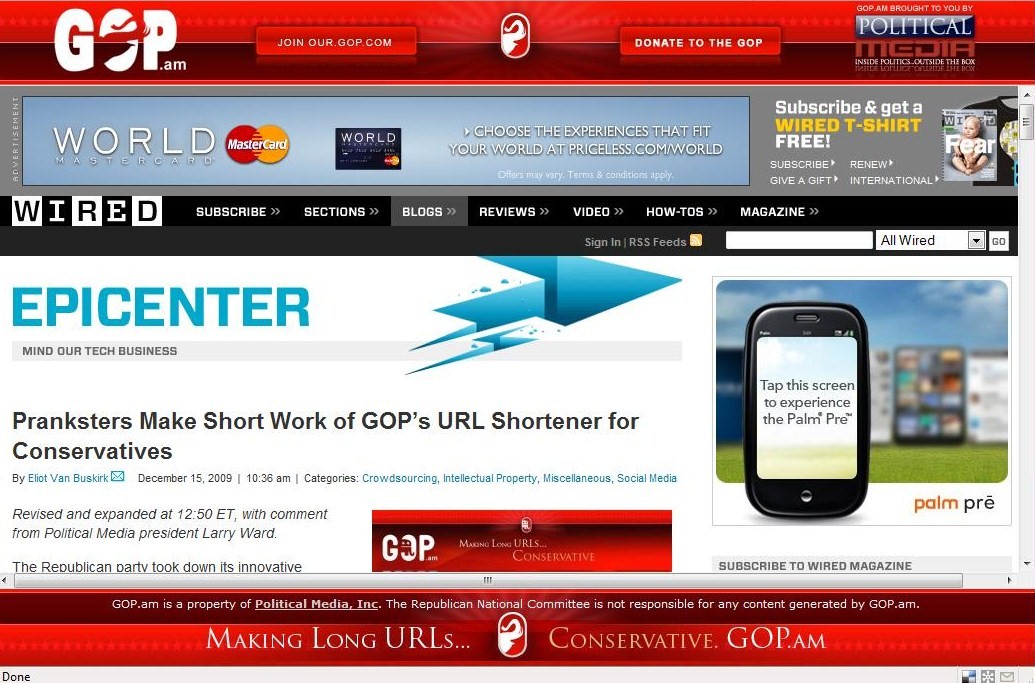
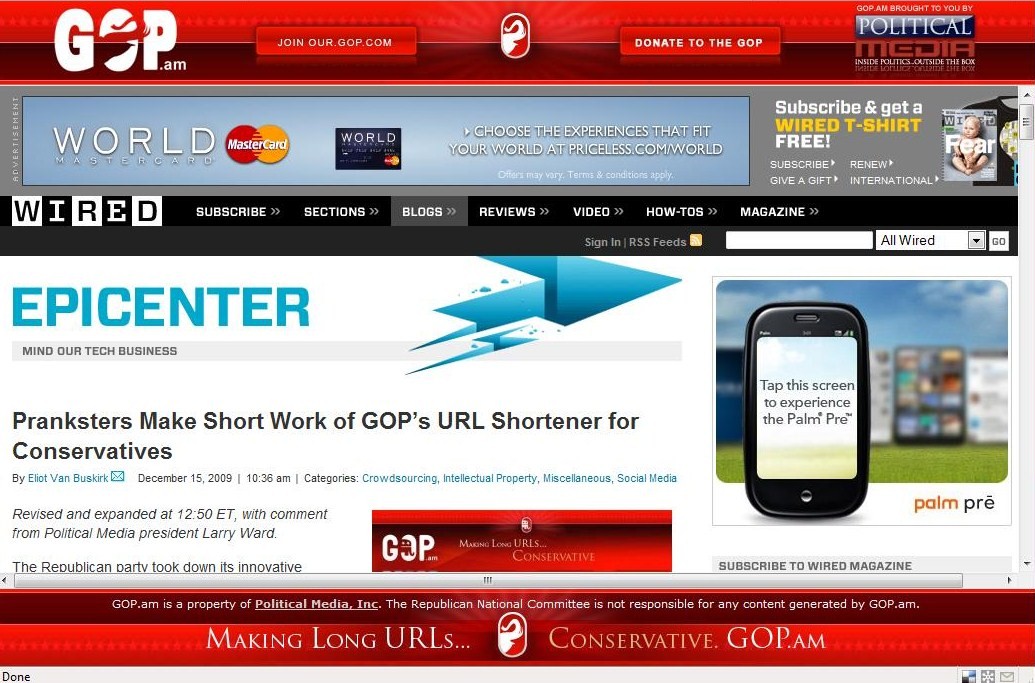
The Republican Party caught plenty of deserved flack for the hamfisted rollout of its website this year, but in the last couple of days there has actually been a pretty innovative development from the online right: the GOP.am URL shortener.

There are plenty of these handy devices for condensing website addresses, but GOP.am is different because it frames every website with banners directing users back to the sign up and donate sections of the GOP website.

Playful pranksters have used the link to put the GOP brand around less-than savory sites.  And, as the Bivings Report notes, the banners take up lots of space and have no obvious method for users to get rid of them.

But it’s also significant that this is not, as of yet, an official RNC project.  Remember that during the 2008 campaign, the Obama campaign benefited from user-generated videos and iPhone applications.   Even their MySpace page was started by a supporter.

Political movements which are successful online or offline have major components which are created by activists outside of the major party.  That makes projects like GOP.am important benchmarks to measure grassroots innovation – even if it isn’t perfect.

It’s in the dictionary now, and can’t be “unworded”

The verb “unfriend” is in the Oxford American Dictionary Word of the Year.  (It is also now officially a word.)

Of all the verbiage to come out of social networking and new online environments, it’s interesting that unfriend – the negative act of rescinding a connection – takes this honor.  The inclusion and exclusion of words in dictionaries is more a measure of culture than technology – technology creates new terms every day, but to be included in popular language those terms must have a crossover appeal that removes them from the realm of technical jargon and into the realm of word you might read in a newspaper article.

When most of us “unfriend” someone, it’s not because of an offline relationship that has gone south, but because the online relationship was more than we could handle.  Anyone with a Facebook account has had the friend who constantly sends requests or shares too much information.  Most people on Twitter have followed a friend who peppered their feeds with such witticisms as, “Making a sandwich and can’t decide – grape or strawberry jelly?!?”  Speaking of Twitter, after a spike earlier this year their new user numbers seem to be leveling off,and big companies that were excited to enter the medium have become absentee Tweeters.

In other words, we are settling into these new online environments by shifting from the mindset of signing up every new and shiny community or connecting with every long-lost high school class.  Perhaps we are getting better, both in terms of who we connect with and where we connect, at prioritizing what is best and most useful for us individually – and unfriending the rest.

App shoot

Upon reflecting more about recent, high-profile rejections from Apple’s App Store, one thing is becoming apparent: with the iPhone/iPod platform is gaining popularity, more developers are investing time and resources writing software for it only to see their creations rejected.

The closed-door approach makes sense for Apple – since their platform is the first of its kind, any questionable use would reflect back on their highly-recognizable brand rather than an anonymous developer.  If Saturday Night Live legend Garrett Morris developed a game for the iPhone called “Gonna Get Me a Shotgun and Kill all the Whities I See,” Apple would bear the brunt of the protests for allowing it rather than Morris.  (When Morris famously – and hilariously – sang that line on the air in 1976, the NBC switchboard probably got more calls than Morris’s home phone.  By citing the actual sketch, do I avoid somehow being called a racist for quoting it?)

But the closed door has implications for potentially revolutionary uses of mobile technology.  In 2008 a developer created an excellent application for the Obama Campaign, allowing volunteers to prioritize their contacts for get out the vote calls.  If the time and effort invested in creating an app is possibly wasted, how will small, volunteer-driven campaigns for local or Congressional offices – the types of campaigns who could really use the technology – justify exploring the possibilities of the platform?