Isolation brings people together

This past weekend dropped a foot and a half of snow (or more) on the Washington, D.C. are.  And since six inches is enough to grind Your Nation’s Capital to a halt, the Blizzard of ’09 was dubbed the DC Snowpocalypse.

The weather event was a fitting way to end a year that has seen an increased level of attention paid to online social networks.  Those of us glued to the local NBC news coverage found elfin weekend meteorologist Chuck Bell giddily inviting users to get involved by emailing him pictures and name suggestions (his favorite was “Shopper Stopper”).  A Snowpocalypse page quickly popped up on Facebook, and those on Twitter used the hashtags #snOMG and #DCsnowpocalypse to discuss the onslaught.

Twitter, YouTube look back on 2009

This week, both Twitter and YouTube released their 2009 trends list, much as Google did a few weeks back.  Unlike Google, though, these trend lists say more about the way each site is used rather than social trends.

Twitter Trends: The Iranian election was not the top story of the year in American media, but it did top Twitter’s news trends list – largely because Twitter itself was such an important tool in organizing street demonstrations.  In Entertainment, movies Paranormal Activity and District 9 ranked highly.  Both became early examples of what is being called the “Twitter effect.”  Real-time fan reviews on social networks gave both films an instant box-office boost.  (The same effect may have sapped the excitement around other top-Twitter-trenders GI Joe and Watchmen, both of which did worse than expected.

Predictably, there were other trends that lend credence to the “I’m-sitting-on-the-porch” pointlessness of Twitter when misused.  However, these examples also speak to the potential advantage of Twitter as an organizing tool – whether the goal is overthrowing an unpopular regime or flocking to a better-than-expected movie.

YouTube Trends: YouTube is interesting in that it can report two trends: the most-watched videos and the search terms.

The top viewership trends on YouTube centered around you-gotta-see-this viral sensations such as Susan Boyle’s performance on Britain’s Got Talent and the famous wedding party entrance to the tune of Chris Brown’s “Forever.”

Top search trends, which were broken out by month, centered around news and entertainment events but weren’t always directly related.  For instance, the death of Michael Jackson led to an increase in searches for the Thriller music video.  What does this mean?  Probably that a generation that doesn’t remember the dawn of the music video era was looking for a famous short film that was frequently discussed but seldom seen.  YouTube’s slogan is “Broadcast Yourself,”  but it may as well be “Catch what you missed.”

Year in review lists are a chance to look back at the big stories of 2009, but those are common knowledge.  Digging into the trends can, however, show how people are using the online tools – and give insight on how to reach them.

That’s one small URL for the GOP…

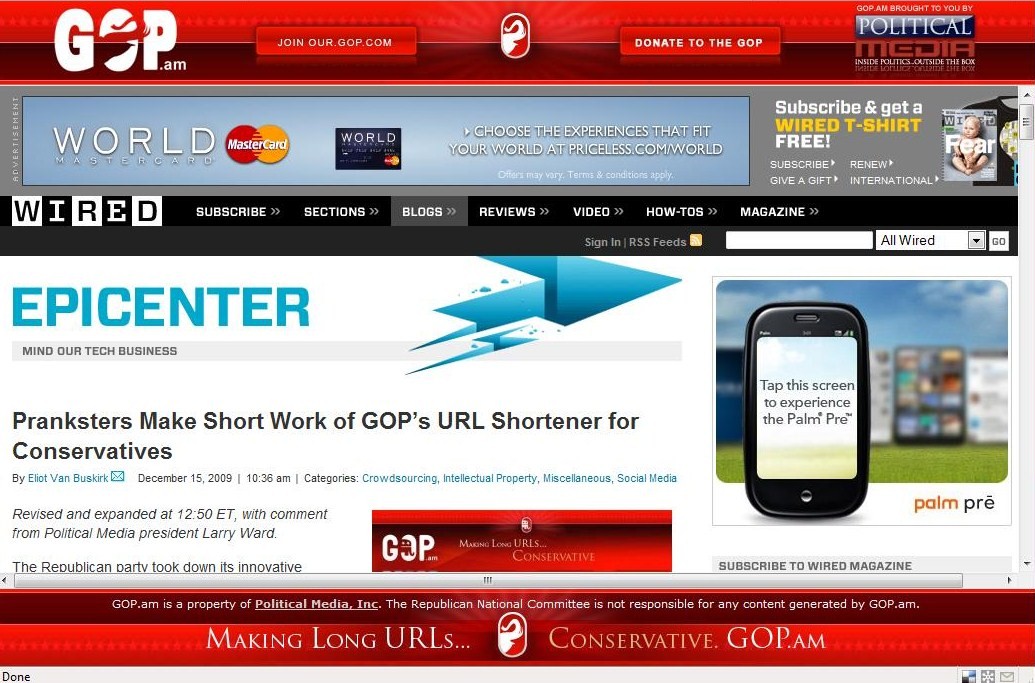
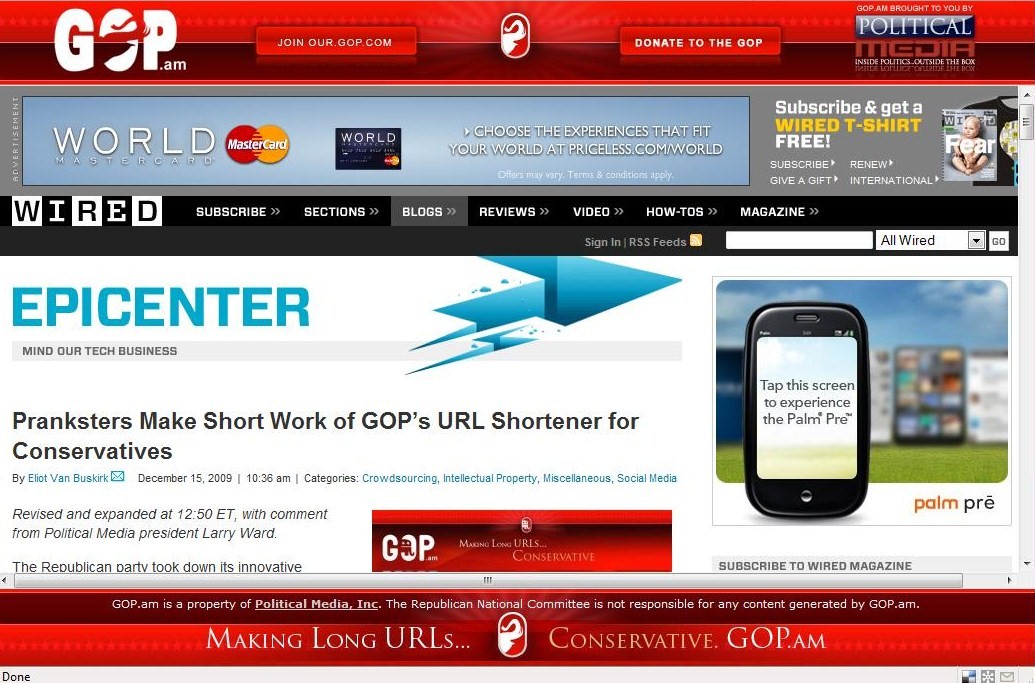
The Republican Party caught plenty of deserved flack for the hamfisted rollout of its website this year, but in the last couple of days there has actually been a pretty innovative development from the online right: the GOP.am URL shortener.

There are plenty of these handy devices for condensing website addresses, but GOP.am is different because it frames every website with banners directing users back to the sign up and donate sections of the GOP website.

Playful pranksters have used the link to put the GOP brand around less-than savory sites.  And, as the Bivings Report notes, the banners take up lots of space and have no obvious method for users to get rid of them.

But it’s also significant that this is not, as of yet, an official RNC project.  Remember that during the 2008 campaign, the Obama campaign benefited from user-generated videos and iPhone applications.   Even their MySpace page was started by a supporter.

Political movements which are successful online or offline have major components which are created by activists outside of the major party.  That makes projects like GOP.am important benchmarks to measure grassroots innovation – even if it isn’t perfect.

Thanksgiving Recap: Turkey, Tiger, and TMZ

The Thanksgiving weekend accident that sent Tiger Woods to the hospital proves that what’s true of nature is true of modern media and media consumers: both abhor a vaccum.

The bizarre circumstances surrounding the situation suggest a deeper explanation than Woods heading out to his local Best Buy to snag some Black Friday door buster deals.  Traditional media outlets have reported  poked fun and spread rumors.  But TMZ is pointing to eyewitness reports that contradict the facts given by ESPN on the ubiquitous crawl across the bottom of the screen during the Thanksgiving weekend college football games.  TMZ also reports that law enforcement agencies are looking more deeply into the matter.

Honestly, the truth of Tiger Woods and his wild ride are of little import to world affairs.  Everyone – or at least, almost everyone – is happy that his injuries weren’t serious, and he can go back to being the amazing golf ball whacker guy that he was on Wednesday.

For TMZ, though, the Tiger tale gives them another notch on their belt to go along with their scoop on the death of Michael Jackson.  What used to be a disdained celebrity gossip site has now played a key role in two major stories over the past six months.  Woods even had to respond to the reports – predictably calling them false, but offering no new details.

TMZ succeeds because they fill a need for information that other media are unable to provide – working largely by interviewing witnesses, digging through public records, and other classic hallmarks of the un-sexy world of old fashioned shoe-leather journalism.  Contrast that with the largely opinion-driven chatter that permeates 24 hour news channels, and the secret of TMZ’s success becomes a little more clear.

It’s in the dictionary now, and can’t be “unworded”

The verb “unfriend” is in the Oxford American Dictionary Word of the Year.  (It is also now officially a word.)

Of all the verbiage to come out of social networking and new online environments, it’s interesting that unfriend – the negative act of rescinding a connection – takes this honor.  The inclusion and exclusion of words in dictionaries is more a measure of culture than technology – technology creates new terms every day, but to be included in popular language those terms must have a crossover appeal that removes them from the realm of technical jargon and into the realm of word you might read in a newspaper article.

When most of us “unfriend” someone, it’s not because of an offline relationship that has gone south, but because the online relationship was more than we could handle.  Anyone with a Facebook account has had the friend who constantly sends requests or shares too much information.  Most people on Twitter have followed a friend who peppered their feeds with such witticisms as, “Making a sandwich and can’t decide – grape or strawberry jelly?!?”  Speaking of Twitter, after a spike earlier this year their new user numbers seem to be leveling off,and big companies that were excited to enter the medium have become absentee Tweeters.

In other words, we are settling into these new online environments by shifting from the mindset of signing up every new and shiny community or connecting with every long-lost high school class.  Perhaps we are getting better, both in terms of who we connect with and where we connect, at prioritizing what is best and most useful for us individually – and unfriending the rest.

App shoot

Upon reflecting more about recent, high-profile rejections from Apple’s App Store, one thing is becoming apparent: with the iPhone/iPod platform is gaining popularity, more developers are investing time and resources writing software for it only to see their creations rejected.

The closed-door approach makes sense for Apple – since their platform is the first of its kind, any questionable use would reflect back on their highly-recognizable brand rather than an anonymous developer.  If Saturday Night Live legend Garrett Morris developed a game for the iPhone called “Gonna Get Me a Shotgun and Kill all the Whities I See,” Apple would bear the brunt of the protests for allowing it rather than Morris.  (When Morris famously – and hilariously – sang that line on the air in 1976, the NBC switchboard probably got more calls than Morris’s home phone.  By citing the actual sketch, do I avoid somehow being called a racist for quoting it?)

But the closed door has implications for potentially revolutionary uses of mobile technology.  In 2008 a developer created an excellent application for the Obama Campaign, allowing volunteers to prioritize their contacts for get out the vote calls.  If the time and effort invested in creating an app is possibly wasted, how will small, volunteer-driven campaigns for local or Congressional offices – the types of campaigns who could really use the technology – justify exploring the possibilities of the platform?

Bad news for old school papers

The troubles of traditional print newspapers, including those in major metropolitan areas, is well documented – with news consumers moving toward online sources, advertisers are less likely to buy space in printed periodicals.  Unfortunately for most news organizations, it turns out that the advertisers are not moving online along with the readers – even though online advertising spending continues to rise.  If you consider the way ads are displayed on newspaper websites, and internet advertising models, it makes sense.

Back when print advertising was all the rage – in the olden times before 1997 or so – the model for effective advertising was fairly simple: you bought space in a publication that matched your target demographic.  If you were a Boston-based business, for instance, that meant advertising in the Boston Globe or the Herald.  It was expensive, but you were paying for exposure – the more pairs of eyes would look at your ads, the more customers you would get at the other end of the funnel. When you paid your advertising dollars, you paid for exposure.

Online advertising has changed that model in every way imaginable, especially search advertising.  When you buy search ads today on Google or Bing, you pay based on how many people click on your ads.  That creates an extra incentive for the search engine folks to put your text ads in places where people are most likely to click.  With search advertising, you are paying not for how many people see your ad, but for how many people actually show interest.

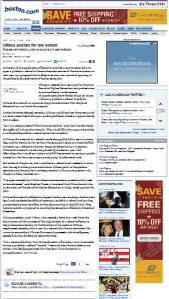
So, why aren’t newspapers able to capture those online advertising dollars?  To illustrate their problems, let’s use the Boston Globe – a paper which has had very public issues adapting to the new world of news.  If you visit the Boston Globe and search for my alma mater, UMass, one of the first stories you get is about UMass angling to open their own law school.  Check out what the page looks like:
globe1

Note the three ads – a banner across the top, a box in the right column, and a tower ad running down the right side a little ways down the page.  The banner and tower in this image are for Roadrunner Sports, and as near as I can tell they rotate.  The big, blue Air France rectangle, though, is all over the Boston Globe’s site today.  That probably means Air France bought a high level of visibility – in other words, they bought ads online the same they would have in the print version of the Globe.

But here’s a pertinent question: why would someone be reading this story?  What does that indicate about their interests?  Air travel seems like an odd fit for a story like this, which one might read if he or she is researching law schools or is a UMass alum.

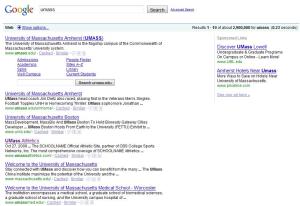
To contrast, here’s what I found when  searching for “UMass” on Google:
google1

Along the right side are two simple text ads for one of UMass’s satellite campuses and Priceline.com – the Priceline ad trumpeting their ability to find good hotel deals in and around Amherst.  What’s more, the ads look much like the search results – with the search term showing up in bold.  If you are searching for “UMass” because you are looking to further your education or visit your alma mater, these ads are up your alley; if not, the companies that bough the ads lose nothing because they only pay if you click.

While the search ad model anticipates the user’s possible interests and serves ads based on that, newspapers and the ad networks through which they work too often continue to display the ads that they want the user to see – even online.  Why would anyone pay for eyeballs when they could pay for the whole brain?
It takes more than a blog post to take down The Sandman

Joel Sherman, baseball columnist for the New York Post (Our Nation’s Newspaper of Record), fears that Mariano Rivera’s reputation will be unfairly tarnished because an Angels Blog, Halos Heaven, posted the video above and speculated that it shows one of the greatest players ever throwing a Gaylord Perry Special:

In this age, a stellar reputation built over years can turn to spit in a few clicks of a mouse… In the few hours in between film clip posting and absolution by MLB, every save in Rivera’s illustrious career was put in question.

Sherman’s fear of a rogue blogger making unfounded and senseless claims is understandable, especially given the fact that Major League Baseball at least payed lip service to the idea they were “investigating” the charges.  But Mariano Rivera’s reputation is not in danger.

Predictably, Yankees Manager Joe Girardi denied any chance that Rivera threw a spitter.  But so did Rivera’s former manager, Joe Torre – as well as fellow Dodgers coaches Don Mattingly and Larry Bowa, who coached Rivera in New York.  Even the opposing manager, Mike Scioscia, said he was surprised the idea had even been brought up.

Rivera has people standing up for him now because of his entire career – not for the success he’s enjoyed, but because of how he enjoyed it.  A recent Sports Illustrated article summed it up nicely.  David Ortiz and Jonathan Papelbon – from the Red Sox – gushed about their respect for his personality:

“I have respect for Mariano like I have for my father,” says Boston designated hitter David Ortiz. “Why? He’s just different. If you talk to him at an All-Star Game, it’s like talking to somebody who just got called up. To him, everybody else is good. I don’t get it. To him everybody else is the best. It’s unbelievable. And he is the greatest.”

Sure, coming from a steroid cheat that may seem tainted, but Ortiz isn’t the only one singing Rivera’s praises – or the only one whose respect Rivera has won.

Writer Tom Verducci reminded readers that Rivera taught Roy Halladay – a pitcher for a rival team – how to throw his signature pitch during the 2003 All Star Game.  While over the past 30 years, great closers like Dennis Eckersley and Francisco Rodriquez have celebrated strikeouts the way NFL players celebrate touchdowns, Rivera shows respect to every hitter he dominates.

It’s an important lesson in image management: for all the power of online communications, there is no substitute for genuine substance.  So when a blogger posts an accusation – with flimsy evidence – accusing Rivera of cheating, you can bet there’s a reputation at stake.

And it sure ain’t Mariano Rivera’s.

Study: Still waiting on that online advocacy revolution

A new study released by a troika of new media firms (2ndSix, TribeEffect, and Chris Lisi Communications) charts some surprising trends in online advocacy – more accurately, the lack thereof.

The study evaluates 102 top trade associations, membership organizations, and other groups with political advocacy goals and charts their use of a number of online tools – everything from collecting email sign ups to Twitter to blog badges to Facebook and everything in between.  Most of the tools considered were either free or low-cost; yet the study found a surprising lack of use:

Overall, there is a lag in the implementation of the new media tools.  Many of the organizations reviewed in this report have not yet embraced or employed many of the readily accessible online communication and social media tools… 76% of the most commonly used social media tools are not being utilized to communicate with members, voters and other constituencies.

On the heels of the Obama Campaign, Washington D.C. was abuzz with the possibilities of online campaigns.  So what gives?

There are three things to consider when wondering why the digital wave hasn’t crashed the banks of the Potomac.  First, online and social media are new, and some of the key decision-makers in these groups may not understand them fully.  Being fully committed to online activity means surrendering some message control and directly engaging people who have negative comments.  That may resonate with the front line folks, but senior management will usually have to deeply consider what amounts to a change of strategy.

The second item to consider – which draws a bit from the first – is that social media activity can be difficult to quantify to important stakeholders.  Anyone can build a Facebook page with 5,000 fans given the resources; but translating that to action can be difficult.  In other words: if you work for a health insurance trade group, and you recruit 5,000 Facebook fans or Twitter followers from all over the country, how many are going to be able to call Sen. Olympia Snowe’s office to tell her she shouldn’t bow down to the Democrats’ health care overhaul?

There’s a third and final item to keep in mind.  The study itself admits that it doesn’t evaluate the effectiveness of the various tactics employed by each organization – in other words, the study simply charts charted whether a group has a presence on Facebook, but not whether that presence helped further their policy goals.  Just like a real-world toolbox, and online toolbox has  implements for a variety of uses.  But just as you wouldn’t use a screw driver to pound nails into a plank of wood, you might look at your online goals and decide that Twitter or LinkedIn just isn’t right for you.

Because I switched to WordPress, this will never apply to me

New York is investigating whether a blogger is considered self-employed or unemployed.  The decision hinges on the buck-per-day revenues she generated from Google ads on her blog.  When the former lawyer reported the revenue, the state launched an investigation into whether she still deserved unemployment benefits.

The site is still up, and the ads have been removed – which means New York’s Department of Labor succeeded in keeping a laid-off lawyer from experimenting with new revenue streams which could have lead to gainful self-employment.  Good job!