Washington, TMZ

The Washington Post’s David Weigel found himself the object of DC gossip columnists for venting on a journalists-only message board – and, before that, for – gasp – dancing at a wedding.

Weigel was a target for this because of his coverage of Congressman Bob Etheridge’s reaction to a couple political paparazzi.  (And incidentally, Weigel was right – Etheridge does look like he’s hugging the camera guy.)  The reaction that he went easy on Etheridge led to his explosion on the list, which snowballed into an even bigger deal, and led to his resignation.  Both his situation and Etheridge’s are part of a bigger trend in DC media.

The last few years have seen the launch of several DC gossip blogs and columns.  Instead of tracking the latest developments on pending legislation (as, say, an MLB gossip blog might cover trade rumors) they cover such matters of national import as the dressing habits and sometime stupidity of summer interns.  It’s not altogether bad, as it’s often entertaining;  But it’s a noticeable trend.

It would be easy to blame this trend on media saturation, but that would be an oversimplification.  This is an environment built on purpose by politicians and their communications professionals.  From state dinners to the White House Correspondents’ dinner, events which were once matters of course are increasingly staged as red carpet galas.  (This year, Politico likened the White House Correspondents’ dinner to the Oscars.)  Celebrities are routinely invited to testify before Congress as experts.

At the same time, much like Hollywood, Washington has created supporting industries around its main business, governing.  Just as movie makers need agents, consultants, special effects companies, costume designers, and other supporting industries, politicians need… well, agents, consultants, special effects companies, and costume designers.  With a community built around a central function, there’s bound to be an esprit de corps that binds people together even more than partisan leanings.

The casualties in this are, of course, old school folks like Etheridge and Weigel.  However, it’s important to note that their failures to adapt are for somewhat different reasons.  Etheridge isn’t used to have to answer questions directly; while Weigel is likely accustomed to the direct, personal questioning that is often a casualty of gossip blog culture.
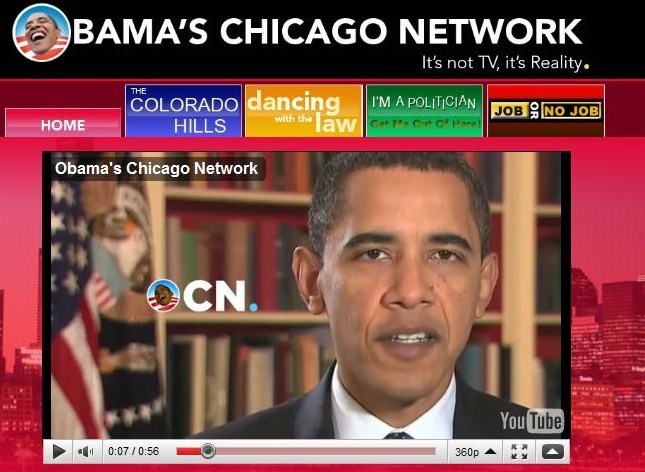

It’s still better than WGN

Looking to keep stories about the White House’s dabbling in primary elections alive, the RNC launched the “Obama Chicago Network” in an email to supporters this afternoon.

The site boasts four “shows” that deal with various negative stories surrounding the Sestak/Romanoff could-have-been-bribery affairs, plus Rod Blagojevich thrown in for fun:

Even if it is somewhat dated in the pop culture references (some of the shows they are spoofing are past their prime or canceled), it’s pretty funny, makes good use of news clips, and has a poll to collect people’s contact information.  With Blagojevich in the news, it does a good job of tying the administration As a lead generator, the site is good, but it’s missing something that could make it a really useful tool for Republican messaging: a section where users could “pitch” their own shows.  Not only is audience participation a good thing, but it might make for some must-see TV.

No one likes citizen journalism

This week may be called anti-indie journalism week.  Consider these three stories:

Each story, in its own way, is based on a lack of understanding of the modern media landscape.  But door number three is the most egregious.

Risen’s comments about bloggers could be appropriate – the downside of a media universe with more outlets is that there are more outlets tat just spew crap, and it is up to the reader to be more discerning.  He doesn’t summarily dismiss the concept of blogs, though he does come off as an arrogant schmuck.  Similarly, the “student” who questioned Etheridge never identified himself as a reporter, which would have been the smart thing to do.

The FTC, on the other hand, is just way out in left field.  The document, which outlines options such as granting tax-exempt status or other allowing reporters to copyright “hot news.”  Really, though, these recommendations are simply reactions to the fact that print newspapers have fallen on hard times:

Although many of the issues confronting journalism cut across different news media platforms, such as broadcast television and radio, most of the discussion in this document will use the perspective of newspapers to exemplify the issues facing journalism as a whole. Studies have shown that newspapers typically provide the largest quantity of original news to consumers over any given period of time. We include within the term “newspapers” online news websites run either by an existing newspaper or by an online-only news organization.

That an online news aggregator like the Drudge Report would seem to count as a newspaper to the FTC isn’t the biggest problem.  The big problem is the concept of establishment journalism, which is the bedrock of the FTC report: professional and somehow specially qualified reporters paid to investigate and package stories for consumption by the reader.   That mindset is what leads a reporter for a prominent newspaper to lash out at internet critics or a Congressman to take umbrage with a question from a reporter without a press pass.

When the reporter or the politician does thinks that way, it’s just stupid.  When the FTC thinks that way, it could also become the law.

Being the media

Last night I spoke at the Leadership Institute‘s Public Relations School on writing effective press releases.  It’s a talk I’ve been giving since 2002, but since then it has obviously changed pretty considerably.

The most significant change has been in the forms a press release has taken.  Eight years ago a basic press release was a one-page document written like a news story that was emailed and faxed to a media list, or distributed through a press release service.  Today, through formats like social media releases, plus tools like easy blogging and media hosting platforms (like Flickr and YouTube), organizations and campaigns can augment their news releases with all kinds of extras.

And frankly, if they aren’t doing that, they’re missing out.

The media landscape has changed, too.  Bloggers and power social network users can reach thousands of people.  There’s no reason to wait for traditional media outlets to create content that can be picked up virally.  The Washington Times mentioned how this helped insurgent candidates circumvent the media in upsetting candidates hand-picked by political parties:

Just as important, platforms such as YouTube have given long-shot candidates ways to circumvent political reporters reluctant to cover campaigns they don’t believe have much chance of success…Most prominent is Florida, where former House Speaker Marco Rubio, a darling of the “tea party” movement, had nearly 20 times the video views in late May as Gov. Charlie Crist, whom Republican leaders had recruited into the race. Mr. Crist has since fled the Republican Party to run as an independent.

One key element of public relations hasn’t changed, of course: the importance of having a strong, well-framed message.  If a tree falls in the forest, and no one’s around to tweet about it, it won’t make the front page – but the tree has to fall first.

5 Truths of the YouTube Age

YouTube is celebrating not only turning five, but reaching 2 billion views per day.  In the decade before YouTube, internet publishing and blogging had become commonplace.  But though the internet had long been a place where anyone could put their work out there (as long as they didn’t mind not getting paid for it), YouTube’s video sharing platform – along with technology that made quality video devices cheaper – turned everyone into a video producer.  Anyone could be Cecil B. DeMille.

That said, not everyone can effectively communicate on YouTube.

1.  Video is now essential to message delivery.

Political communication has always been a matter of telling stories, and no medium can tell a story like video. In 1960, the story of the cool, collected, and telegenic JFK as the harbinger of a new political generation was cemented by his now-famous debate performance; in 2008, the story of Barack Obama as the idealistic, optimistic harbinger of a new political generation was cemented by a music video adapted from one of his speeches that seized upon the phrase, “Yes We Can.”

Politicians can try to position themselves with stump speeches and media appearances, and their surrogates can attempt to provide “objective” support.  People believe what they see.  That makes effective online video a must-have.

The reality of modern politics is that if you can’t make your case in a YouTube video, you have no chance of winning the hearts and minds of the public.

2.  Brevity is art.

Part of the “effectiveness” factor is being able to boil an argument down to the point where it fits in a two-to-five-minute video clip.  Case in point: one citizen activist was able, in 1:38, to sum up just how insignificant a 2009 federal budget cut proposal was:

3.  The best ideas come from others.

The best part about YouTube is the opportunity for participation from the initiated, regardless of their “official” role.  Obama’s nascent 2008 campaign had a lot of energy, yet it was tough for people to discern exactly what kind of change he offered.  All Democrats were, in fact, plugging away at that theme after eight years of a Republican administration.  But one Obama supporter – whose involvement in the campaign was tangential, though his enthusiasm wasn’t – summed it up by repurposing a famous 1984 Macintosh commercial:

The Obama campaign could not have cut this ad – it’s too direct, and it uses images and clips which are most likely protected by copyright.  By supporting user generated content like this, YouTube invited a new level of citizen participation.

4.  Compelling content is the most important factor in attracting an audience.

Never has publishing content been easier.  Yet because of this, never has it been more important to create quality content: media consumers have plenty of choices.

And don’t let the lists of the most-viewed YouTube videos that tend to focus on music videos fool you: quality viewers are more important than total viewers.  If New York voters see George Allen call an opponent’s campaign volunteer a word that sounds like an ethnic slur, they may be offended.  If Virginia voters see it, they can actually take action and vote against him (which they did).

5.  Online video is a social experience

It’s counter-intuitive: We think of the internet as this highly personalized frontier, where each user has the utmost control over the news he or she reads or the entertainment he or she consumes.  Humans are social beings, and the internet augments that.

YouTube’s comments, video responses, subscriptions, and other site tools make it more than a place to post and share media; YouTube is a social network built on user connections.

But more that, YouTube success is based on the ability of an idea to pass from one person to another.  High-ranked YouTube videos don’t amass viewers from independent searches, they come from recommendations.  It’s the most obvious viral medium.

Just make sure you don’t say anything stupid.

Hitler finds out he’s pulled from YouTube

Downfall is the movie about the final days of the Third Reich.  But of course, many of us know it for its climatic scene of Adolf Hitler’s bunker tantrum – which has been re-subtitled on YouTube to make Hitler rant about HD-DVD losing to Blu-ray, his car getting stolen, the Cowboys losing to the Giants in the 2007 playoffs, and even everyone forgetting his birthday.

Coming soon: Hitler finds out that Constantin Films, which owns the rights to Downfall, is pulling the clips from YouTube.

While it should be well within their right to do so, is this the smartest business move for the film company?  Recall that Chris Brown (before his alleged domestic violence incident made him untouchable) was able to use a viral video of a wedding party dancing to one of his songs to sell mp3 downloads.

I added Downfall to my Netflix queue last month just because of the Hitler parodies – how many DVD sales is Constantin missing out on?

iJournalism or iReceiving stolen goods? (Or something iElse?)

The lather over Gizmodo’s exposure of the new iPhone 4 has ignited some debate over whether the techno-geek blog went too far in buying a possibly lost and/or stolen iPhone prototype for their exclusive.  Joe Wilcox does a pretty good job summarizing how Gizmodo’s scoop broke the law:

California’s “Uniform Trade Secrets Act” is unambiguous, partly defining “trade secret” as “information, including a formula, pattern, compilation, program, device, method, technique, or process.” The Act uses several definitions of “misappropriation,” of a trade secret with one being: “Acquisition of a trade secret of another by a person who knows or has reason to know that the trade secret was acquired by improper means.”

An unreleased phone accidentally left in a bar and sold to Gizmodo surely qualifies as acquisition “by improper means.” Proper means would be purchase of the device from Apple, following its public release.

Wilcox also mentions the recourse Apple would have if they chose to pursue it.  At this point, it doesn’t look like Apple is going to make a move – and from that fact follows the point which makes the whole discussion moot: Apple doesn’t want Gizmodo to take down their “exclusive look” at the iPhone – not even the post where the phone gets dissected it like a science class frog – ostensibly, the party that tips Apple’s hand the most to industry competitors.

Of course Apple wants the pictures up on the internet, and of course they want everyone talking about the brand new secret product.  Consider that Apple announced the existence of the iPad months before the official release date; this staged rollout allowed Apple to break into two news cycles.

Not to play conspiracy theorist, but Apple could benefits from three rounds of coverage – the current stories about the leak, stories about the announcement, and finally the release (complete with the requisite long lines around the block early in the morning at an Apple store near you).  Is it far-fetched to think Apple would have left this “lost” phone in plain view as a brilliant guerrilla marketing move?  Then again, maybe Apple wouldn’t have any security systems in place that would prevent an engineer from taking a super-secret prototype out of a lab and into a bar.  Apple may not have purposefully leaked the iPhone 4, but they clearly aren’t crying about it now.

Twit-story: The Library of Congress vs. Google Replay

The Library of Congress will collect and store the full volume of Twitter for “scholarly and research purposes.” Twitter is psyched because it’s another demonstration of legitimacy:

It is our pleasure to donate access to the entire archive of public Tweets to the Library of Congress for preservation and research. It’s very exciting that tweets are becoming part of history. It should be noted that there are some specifics regarding this arrangement. Only after a six-month delay can the Tweets will be used for internal library use, for non-commercial research, public display by the library itself, and preservation.

As evidenced by events like the Iranian election protests, Twitter users can act as documentarians of history as it happens.  The Library of Congress’s recognition of this is another sign that Twitter has grown up a bit; the timing couldn’t be better, coming just a couple days after they announced their advertising model.

For the vast majority of Twitter’s data, this announcement is really a non-story – after all, there’s nothing stopping anyone from visiting Twitter and accessing all public tweets.  What about accounts that have been deleted, though?  And what about the accounts that get deleted after the Library of Congress makes an official historical record of them?

Buried in Twitter’s blog post is a much “friendlier” strategy for making Tweets a part of history: Google’s Replay service, which allows users to revisit moments in history and watch events unfold through Twitter and other online media.

As with most announcements, the difference lies in the semantics.  Google Replay would pinpoint specific times and issues – in other words, it would gravitate toward tweets which were sent with the idea that they were for public consumption.  The idea of Twitter turning over a hard drive full of information to a government office may be no different in practice or outcome, but it sounds a lot creepier.  Suddenly, you may find yourself perusing your own Twitter feed to see if you have anything to worry about.  A better announcement might have been a joint release by Twitter, Google, and the Library of Congress discussing a way to incorporate publicly broadcast real-time updates into research.  It might have looked like a tool on the Library’s website, powered by Google.

The nature of Twitter makes this a minor issue, but it isn’t the only place that history is recorded in real time.   Facebook and Google Buzz have both incorporated elements to mimic Twitter’s free-flowing stream-of-consciousness format.  That means they’re just as potentially attractive to the Library of Congress as part of the “historical record” – even though their data is decidedly more sensitive.

Free News!

Rupert Murdoch – the Australian who prints Our Nation’s Newspaper of Record – is sticking to his guns: advertising alone won’t support journalism, so if you want news from his properties, you’ll have to pay.  (Eventually.)

Murdoch has a problem with news aggregators like Google, which monetize other people’s content.  Critics say Murdoch’s time has passed, and that putting up paywalls would hurt readership.  While this is true, readership really isn’t the problem for news media, it’s revenue.

Like any foray into the online world, eyes on the page mean little unless those eyes do something.  Campaigns and causes find that out all the time.  It’s relatively easy to drive traffic to a site or amass 10,000 Facebook fans, but unless those site visitors and fans sign up, give money, and/or take action, they’re nothing more than numbers on a spreadsheet.

Similarly, if  Murdoch’s papers don’t have users that somehow create revenue, it really doesn’t matter how much news they read.  It isn’t a matter of greed; it’s a matter of keeping the lights on.  And if Murdoch chooses to monetize his content completely, then Google and Microsoft have no right to take his content and serve ads around it.

To be sure, committing to a business model that sells content means that content will have to stand out a bit.  If Murdoch’s content stands out to the point where people are willing to pay, then he should charge.  And if not, the problem will correct itself.

Eight-year-olds, Dude

Erick Erickson of Redstate reports on a county council race in Ohio that features candidate Tim Russo.  The twist: Russo was arrested and convicted in 2001 on charges of soliciting minors for sex – turned out, the minor was actually an undercover FBI agent.

But Russo has an ardent defender in blogger Howie Klein.  Klein calls the 2001 incident “the most boring episode of To Catch a Predator ever” in a cross-posting at both DownWithTyranny and The Huffington Post:

Easily the most reactionary pope since Hitler’s boy Pio, Ratzinger didn’t have a problem with priests raping young boys– as long as they stuck with conservative dogma. When he ran the Munich diocese that was also the birthplace and heartland of the Nazism that he once fully and openly embraced, the future Pope had hundreds of child rapists and mentally unbalanced priests in his ranks and he never said a word beyond, “don’t get caught, boys.”

My mistake – that last paragraph was Klein criticizing the Pope and the Catholic Church for covering up instances of adults taking advantage of minors.  It was written way back in those simple times of late March 2010.

Of course, Klein has a point – no matter how much you agree with someone philosophically, if they do something wrong that has consequences.  Unless, apparently, it’s a political candidate Klein supports:

Russo has the sort of leadership experience Cuyahoga County desperately needs at this dangerous, hopeful crossroads. But local media are doing their best to scuttle his campaign before it really begins. Why? Because in November 2001 he solicited sex from an FBI agent posing online as a minor and was made Pervert of the Day for an entire 24-hour news cycle. Local media want him to pay for that for the rest of his life.

Clearly, Russo has paid for his crimes, but there are a few mistakes which you simply can’t pay off – and soliciting minors for sex is one of them. As Edwin Edwards famously quipped, the scandals which end political careers are getting caught in bed with a dead girl or a live boy.

Russo has compounded his crime with his own words, sounding more defiant than understanding of the reluctance to embrace him.  “Bottom line, I survived it. Many would not have. That should tell you all you need to know,” he writes – just before asking for donations.