Politics, policy, and the President’s speech

Criticism of the President’s speech last night ranged from the lack of specific policy asks to the aggressive tone he took in describing what BP would be forced to do.  But those elements are what made the speech a short term winner – and possibly the only viable course of action.

Though it breaks a personal moratorium on referencing Ronald Reagan, the purpose of this speech should have been similar to the 1986 speech after the Challenger disaster.  That speech sought to restore confidence in American ingenuity, which had just taken a very dazzling and public hit.

Obama’s speech had a similar goal – channel and focus people’s emotions.  In his case, he wanted to empathize with Gulf residents and all Americans who will feel the environmental brunt of a company’s mistake.  The policy ideas he put forward are window dressing for the bigger message – he feels your pain, and he’s going to inflict some of it on BP through a relief fund that the oil company will fund but not direct.   (Something that would have been a good idea for BP to set up in the first place.)

Could he come out of this swinging and missing?  Could BP challenge the seizure of their assets in court – and, conceivably, win?  Perhaps, but after waiting 57 days to make this statement, it’s the best message the President has.

Plus, if BP weasels out of the bill some how, the President will still have a chance to make them the bad guy.  Just because a James Bond villain jumps in an escape pod and eludes capture doesn’t make Bond’s effort any less heroic.  It just means that Obama will have to find new and creative ways to hold BP accountable – something like tax credits for owners of local BP gas stations  owners who want to change  their affiliation.

It may not be good policy, but it’s good politics.  As the old saying goes, when you see a mob coming with pitchforks and torches, either grab a torch and join the crowd or start running in another direction.

Strasburg: Obama or Palin?

Merry Strasmas!  With California, Arkansas, South Carolina, and other states taking a turn as centers of the political universe, Washington, D.C. is free to be the center of the baseball universe today thanks to Stephen Strasburg.

Strasburg, has little professional baseball experience, yet is already the standard-bearer for his team.  In that way, he’s a little like the 2008 versions of both Barack Obama and Sarah Palin.

DC likes to claim to be a secular town, but it’s a town that looks for saviors almost constantly.  Whichever political party is out of power and seeking a way back in looks for the Chosen One who can at once articulate his or her side’s philosophy while appealing to wide demographics of the electorate.  The list of would-be saviors is truly bipartisan: Howard Dean, Newt Gingrich, Fred Thompson, Wesley Clark, Hillary Clinton, Al Gore, Bill Bradley, and John McCain have all been set up at various times in the last decade and a half to ride in on the white horse and save their party from ruin.  Stephen Strasburg’s role as the savior of a franchise coming off consecutive 100-loss seasons and mired in last place is appropriate for the dialect of his new home town.

Having been mostly dominant in a quick ascendancy through the minors, Strasburg certainly looks like he belongs on the next level – just like both Obama and Palin looked like they were ready for the big stage of national politics in easily winning a Senate seat and a governorship, respectively.  Both stumbled a bit out of the gate – allowing interviewers or non-scandals to take them off message.  But Obama was prepared and came back from early hiccups to win his primary and, eventually, establish the perception of polished confidence.  Palin never really got on track, and her debut on the national stage seemed rushed.  Accounts of John McCain’s Vice Presidential selection process seem to confirm that she was rushed through the minors.

When Strasburg, who has been pitching professionally for less than a year, toes the rubber tonight, the Nationals will hope he is a player whose time has come, albeit earlier than most expected, and who will trust his stuff through the inevitable early struggles.  They will hope they haven’t given the ball to a pitcher who isn’t quite ready for the big leagues.

They will hope for the pitching equivalent of Barack Obama.  They will not, however, want Barack Obama actually pitching.

Photo finished?

This picture is not good for our President:

Earlier this week, I talked with Matt Lewis about how the lack of a Bush-esque, detached, looking-down-from-an-airplane-at-disaster picture or video would help save President Obama from the derision and scorn his predecessor received after reacting to a Gulf coast crisis.

More likely to hurt Obama is the perception that he is at once corrupt and incompetent.  Politico details the frustration many Democrats have with the White House’s failed meddling in Democratic primaries – but it’s the accompanying hilarious picture which cuts the administration’s political shop deepest.

3 Ways the Democrats Won on 4/15

And that isn’t counting a penny of tax money, either.

Yesterday was a big news day. Tea partiers marched here in DC and elsewhere to define their core principle: that the federal government is too big, that high taxes siphon money out of the economy, and that government programs tend to make matters worse, not better. Overall, yesterday’s messaging seemed positive for limited government activists.

But the opposition was smart, too.  Nationally, Democrats drove three well-timed news stories – two by President Obama, one by Sen. Harry Reid – that added up to a communications masterstroke.

1.  President Obama announced we’re goin’ to Mars (eventually).

This was a good story to grab headlines on the other side of the tax day protests.  Instead of trying to directly engage, President Obama simply highlighted a use of taxpayer money that many folks from both sides of the aisle agree with: scientific research.  The space program specifically creates tons of jobs not only in research but in manufacturing the components of Major Tom’s tin can.

You can’t answer a call for lower taxes with the stance that taxes are just fine.  However, showing a positive use of tax dollars can undermine that message.  It wasn’t a happy coincidence – the Florida trip has been on the President’s schedule for weeks, if not months.

There’s another, more subtle attempt at differentiation here, too.  The announcement of an advanced science program will now be played on the same newscast with footage of grassroots protesters – citizen activists who, in their haste to participate, misspell signs and don’t have a staff of speechwriters to help them articulate their views.  Without actually saying it, Obama gets to present his side as better-educated and smarter than the knee-jerk, anti-tax tea partiers.

2.  President Obama signed an executive order permitting hospital visitation rights to same sex couples.

This is another point of differentiation – and a chance to bait his opponents.  Most of the focus of tea party activism has been on fiscal policy, and many Americans tend to agree with the most conservative segment of the electorate that the government spends too much and spends it wastefully.  For social issues, there is less common ground, and yesterday’s announcement has the potential to begin peeling off moderate voter support from the Republicans.

Making this announcement on a busy news day means that there won’t be much media discussion – unless someone at a tax day rally goes off message, and gets captured in a YouTube video proselytizing about moral codes.  Then it feeds the idea that tea parties are run by intolerant bigots.  It’s a win-win for Obama – either his announcement slips almost completely under the radar, or it’s a chance to take shots at the other side.

3.  Sen. Reid announced that financial reform package will hit the U.S. Senate floor next week.

The Democratic talking points for November are already written: Republicans are the party of Wall Street.  They will attempt to make this distinction with a bad financial services reform package scheduled to hit the floor next week.

Like the other two examples, Reid’s announcement serves to distinguish the Democrats from limited government activists by calling for a larger government for an ostensibly good cause – safeguarding consumers and investors.

There’s also a great strategy in this timing that has nothing to do with tea parties but everything to do with tax day.  The folks who would be most likely to oppose this legislation would be financial professionals, who understand that it isn’t all it’s cracked up to be.  If they had the time to do it, they might rally their customers and colleagues, making the case that the bill would actually hurt efforts to keep the players in the financial system honest, and mobilize a strong push against the bill.  They haven’t had time, of course, because over the last two weeks, financial professionals have been working around the clock at their day jobs – because yesterday was April 15.  So when the bill hits the floor next week, they won’t be ready to stir up opposition.

Gearing up already?

Passion is important in politics because it helps win over the uncommitted moderate voters; excited activists are the ones making phone calls, dragging people to the polls, and giving one side the image of a winner.  In 2008, then-candidate Obama’s campaign enjoyed demonstrable shows of emotion from his supporters.  In 2010 that excitement is trending toward the right – so far.

But it isn’t to early (or too late) for the President and his allies to begin letting some air out of that balloon.  The further he can create the perception of a gulf between conservative activists and the values of moderate voters, the more Republican chances in 2010 and 2012 will deflate.

We all get unicorns? Oh, it’s April Fools…

The National Republican Senatorial Committee celebrated April Fool’s Day by releasing a well-timed video chronicling the difference in President Obama’s promises and results:

Messaging on April Fool’s Day can be tricky for political groups.  As a private company with a reputation for lightheartedness, Google can make annual fake announcements without fear of retribution.  (This year they are renaming the company “Topeka” – reciprocating the promise of the free-broadband-seeking Topeka, Kansas to rename their city “Google” for a day.)

The NRSC did a good job with the video.  Because it’s obvious and over the top, it’s clearly an April Fools joke from the beginning.  Sure, that might make it a bit less funny, but the NRSC isn’t going for an award from a comedy film festival.  They were looking to do just what they did: use measured humor and creativity to deliver an important – and well-timed – political message.

3 Unfortunate Predictions about Health Care

Sunday looks like D-Day for President Obama’s push to overhaul health care.  There is plenty of speculation flying around about votes in the coming days and what those mean for votes in November.

How will health care affect the political environment over the coming eight months?  Some humble predictions:

1. Health care will only be a short-term political liability for Democrats if it doesn’t pass – if it does, it will be a short-term benefit.

The bitter battle over health care is one reason that voters are souring on everybody in Washington.  The sooner that debate is over, the sooner Democrats can focus on things like regulatory reform and passing out money like Jack Nicholson’s Joker in Batman ’89 while asking, “Who do you trust?” – both of which are much easier to craft messages for.

But there’s more than that.  The opposition to Obamacare (both official and unofficial) has highlighted long-term effects for the American health care system and federal budget – unfavorable comparisons to British and Canadian health care systems, excessive cost, and even shortages of care and care givers.  These won’t take effect by November 2010 or even 2012.

If the health care overhaul passes – and the expected state challenges are quick and quiet – Democrats will trumpet their progress for the next three years while accusing Republicans of lies and scare tactics.  Obama is right to link the passage of health care and his party’s political fortunes.

2. It’s probably going to pass, and it doesn’t matter how.

As Dan Flynn opines, the reason there hasn’t been a vote already is because there aren’t enough votes.  Until Nancy Pelosi can amass 216 Democrats to support whatever parliamentary gymnastics she has to do to get a bill through the House, there will not be a vote.  When the vote comes up, bet the house – it’s getting through.

3.  The “Repeal Obamacare” movement will get less traction than one might expect.

Entitlements are the gifts that keep on giving.  They don’t actually help end poverty, they don’t give people a comfortable retirement, and they don’t help people who have lost their jobs find new ones.  They do provide platforms for politicians to promise even more entitlements.  When entitlements fail to fix the problem they were meant to solve (or make it worse), the answer is generally to dump more funding into the failed program.

Even failed programs can be elevated to third-rail status.  Remember the left-wing backlash against President George W. Bush’s Social Security reform?  You can expect a similar reaction to future attempts to roll back Obamacare.

Like Social Security reform, real health care reform – that involves doing more than just getting more people into a broken system – will require a long-term, sustained effort that changes how our culture views our government.

Bonus prediction: By the way, whatever the outcome of the vote on Sunday, people with money will always get the health care they need and want.

I don’t get tourney picks right very often…

While filling out his 2010 March Madness bracket, President Barack Obama made picks for the NCAA women’s basketball tournament as well.

Not to crow about this, but after our President received some mild criticism for ignoring the ladies’ tourney, my exact words were: “I’ll put $5 down that there’s a women’s bracket next year.”  That makes it the first March Madness bet I’ve ever won.

CoCoBama

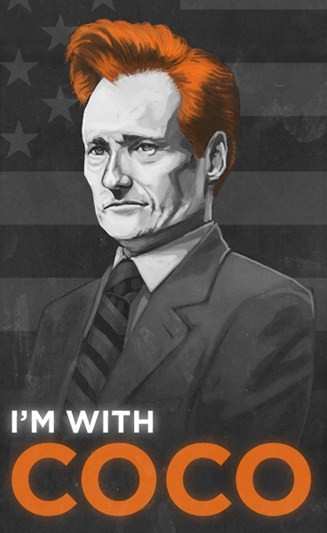
The official logo of Conan O’Brien’s upcoming Legally Prohibited from Being Funny On Television tour is based on the now-familiar illustration of a stoic O’Brien standing against the American flag, gray but for the bold orange pompadour rising from his head like a mighty wave rising from the ocean.  It may be the icon of Team CoCo, but it didn’t come from Team CoCo: the graphic was created by Mike Mitchell, an enthusiastic artist who had nothing to do with O’Brien other than being an avid fan with an idea and some spare time.

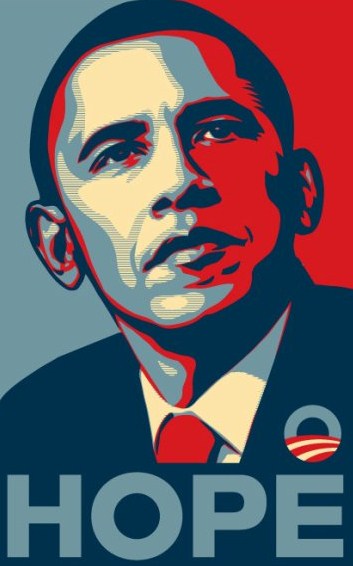
Largely on the back of the massive outpouring of support he enjoyed in the final weeks of his Tonight Show run, O’Brien stands to make a lot of money wherever he lands this fall.  O’Brien will be rewarded for embracing that organic excitement.  It’s similar to the smart moves made by the 2008 Obama Campaign, which enjoyed the creation of a similar iconic image created by Shepherd Fairey – an enthusiastic artist who had nothing to do with the campaign, but had an idea and some spare time.

A technical term for this is “advocate-generated content.”  Even that mouthful is easier said than done.  You can’t force people to identify with a cause, let alone feel so strongly about it that they are willing to make art.  Both Team CoCo and Obama 2008 benefited from a simple, direct, and resonant message.  The fancy artwork was just a symptom.

The Obama base

USA Today wonders about Barack Obama’s base being “disengaged” come 2012.  That may make the presidential election closer than it would have been otherwise, but it won’t tip the scales in favor of a Republican challenger.

George W. Bush had a similar problem in 2003.  Conservatives were grumbling about education reforms and the prescription drug benefit; there was even a healthy dose of disagreement on the Iraq war.  For many, it meant sitting on their hands – and one conservative writer even told me he voted for John Kerry because he felt anyone would be better than Bush.

Bush did, however, have a brilliant campaign apparatus in place and enough excited activists to overlook some specific policy disagreements.  Initially, it seems Obama can boast the same.

If Dick Cheney is to be turned into a prophet, it will not be due to former loyalists losing faith; more likely, it will be because independent voters don’t buy what those loyalists are selling, Obama may join the ranks of the unemployed.  A GOP version of John Kerry – or, to avoid crossing party lines, a re-enactment of Bob Dole’s uninspired 1996 campaign – will still run into a buzz saw.

Yes we can differentiate between crazy people

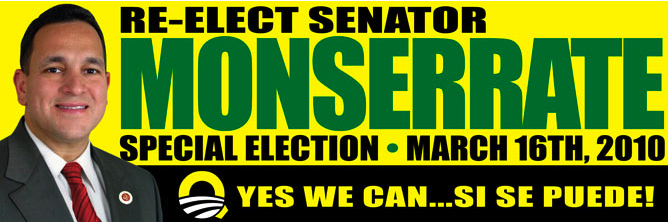
The Southern Poverty Law Center paints anarchist extremists with the same brush as tea partiers and small-government enthusiasts.  I wonder if they draw the same lines between President Barack Obama and New York State Senate candidate Hiram Monserrate.

Monserratte – or “Monster Rat,” according to the New York Daily News – is running for re-election to the state senate seat he was kicked out of last month for his unconventional domestic conflict resolution methods.

His campaign slogan for next week’s special election is “Yes We Can,” and his paraphernalia features the Obama ’08 logo prominently.  The DNC has told him to knock it off, but it’s not clear if there’s really anything they can do – at least, not in time for the election.  (And if they do, they better get their arms over their faces quick, Monserrate reportedly likes to get stabby with broken glass.)

One can either accept that there are crazy people in both parties or we can take the extremists on both ends as the norm, but certainly neither side has a monopoly.  Despite best efforts by either side to brand opponents by the lunatic fringe, crazy may be the only place to find true bipartisanship.