Flubs of Steele

Michael Steele shouldn’t have blamed his recent fundraising flaps on racism.  Luckily, he didn’t, despite the headlines crawling around today

Watch the clip: Race was actually brought into the discussion as part of a viewer question, which Steele answered honestly – and, to be fair, correctly.

Maybe Steele should have been a little clearer on the fact that he was speaking broadly about the fact that, although we have come pretty far in this country, black people still get the crap end of the stick more than they should.  He did bring it up as a bipartisan issue.

But his out-of-context quote has been framed to sound like an excuse and repeated over and over.  Any person who wrote a headline – or worse, a story – that implied that Steele was hiding behind race for the recent RNC scandal is either a political hack or a bad journalist.  (And ABC’s own site, which claimed Steele “played the race card today,” is no better.)

Again, watch the clip.

Last week the New York Times went over the top, implying that anyone who opposes government-run health care might as well be hanging with Ed Norton and Edward Furlong and giving out curb smileys to anyone who rooted for the Lakers over the Celtics in the 1980s.  In comparison, Steele’s mild observation is a much more reasoned and well-thought-out social commentary on race relations.

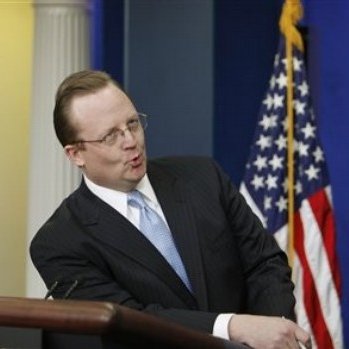
Thankfully, the White House’s Robert Gibbs set everything straight during the daily press briefing, calling the concept that black people and white people are treated different “fairly silly.”

Because there could be no better expert on race relations than this guy:
Bringing the politics to you

Minnesota Governor/2012 Presidential hopeful Tim Pawlenty is holding a  town hall meeting tomorrow.  Last night, California Senate candidate Chuck DeVore held a fundraiser with Andrew Breitbart.

You can go to either of these events without being in Minnesota or California – both will be online.  (Though, if you want to attend the DeVore event, you’re going to have to also find a way to channel 1.21 gigawatts into the flux capacitor, which may cost more than the $50 minimum donation.)

In Pawlenty’s case, the two-term governor is attempting to build a national base in advance of his 2012 run for the White House.  For people nosing around and still feeling out the contenders, it’s a low barrier of entry.   With the first primaries still more than 20 months away, Pawlenty wisely doesn’t want to burn out his activists; at the same time he wants to start building a list of engaged supporters.  Some of his likely primary opponents (like Mitt Romney, Mike Huckabee, and maybe Sarah Palin) already have exposure and campaign infrastructure from 2008.  The town hall could help Pawlenty catch up and – maybe even more important – allows him to build the perception of his candidacy being more firmly rooted in ideas than personality.

DeVore is trying to broaden his base, too – and continue extending his brand as one of the leaders among Republicans in the use of online tactics.  Thus far in the primary, DeVore has been the Martin Short of the Three Amigos running for the Republican nomination.  (If you’re wondering, Steve Martin was the best Amigo, followed closely by Chevy Chase.  Barbara Boxer is already El Guapo.)  The virtual pizza party may not put him on the Republican ticket to face Boxer in 2010, but it’s a good idea – one that could help other Republicans in 2010 or even DeVore himself in a future race.  After all, winning campaigns aren’t the only ones with good ideas.

Now America loves health care reform

In a reversal not seen since Springfield decided they loved the Burlesque House, poll numbers on the health care bill have just about flipped since its passage, with a small edge favoring the bill.

Those numbers will likely go up in the next few months.  Americans are overwhelmingly satisfied with their own health care, and most of the provisions of the health care legislation will roll out slowly over the next decade.   President Obama’s oh-so-Presidential taunts about health care overhaul – calling on Republicans to “look around” in “two months, six months” – are backed up by the fact that very little will happen in that time.

More evidence that “repeal the deal” would be a loser as a political slogan this November.  But what if the slogan was “finish the job”?

Buried in the bill (and this story on CNN) are limitations on Flex Spending Accounts – personal savings accounts people can use to save money for their own health care.  Along with silly items like taxes on tanning beds and regulations on the McDonald’s dollar menu, there are plenty of gaps in the program administered by our new health overlords.  Why not attack those in the name of making people healthier?

Framing real health reform this way is a winner – after all, as the polls show, America loves to back the winning horse.

Diluting the tea

Claims of racial epithets and gay-bashing have diffused the impact of the crowds that descended on the Capitol last weekend.  The images on TV of citizens rallying by the thousands were amazing; the allegations that some of those citizens used ugly, personal, and unintelligent attacks.

Democrats have used the alleged incidents to criticize tea partiers – and it certainly gives them a convenient way to shift the debate away from the massive amounts of people who showed up to oppose a government-mandated reorganization of the health care system.

Far be it from me to say that Democrats are trying to use race to scare people out of siding with their opposition.  But it wouldn’t be the first time.

The real problem here isn’t what racial epithets may or may not have been used.  Anyone who has worked in legitimate Republican and conservative circles knows that racists tend to be booted out as soon as they are discovered.  The racial arsonists of the left start enough fires on their own, they don’t need any kerosene.

Yesterday, passing healthcare seemed so far away

On Friday, Barack Obama was a one-term President.  The Democrats were swimming upstream against the political current, weighed down by an unpopular health care bill.  Scott Brown’s election meant that the Republicans would sweep the fall elections.

Today, the details of the health care bill are quite inconsequential: despite the fact that many Americans are saying they’d support a candidate who pledged to repeal the deal, Obamacare is now the law of the land.

If you can get past the needless potshots at conservative talk radio and other efforts to prove he’s really one of the cool kids, David Frum’s piece on CNN makes a few tidy points about how hard a straight repeal is:

Some Republicans talk of repealing the whole bill. That’s not very realistic… Will they vote to reopen the “doughnut” hole for prescription drugs for seniors? To allow health insurers to deny coverage to people with pre-existing conditions? To kick millions of people off Medicaid?

Kudos to Frum for the correct spelling of the word “doughnut” – and for laying several policy proposals to fix the bill that was passed last night.

He gets some of the policies wrong, but he gets the big point right: that the one-word campaign of “Repeal!” just won’t cut it.  Republicans will need to have a plan in place to do things Obama promised to do with his health plan – especially reducing cost and expanding access.

Obamacare’s opponents can no longer arguing against an unpopular proposal; they now must argue against an existing entitlement.  Polls may show that many voters opposed the health care overhaul last week, but those who would change the policy must now fight a different battle altogether.

3 Unfortunate Predictions about Health Care

Sunday looks like D-Day for President Obama’s push to overhaul health care.  There is plenty of speculation flying around about votes in the coming days and what those mean for votes in November.

How will health care affect the political environment over the coming eight months?  Some humble predictions:

1. Health care will only be a short-term political liability for Democrats if it doesn’t pass – if it does, it will be a short-term benefit.

The bitter battle over health care is one reason that voters are souring on everybody in Washington.  The sooner that debate is over, the sooner Democrats can focus on things like regulatory reform and passing out money like Jack Nicholson’s Joker in Batman ’89 while asking, “Who do you trust?” – both of which are much easier to craft messages for.

But there’s more than that.  The opposition to Obamacare (both official and unofficial) has highlighted long-term effects for the American health care system and federal budget – unfavorable comparisons to British and Canadian health care systems, excessive cost, and even shortages of care and care givers.  These won’t take effect by November 2010 or even 2012.

If the health care overhaul passes – and the expected state challenges are quick and quiet – Democrats will trumpet their progress for the next three years while accusing Republicans of lies and scare tactics.  Obama is right to link the passage of health care and his party’s political fortunes.

2. It’s probably going to pass, and it doesn’t matter how.

As Dan Flynn opines, the reason there hasn’t been a vote already is because there aren’t enough votes.  Until Nancy Pelosi can amass 216 Democrats to support whatever parliamentary gymnastics she has to do to get a bill through the House, there will not be a vote.  When the vote comes up, bet the house – it’s getting through.

3.  The “Repeal Obamacare” movement will get less traction than one might expect.

Entitlements are the gifts that keep on giving.  They don’t actually help end poverty, they don’t give people a comfortable retirement, and they don’t help people who have lost their jobs find new ones.  They do provide platforms for politicians to promise even more entitlements.  When entitlements fail to fix the problem they were meant to solve (or make it worse), the answer is generally to dump more funding into the failed program.

Even failed programs can be elevated to third-rail status.  Remember the left-wing backlash against President George W. Bush’s Social Security reform?  You can expect a similar reaction to future attempts to roll back Obamacare.

Like Social Security reform, real health care reform – that involves doing more than just getting more people into a broken system – will require a long-term, sustained effort that changes how our culture views our government.

Bonus prediction: By the way, whatever the outcome of the vote on Sunday, people with money will always get the health care they need and want.

Where are the Massholes on health care?

Democrats like to throw it back in Scott Brown’s face that he voted for the Massachusetts health bill back in 2006.  Mitt Romney gets it thrown back in his face a lot, too.  That bill was the Mogwai to the current Gremlin of a proposal that Congress is trying to pass-without-passing.

Those critics don’t like to mention the problems Massachusetts is having now.  And Romney and Brown aren’t about to issue the mea culpa the country needs to hear now.

As Bay State native Dan Flynn chronicles, the Massachusetts plan has increased coverage but also insurance costs.  State treasurer Tim Cahill, a Democrat turned Independent, railed against the plan.

“This has been tried, and it failed,” Romney or Brown could plead of the current incarnation.  “In Massachusetts, we tried this.  It cost the state more, it cost patients more, and though there were more people insured they got less care for their money.”  They might even quote Franklin Roosevelt: “It is common sense to take a method and try it: If it fails, admit it frankly and try another.”

Why no ActRed?

While catching up on my reading, I ran across a TechPresident post on how left-wing groups may be funded in the future through small donations just as ActBlue has helped fund left-wing politicians.  One quote stood out:

It would, in theory, also work on the right side of the spectrum, though there’s no ActBlue equivalent in conservative circles.

True dat.  But the question is, “Why?”

ActBlue came along in 2004, when the model for online fundraising was John McCain’s 1999-2000 primary run against George W. Bush.  Outside of PayPal, there wasn’t much in the way of online infrastructure payments.  ActBlue was like a railroad, building tracks between excited online activists with cash and the candidates who needed it.

Six years later, there isn’t an ActRed, and with good reason.  Campaigns have become sufficiently sophisticated that there’s no mystery to internet fundraising.  (There are also lots of good consultants ready to help.) While internet fundraising in 2004 was like the railroad system, internet fundraising in 2010 is more like the interstate system, with individuals controlling their own destination more directly.

The Obama base

USA Today wonders about Barack Obama’s base being “disengaged” come 2012.  That may make the presidential election closer than it would have been otherwise, but it won’t tip the scales in favor of a Republican challenger.

George W. Bush had a similar problem in 2003.  Conservatives were grumbling about education reforms and the prescription drug benefit; there was even a healthy dose of disagreement on the Iraq war.  For many, it meant sitting on their hands – and one conservative writer even told me he voted for John Kerry because he felt anyone would be better than Bush.

Bush did, however, have a brilliant campaign apparatus in place and enough excited activists to overlook some specific policy disagreements.  Initially, it seems Obama can boast the same.

If Dick Cheney is to be turned into a prophet, it will not be due to former loyalists losing faith; more likely, it will be because independent voters don’t buy what those loyalists are selling, Obama may join the ranks of the unemployed.  A GOP version of John Kerry – or, to avoid crossing party lines, a re-enactment of Bob Dole’s uninspired 1996 campaign – will still run into a buzz saw.

Rove, Rove, Rove your boat

Despite some stirrings on the right, there’s nothing wrong with Matt Lauer’s interview with Karl Rove, part of which aired yesterday morning.  The Today Show host was a bit combative, but journalists are supposed to be that way when talking with political figures.  (And sparring with a Republican is at least better than recycling the same five stories every morning and pretending like something is new.)

Matt Lewis had Rove on his podcast yesterday and came at the interview from a different angle.  If you are a politics junkie, it’s a good interview to listen to.  (For instance, Rove shares a hilarious story of a then-college-aged Lee Atwater’s first meeting with George H.W. Bush.)  It’s definitely worth a listen.