Activating the base so the base activates others

Karl Rove released a brief late last week which demonstrated how over simplistic the idea of “turning out the base” is.

The phrase is political shorthand, but it makes it sound like each election turns on whether dyed-in-the-wool Republicans or Yellow Dog Democrats actually show up to vote.  But as Rove points out, analysis of election results in 2010 and 2008 demonstrate that stalwarts of each party showed up to the polls.  So John McCain’s poor showing in the Presidential election could not be chalked up to Republicans sitting at home, right?

Well, not quite.  Those who strongly identify with one party or another probably do so because of an interest in politics, and are most likely to vote no matter what.   A lack of excitement about a candidate manifests itself in other ways – borderline activists are less likely to go to rallies, make phone calls, or knock on doors if their candidate isn’t exciting.  They’ll still vote, but they’ll do little else to convince others to vote along with them.  Rob Eno of the excellent Massachusetts blog Red Mass Group sums up the need for a good infrastructure based on local activists; that type of activism doesn’t happen if “the base” doesn’t feel like a candidate really represents them.

All of which adds up to less outreach to independents – who are, says Rove, the real collective fulcrum of each election.

The right answer on retirements

Remember when politics was more than a sport?

Years back, I told Matt Lewis I thought candidates were starting to sound too much like strategists.  John Thune fell into that trap with his reaction to the slew of recent Democratic retirements:

“It certainly suggests that the pathway to get to 51 is achievable,” Sen. John Thune (R-S.D.) said Thursday. “I think depending on what happens in the next couple of years and depending on what retirements we have, a lot of these Democrat seats that are opening up, I think there are some opportunities for us — and I hope if we can get the right candidates in the races and resource them, we’ll have a shot at changing the equation.”

Nowhere in Thune’s response is the idea that Republicans could win every seat up for grabs with the ideas that voters are looking for.  He boils it down to an “equation” – a numbers game, as if he’s analyzing fantasy baseball for the MLB network.  Thune would have been better off giving a more general answer about the need to compete in all states, and to focus on working with everyone to make laws that will help out the American people no matter which party wins this election or that election.  It’s not all that quotable, but it’s still better than what was quoted.

It’s true that there are lots of strategic elements that go into winning races.  But speaking about them publicly belittles the fact that for all the microtargeting, get-out-the-vote technology, polling, and positioning, elections are still about ideas.  The techniques of battle don’t change the reason for battle.

And it’s simply poor technique to talk about the machinations of the campaign rather than the ideas.

As the political press covers the horse-race details of campaigns, it’s tempting to use their language and outlook.  But candidates, party leaders, and movement figures have to be above the fray, and their comments have to reflect a commitment to creating policies which benefit the American people rather than building campaigns which outscore the opponent.

Come to think of it, maybe the right kind of media-savvy, unflappable sports star would be a good role model after all.


3 Reasons Why This Is Christie’s Time

Politico reports grumblings out of New Jersey that Governor Chris Christie is mulling the first tentative steps of a Presidential run.  Up to now, Christie has been consistently adamant that he isn’t running, but his candidacy was extremely likely even before this revelation.

The bottom line is that if Chris Christie wants to be President, a 2012 run makes the most political sense for three big reasons:

1.  Christie is well-positioned to deliver the right message for the times.

The protests in Wisconsin may have been a tipping point for Christie, as they look to be the first in a series of clashes between public sector employees unions and the unfortunate realities of states in the upper Midwest, Northeast, Rust Belt, and West Coast whose tax bases are dwindling and whose budget deficits are expanding.  If the abstract concept of reducing government spending was the central theme of 2010, the issue of whom gets what from shrinking government doles will be a recurring discussion leading up to 2012.

How this discussion is framed will go a long way toward deciding how many seats Republicans gain in the Senate and how successful the 2012 GOP candidate is.  Unlike many national elections of recent vintage, 2012 has the potential to pose to the voters a meaningful question about the role and size of government.

Christie has already waged this fight in New Jersey (the only GOP candidate who has done so recently).  But what’s more important than that has been the direct, unapologetic tone he has used in doing so.  With tough financial decisions on the horizon, Christie has become Mr. Tough Love – and unlike most successful politicians, he has not shied from confrontation.

If the momentum from the tea partiers continues into 2012, and there remains a swath of the Republican electorate that still feels government is not working for them, is there a better person to lead the charge against entitlements and special interest groups – and get rank-and-file Republicans excited about it – than Christie?

2.  Christie’s larger-than-life personality can go head-to-head versus President Obama.

That isn’t a fat joke.  It is a recognition that the sitting President enjoyed a huge charisma advantage over all his opponents in 2008, and the electorate still likes him.  Why not?  He’s a cool guy, he fills out an NCAA bracket every year, and he jokes around about salmon during his addresses to Congress.  More important, he still has a remarkable campaign infrastructure in place and is well-positioned to take on any Republican who can’t provide some level of excitement.

But he also has trouble with confrontation.  From the town halls of 2009 to the tea parties of 2010, President Obama has consistently shown that a full frontal assault on his initiatives is the best way to throw him and his administration off their talking points.  Christie’s blunt style seems best suited for flustering the President – and making the election narrative follow the script Christie sets out.

3.  Christie is popular among Republicans now, but political memories are short.

Hillary Clinton might have been President if she had run in 2004 – President George W. Bush squeaked out a reelection victory over a challenger who looked like a sad puppytalked like the Mayor from T’was the Night Before Christmas, and provided precious few reasons to switch horses.  By 2008, she had become Washington establishment – part of the problem that the Obama campaign sought to solve.

Her husband, of course, beat the first President Bush in 1992, less than two years after the incumbent enjoyed record-high 90% approval ratings.

In between 2012 and 2016, there are plenty of things that could go wrong for Christie.  His hold on the blue New Jersey electorate could slip, he could enter into a legislative compromise that sours his standing among social conservatives, or he could simply become yesterday’s news with a lost reelection bid 2013.

Christie running in 2012 isn’t just a convenient answer for Republicans looking for a leader.  Second chances in presidential campaigns are rare.

The biggest obstacle to Christie’s candidacy will of course be his promises that he won’t run.  His denials have been just as adamant as Barack Obama’s in 2006, and getting around the statement “I swear I’m not running” is one of the easiest maneuvers in politics.  If anyone could get away with, “eh, I changed my mind” as a response, Christie’s the one to do it.
When is boycotting CPAC the smart move?

On Friday, Jim DeMint announced he will boycott CPAC.  He joins a host of conservative organizations – including the Heritage Foundation and the Media Research Center – who have decided not to attend this year’s event and Congressman Jim Jordan, head of the conservative Republican Study Committee in the House.

For an inside the beltway conservative organization, CPAC is a place to be seen by activists – mostly students – coming in from across the country.  It’s a rare chance to be face to face with members, participants or supporters of your organization – people you may only communicate with via email or phone.  And because it’s such a rare chance, it costs money – lots of it.  Beyond the thousands in sponsorship and/or booth rental fees, an organization has to put lots of thought and resources into making their booth stand out.  Giveaway items, multimedia displays, and other amenities cost money – to say nothing of staff time.

It’s not a prohibitive or unwise investment, but it is an investment.

On the other hand, for a group with a limited budget, boycotting CPAC can separate you a bit from the crowd.  Articles and blog posts about your boycott will likely get into the hands of activists who care about your issue.  If you are one of hundreds of booths in CPAC’s main hall, you may not be able to cut through the noise in quite the same way.

For the politicians who don’t go, it’s also a win-win.  For DeMint, who has crafted a brand as a gadfly against Republican leadership, bowing out aligns him against an inside-the-beltway professional conservative movement.  For tea party activists who paint the entire Washington crowd with the same brush, DeMint and Jordan become horses of a different color.

And the reality is that the Washington, DC version of CPAC isn’t nearly as important as it was 20 years ago, before communication between outside the beltway activists became as easy as it is today.  In its first decades of existence, CPAC could have helped set the conservative message for an entire year or election cycle.  For conservative activists, CPAC might be a rare time to hear from Presidential hopefuls early on, before their campaign started in earnest. But this is a different time.  The era of 24/7 news means campaign themes and messages for 2012 might not be set until weeks or months before – after all, who would have predicted in February of 2007 that a late financial crisis would tip the scales for Barack Obama in 2008?  (In fact, who would have predicted at that time Obama would be the nominee?)  The shorter news cycles have extended Presidential campaigns – meaning that 2012 contenders will be crisscrossing early target states like New Hampshire, Iowa, and South Carolina within six months.  There will be no shortage of chances to hear from Mitt Romney, Mike Huckabee, and Sarah Palin.

CPAC is still important; but in the modern media environment, it simply cannot be as important as it once was.  CPAC may still be the conservative movement’s biggest stage, but it’s hardly the only stage anymore.

How the GOP could heart Huckabee


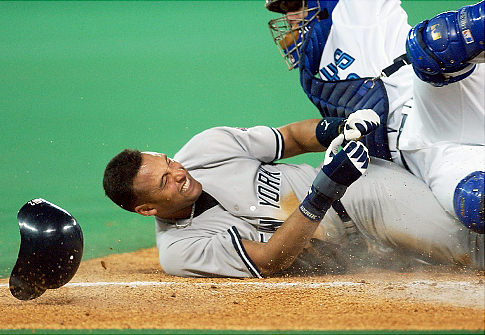
(Image from the NY Daily News) Ken Huckaby injures Derek Jeter with a knee to the shoulder on Opening Day, 2003. Though this play had no material effect on the Yankees' 2003 season or Jeter's career and Huckaby is no relation to Mike Huckabee, the world needs to remember that this happened.

In 2008, Republican Presidential candidates climbed all over one another to compare themselves to Ronald Reagan.  It’s a sorry speech to give when the best case you have to convince voters is to try to reduce a dead President (even a great one) to a buzzword.  But if Mike Huckabee does find a way to the Republican nomination (and Politico reports the polls look good for him) he would at least be able to draw a comparison between himself and Reagan on their respective political paths.


During his oh-so-close 1976 primary challenge to former President Gerald Ford, Reagan was clearly identified in the mold of Barry Goldwater’s limited government, libertarian-themed brand of conservatism.  His 1980 path to victory was made possible by heavy inroads to southern social conservatives – then called the “Moral Majority” and today categorized as “values voters” – and convincing them to abandon favorite son Jimmy Carter.  Huckabee’s second-place showing in 2008 came from conservatives uneasy about supporting John McCain (or socially liberal Rudy Giuliani or Mormon Mitt Romney).

After being the voice of social conservatives in 2008, Huckabee’s path to the nomination in 2012 will mean courting the small-government voices – who, like the values voters from 1976-1980, have become more organized and vocal through the tea party movement.

From a policy perspective, that may not be hard for Huckabee.  Other candidates (as Politico notes) supported TARP while Huckabee opposed it, and his chief rival Romney has the albatross of his Massachusetts health care plan.

Easy right?  Not so fast.  For as much hype as the tea party received, the Club for Growth flexed some pretty big muscles in the 2010 thanks to their small-government, anti-establishment message taking a strong foothold among grassroots activists – and the Club is no friend to Huckabee.  While the Club as an organization probably couldn’t make or break a Huckabee candidacy, garnering support among Club supporters will be critical if Huckabee wants to have a legitimate comparison between himself and the Great Communicator.

Anuzis challenges Steele

The Weekly Standard caught a tweet from Saul Anuzis, the former Michigan Republican Party chairman, saying he will again run for RNC Chair.  He will probably not be the only challenger to incumbent Michael Steele.

Steele seemed like a good fit for the job when he bested five rivals – including Anuzis – in January 2009 in a grueling, multi-ballot race.  He provided much-needed racial diversity to the ranks of the Republican talking heads and brought blue-state credibility.  On the heels of the 2008 shellacking, the Republicans badly needed to demonstrate they were more than a party of white southerners.

From the beginning, there were whispers about Steele’s lack of conservative street cred.  Where Steele has drawn criticism, though, has been in the “blocking and tackling” – the basic elements of a party chair’s job, like fundraising and building a GOTV infrastructure.  (In fact, Anuzis uses just that term.)  After a six-way race for the chairmanship, criticism was inevitable for whoever won, but Steel made it easier.  The whispers in Republican circles (which “unnamed sources” give voice to in the Weekly Standard piece) is that the 2010 gains should have been bigger.

In his announcement, Anuzis channels the 2008 McCain campaign (which poked at then-candidate Obama’s quasi-celebrity status):

My agenda is very straightforward. I have no interest in running for office. I won’t be writing a book.  It is not my goal to be famous. However, you’ll be hard pressed to find anyone who will work harder, more diligently and be more committed to electing Republicans from the top to every township and city across this great country of ours.

It isn’t worth including at this point in the campaign, but Anuzis has another bullet left in his chamber: his background in digital politics.  As the race for RNC chair heats up, look for Anuzis to use this – accompanied by criticism of the failed initial launch of GOP.com – to separate himself from the pack.

You can’t keep the People’s Seat without the people

Politico points to dismal results for Republicans in Massachusetts as a good indication that Scott Brown might not be a Senator much longer.  But a post by NRO’s Jim Geraghty recounting some intelligence from New England indicates that it may be more than the Bay State’s penchant for Democrats at play.

Geraghty’s source talks about the unified effort that Democrats and their organized labor allies made in contacting nearly a million voters to stave off another Brown-esque upset.  But the phenomenon is not exclusive to Massachusetts.  For example, in Nevada, Washington, and Colorado Democrats defended vulnerable Senate seats by outperforming opinion polls that showed either a tie or a Republican advantage.

When Brown won his election, it had much to do with enthused Republican activists (nationally as well as in Massachusetts) sensing an opportunity and paying lots of attention to the race by making phone calls or going door to door to recruit voters.  In past midterm elections, the the Republican 72-hour Task Force would do the necessary grunt work to get voters to the polls.  That effort was missing this year – and nothing takes it’s place in 2012, Brown may not be the only Republican Senator in trouble.

Same election, two messages

In the week of fallout since the most recent ground-shaking election day, Democrats and Republicans alike have been on the airwaves, trying to put it in context.  But have you looked at their postmortems side-by-side?

Marco Rubio owned the GOP message on election night:

But we know that tonight, the power in the United States House of Representatives will change hands. We know tonight that a growing number of Republicans will now serve in the Senate as well. And we make a grave mistake if we believe that tonight these results are somehow an embrace of the Republican Party.

What they are is a second chance. A second chance for Republicans to be what they said they were going to be not so long ago. You see, I learned early on in this campaign – in fact it’s what propelled me to enter it – that what this race was about was about the great future that lies ahead for our country, a future that Americans know is there for the taking. But it requires actions on our part.

The theme of the Majority That Lost Its Way has been a consistent message for Republicans since 2006 – in fact, less than a year into the Pelosi Era, Rep. Tom Feeney argued that a philosophically adrift GOP had squandered its power:

We lost the majority in 2006 because Republicans could no longer convince voters that we were the party of fiscal restraint and traditional values. Polls in the closing days of the last election showed that a majority of voters felt that Democrats were more trustworthy when it came to issues of spending, taxation and general economic development — that we could no longer be trusted to fight for the limited government and personal freedom that have always been cornerstones of our party’s beliefs.

Contrast that to the Democrats’ lines about “what it all meant” – including the President, who has been vocal in chalking up the Democrats’ failures to messaging strategy:

What I didn’t effectively, I think, drive home, is that we were taking these steps not because of some theory that we wanted to expand government. It was because we had an emergency situation and we wanted to make sure the economy didn’t go off a cliff. I think the Republicans were able to paint my governing philosophy as a classic, traditional, big government liberal. And that’s not something that the American people want.

The first obvious thing is that Republicans, even now, seem contrite for driving the car into the ditch when they held most of the keys from 2001-2007.  Since Democrats haven’t had the benefit of time – and still have the responsibility of governing – contrition may simply be a luxury they can’t afford at the moment.  Still, the difference in where each party lays blame for still-somewhat-recent losses is stark: Republicans blame themselves for not living up to the expectations of the people, Democrats blame the perception that they didn’t meet expectations.

Another underlying current worth noting in all of these quotes is that, despite apparent sea change in the election of 2008, America remains a nation that trends philosophically toward smaller government – with both parties trying to frame their arguments through that prism.


The race for 2012 started last week

With the mid-term elections fresh in the rear view mirror, the serious contenders for the 2012 Presidential nomination are unofficially kicking off their campaigns.  And the two likely front runners, Tim Pawlenty and Mitt Romney, have started with a pretty smart Facebook strategy.

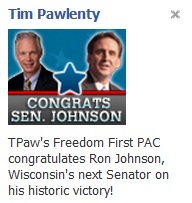
At TechRepublican, Ethan Demme noticed Mitt Romney’s new Facebook ads running immediately after the election, congratulating “high profile” candidates.  Tim Pawlenty has been doing the same thing.  But the strategy appears to be even more specific than that.  Here are the ads I saw:

What does incoming Arkansas Congressman Tim Griffin have in common with the Feingold-conquering Wisconsonite Senator-elect Ron Johnson?  Turns out, I’ve clicked “like” on both of their Facebook pages.  (I’ve also seen Romney ads supporting former and future Iowa Governor Terry Branstad, whose Facebook page I’ve also liked.)  In other words, I’m a self-identified supporter of these politicians – a factor that Facebook’s ad platform allows campaigns to take into account when they target advertising.

By playing on the interest of possible supporters, Romney and Pawlenty share an excellent outreach strategy.  The question will become what each campaign does with the supporters they recruit.  Pawlenty has already made a push to take advantage of Facebook’s capability for activation through interactive town halls, while Romney’s page is more or less a one-way communications channel – but neither has taken a decisive lead in innovation on this platform.

A Purple Congress: The best of all possible outcomes

Last night’s results – a historic wave of pickups in the House along with key gains that did not achieve a majority in the Senate – is the best possible playing field for Republicans nationally.

The reality of the Senate results is that the electoral map was bad for the Republicans in 2010 – but in 2012, counting independent seats in Vermont and Connecticut, Democrats are defending 23 of 33 seats up for re-election, with only one or two Republican seats obvious pickup opportunities.  (Plus, the Tea Party successes of 2010 should serve as a cautionary tale to incumbents like Orrin Hatch, who might not make the same mistakes that candidates like Mike Castle did.)

The Republicans did, however, scored a convincing win, and now control a legislative body – an important factor in a nation that buys as many Yankees, Cowboys, and Lakers hats as America does.

That means that Republicans can be proactive legislatively, and articulate a vision for the nation. And it also means that vision will run into a legislative buzz saw, because the Democrats control the other half of Congress and the veto pen.  In that fog of sawdust, who becomes the “Party of ‘No'”?

The GOP is in the enviable position of being, to paraphrase Reggie Jackson, the underdog and the overdog at the same time.

Of course, this means putting forward policies, and as the Democrats discovered, once you put something on paper it becomes a target.  And two years is, apparently, an eternity in politics.  But if Republicans can position themselves as the active minority party, their chances in the Presidential and Senate elections in 2012 will greatly improve.