Senators make privacy demands to Google

Oh, sorry, that’s Facebook, whose tentacles are constantly expanding throughout the web, but not in Washington.  Sen. Charles Schumer and colleagues have posted an open letter on Facebook’s wall demanding to know just how the social network’s privacy options work.

In the meantime, Google continues to track, store, and process user data from various points in order to build advertising profiles – a practice which raises concerns not only about privacy, but about reach.  In fact, Google’s signature service, search, has a much lower barrier to entry than Facebook’s; while Facebook makes you create an account and is thematically based on the idea of sharing personal information, Google’s search service is open to anyone trackable by IP address.

So why does Facebook get a nasty letter while Google gets a pass?

It may have something to do with the fact that Google spent $1.38 million on lobbying in the first quarter of 2010 alone.  More significant than the actual dollars spent is the intellectual investment: Google has clearly made it a priority to be a Washington, DC player on both sides of the aisle.  This level of involvement positions Google as a resource, preventing policymakers from seeing what is an obvious parallel.

How do you like that? Facebook and microtargeting

This was a big week for Facebook, which stepped up its presence in the battle with Google to control the internet on computers.  (This is slightly different from the battle to control the internet through your phone or the internet through your TV or the battle control the internet through the cord surgically affixed to your brain stem.)

By spreading tentacles throughout the web, Facebook will latch your profile more closely to your online activity.  Sure, it’s a little creepy, but it’s also voluntary; no one has to have a Facebook account after all.

Setting aside privacy concerns, this is a really big [BIDEN] deal in a year when political insurgency is all the rage (no pun intended).  In a great post at TechRepublican, Jordan Raynor outlines how establishment political support (such as Florida Governor Charlie Crist enjoyed a few months ago) can be trumped by a campaign which connects directly with supporters and leverages that energy to create its own momentum.

Facebook is going to become a better and better place to do that – providing in 2010 and 2012 what the concept of microtargeting was in 2002 and 2004.  In those years, Republicans used consumer data to identify potential supporters – if you shop at a certain place and subscribe to certain magazines, for instance, you might fit a profile of a Republican voter.

Now, you can profile your supporters (who may or may not belong to your party) and directly serve them online ads.  The possibilities are pretty exciting – unless you’re sick of political ads.

You will be.  You will be.

Automatic to the People

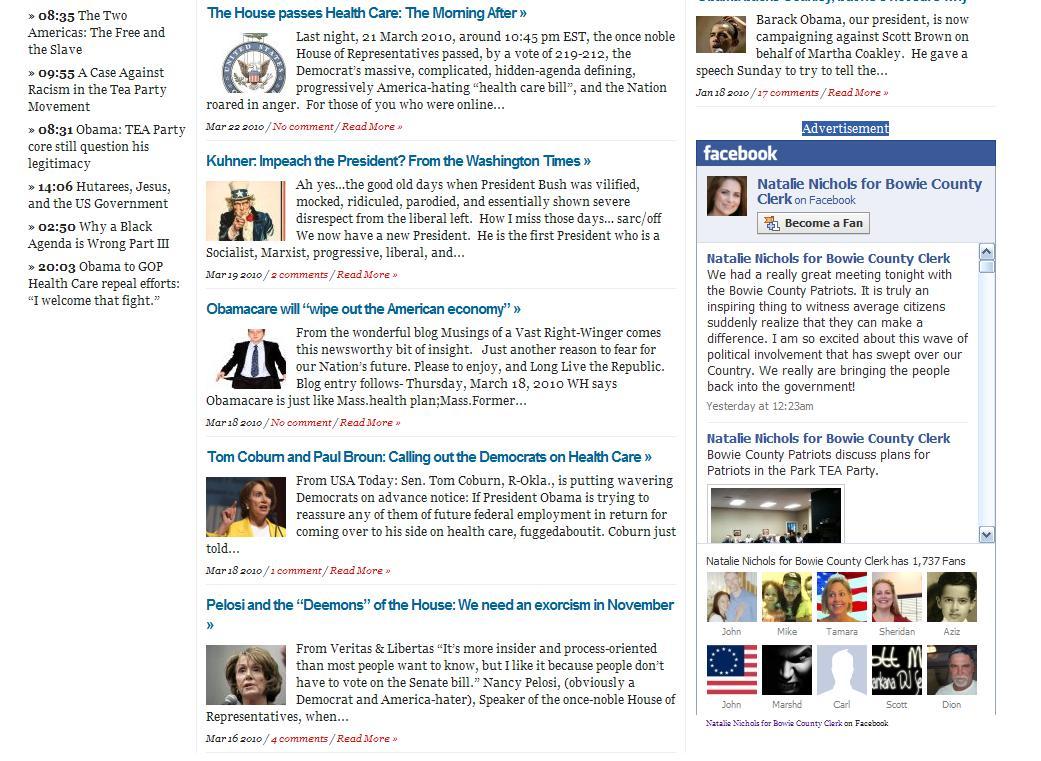
Readers of Political Integrity Now – or, most likely, any of several other websites – may have caught a nifty advertising tactic from Natalie Nichols, who’s running for Clerk down in Bowie County, Texas.  Nichols’s campaign is using ads to direct people right to her Facebook page through a Fan Box.

Facebook created Fan Box widgets to let visitors of a given website see the corresponding fan page without having to click through or anything.  Nichols is putting her Fan Box on other people’s networks by making it the creative of her ad campaign:

Nichols has a nice looking website, so why wouldn’t she just direct people back there and wow them with the flashy design?  Because as impressive as it may look, people don’t visit Nichols’ campaign website every day.  Many do visit Facebook every day.  By directing people to the Facebook page, Nichols is getting people where they already operate.  People who join her Facebook fan page are probably more likely to take further action down the road than folks who sign up for an email list and then forget two days later.

The Facebook Fan Box also has an advantages that shouldn’t be overlooked: it shows the pictures of people who have joined up.  People are hard-wired to look for images of other people, and ads which feature people tend to draw our eyes more successfully.  Nichols didn’t even have to design such an ad – she let the fan box do the work.

Best of all, readers of Political Integrity Now – or any other site on which the Fan Box appears – can join the cause in one click.  Thus they are able to take a small yet significant action without leaving the site they were on in the first place.

Playing “What If”: A political privacy scandal

Successes of the past five or six years have made online grassroots outreach an absolute necessity for any serious campaign for major office.  And every day, the possibilities for online activism multiply in seemingly exponential rates.  The art of the online possible has grown from a framed wall painting into the Sistine Chapel, and the smart campaigns kept up.

Sadly, that’s probably where the problems will come from.

Consider mashups like Checkin Mania – a site that merges information various location-based networks and Google Maps.   Sites which merge data from various sources are popular with users because they can consolidate information – in this case, it helps you find your friends,  even if one is using Gowalla and another is using Foursquare.  The next “revolutionary” campaign will likely have components like this; when you sign up for Obama/Biden 2012 (or Pawlenty 2012, or Romney 2012, or Zombie Reagan 2012) you would have the ability to link other services as well.  In fact, you might even be able to sign up with Facebook Connect, immediately linking your Facebook profile and all other information that you reveal somewhat publicly.

Now, here’s where the what-ifs get interesting.

This means there will be lots of information flowing around not only the campaign site, but to and from several interconnected sites.  Leaks and mistakes are inevitable, and not from hackers – from random items being posted to networks the user did not intend to post them to.  It may mean embarrassing Facebook pictures being shared on the campaign site; it may means your meeting at the bondage club gets tweeted to your Twitter following.

Sound too far-fetched?  Facebook gets knocked for privacy violations every few months – most recently for an information-sharing in their privacy policyGoogle  Buzz was famously lazy about privacy considerations in its rollout.  And they optimize user experiences in social networks for a living, that’s how they earn their food money.

These mistakes come from innovation – designers trying to come up with ways to make the sites and services they offer easier.  Campaign tech teams worth their salt do the same – the lower the barrier to entry, the more supporters you can attract.

When you have a political team that – like Facebook’s development group – gets starry-eyed while looking at the art of the possible, some details on that fresco are bound to be missed.  When they are, the opposing campaign will be ready to pounce.

This isn’t to say campaigns should stop innovating.  But the “what if” game is an important part of innovating in the high stakes environment of political campaigns.  Privacy is becoming an ever more important issue on the web.  If companies like Google and Facebook have to be ready for these concerns, campaigns must be ready as well.
Where you at?

Facebook plans to add a feature that would let you keep tabs on your friends’ locations (and vice versa).  Like many of Facebook’s tweaks in recent years, this isn’t original – many of the next wave of social networking tools are location-based.

Details are still forthcoming, but the evolution of location data in social networking will be particularly interesting.  As Facebook has learned – and as Google found out when it unveiled its Buzz tool – just because we like to share stuff about our lives doesn’t mean we want to surrender our privacy.  In fact, we want to have the opportunity to separate a little from our digital selves now and again.  Location data chips away a little bit more of that wall.

The utility is pretty clear for businesses, politicians, social butterflies, and other folks who want to be found.  (And it’s also pretty clear for Facebook, which can now allow brick-and-mortar stores to serve ads to people near their physical location.)  To make it worth their while, Facebook and others would be smart to make location data available as a one-way street: to let me find out who’s close to me without letting them know where I am.

This week’s buzz about Google

I joined Google Buzz this week.  It was easy – I didn’t have to do anything except log in to GMail.  Google had transformed my private email – including my contact list (which it automatically populates based on my email traffic) into a social networking experience, a hybrid of Facebook and Twitter.  After several privacy complaints, Google made opting out of certain features a bit easier.  It’s still a little creepy.

Tellingly, Buzz allows you to integrate your Twitter feed but not for Facebook profile – another sign of the coming Armageddon between Google and Facebook, which Google will likely get to right after their fight with Apple and possibly after their fight with Microsoft.

How big is Google?  There were three separate stories about Google which made headlines this week.  That’s not three articles – but three separate issues which made news independent of each other.  First was the aforementioned Google Buzz; second was Google’s plan to become an internet service provider; and now comes news that Google is butting heads with the Department of Justice over intellectual property rights of authors as part of their ongoing effort  to become a latter-day, digital Library of Alexandria.

That these are all separate issues leads to them becoming one issue.  Google is seeking to define how you get to the internet, how you communicate with others, and what information/content you receive.  If this scenario continues on the same logical course, Google would become to the internet what AT&T was to the telephone networks before it was broken up by a federal antitrust suit in 1984.

Is Google at risk of an anti-trust lawsuit?  Possibly, but they have certainly done their best to make inroads with the government that would prevent that from happening.  The relationship between Google and the current administration is well-documented.

And if you believe the balance of power in Washington will tip back to Republicans in 2010 or 2012, Google is ready for that to – they are sponsoring TechRepublican’s Digital Boot Camp at CPAC this year.

Two campaign tools you don’t have to pay for

Google Wave is still a mystery to many folks – I have to confess, I haven’t spend a considerable amount of time pondering its potential yet.  But Wes Donehue of TechRepublican has, and he shares some ways to use this new tool for a cause or campaign:

Also at TechRepublican today: Jeff Vreeland has a good idea about using Facebook as a email match program.  Amassing email addresses has become a basic function of any organized effort, but an email address alone is worth little.  Using that information as a springboard for connecting on other platforms can help draw potential volunteers and donors into the fold.

A Facebook app for the rest of us!

Digital public affairs firm Grassroots Enterprises launched a Facebook application which allows users to celebrate Festivus – the annual holiday which involves an unadorned aluminum pole, Feats of Strength, and – most importantly – the airing of grievances. Grassroots Enterprises has focused on that last one, allowing you to tell your Facebook friends that, in the words of Frank Costanza, “I got a lot of problems with you people.”

The app itself is fun, and shows prospective clients what Grassroots Enterprises can do. Plus, it’s a great way to celebrate this storied holiday.

Isolation brings people together

This past weekend dropped a foot and a half of snow (or more) on the Washington, D.C. are.  And since six inches is enough to grind Your Nation’s Capital to a halt, the Blizzard of ’09 was dubbed the DC Snowpocalypse.

The weather event was a fitting way to end a year that has seen an increased level of attention paid to online social networks.  Those of us glued to the local NBC news coverage found elfin weekend meteorologist Chuck Bell giddily inviting users to get involved by emailing him pictures and name suggestions (his favorite was “Shopper Stopper”).  A Snowpocalypse page quickly popped up on Facebook, and those on Twitter used the hashtags #snOMG and #DCsnowpocalypse to discuss the onslaught.

It’s in the dictionary now, and can’t be “unworded”

The verb “unfriend” is in the Oxford American Dictionary Word of the Year.  (It is also now officially a word.)

Of all the verbiage to come out of social networking and new online environments, it’s interesting that unfriend – the negative act of rescinding a connection – takes this honor.  The inclusion and exclusion of words in dictionaries is more a measure of culture than technology – technology creates new terms every day, but to be included in popular language those terms must have a crossover appeal that removes them from the realm of technical jargon and into the realm of word you might read in a newspaper article.

When most of us “unfriend” someone, it’s not because of an offline relationship that has gone south, but because the online relationship was more than we could handle.  Anyone with a Facebook account has had the friend who constantly sends requests or shares too much information.  Most people on Twitter have followed a friend who peppered their feeds with such witticisms as, “Making a sandwich and can’t decide – grape or strawberry jelly?!?”  Speaking of Twitter, after a spike earlier this year their new user numbers seem to be leveling off,and big companies that were excited to enter the medium have become absentee Tweeters.

In other words, we are settling into these new online environments by shifting from the mindset of signing up every new and shiny community or connecting with every long-lost high school class.  Perhaps we are getting better, both in terms of who we connect with and where we connect, at prioritizing what is best and most useful for us individually – and unfriending the rest.