When the Superbowl isn’t the Superbowl

A few years back, the late Mark McCormack – a key figure in the sports marketing industry and, by some accounts, the basis for the character Jerry Maguire – wrote an excellent business book, Never Wrestle With a Pig.  It outlines various rules for succeeding in a professional career, one of which is to prepare for what McCormack calls “your Superbowl” – a key event which puts your talents on display.  For a campaign, that’s Election Day, for a conservative organization looking to make a splash, it might be CPAC.  In the big brand advertising world, the “Superbowl” was, well, the Superbowl for decades.

In what is a telling sign of the evolving media landscape, big brands like Pepsi and GM are sitting out the Superbowl this year.  Even as ad prices tick downward slightly, Pepsi chose to invest $20 million in a social media campaign instead.

In many ways, corporate advertising is becoming more like a political campaign.  Successful political operations use broad-based communication – like TV and radio ads – to raise name recognition, but as election day nears they focus on contact with individual voters with targeted messages (those solidly in a candidate’s camp are reminded to get to the polls on election day, while those identified as being on the fence are coaxed onto one side or the other).

Pepsi is the second-best selling soft drink in America.  That’s a great spot to be in – it means selling an awful lot of soda.  But it also means that there are plenty of people who, no matter what, aren’t going to buy your product.  Pepsi could get in front of millions upon millions of pairs of eyeballs with a Super Bowl ad, but would those eyeballs be attached to tongues which desire Pepsi?  Or would their entertaining commercials be laughed at and talked about by people who, at halftime, would still reach for a Coke?

Pepsi first claimed to be the choice of a new generation in commercials which approximately one generation ago, but more recent branding has labeled Pepsi as “forever young.” Their advertising strategy has evolved, too (though they surely hope the comparison of Will.i.am to Bob Dylan isn’t congruent to the comparison of their new strategy to their old one).

Sine we’re all wondering, there’s still no word yet on how all this affects Bud Bowl…

Taxing creatively to subsidize creativity

A government report in France has proposed taxing internet advertising to subsidize creativity:

France could start taxing Internet advertising revenues from online giants such as Google, using the funds to support creative industries that have been hit by the digital revolution, a newspaper reported on Thursday… The levy, which would also apply to other operators such as MSN and Yahoo, would put an end to “enrichment without any limit or compensation,” newspaper Liberation quoted Guillaume Cerutti, one of the authors of the report, as saying.

The reasoning, apparently, is that internet giants provide a bridge between users and free content – reaping  rewards through advertising dollars while content creators are left out in the cold.  While those content creators should have the right to control access to their products, this scheme doesn’t come close to doing that; it does, however, limit internet platforms that more creative artists might use to gain exposure.

Google has it’s problems, but no one can debate that their business model is creative.  Google monetizes free stuff – from search to email and calendar applications to information tracking – by collecting information at every step of the way and using it to fuel a highly targeted and personalized advertising platform.

The ill-conceived subsidy outlined in the report, on the other hand, taxes that money to funnel money to the music industry.  In other words, the report lays out a system that rewards content generators who aren’t creative enough to figure out a way to monetize their product.

Bad news for old school papers

The troubles of traditional print newspapers, including those in major metropolitan areas, is well documented – with news consumers moving toward online sources, advertisers are less likely to buy space in printed periodicals.  Unfortunately for most news organizations, it turns out that the advertisers are not moving online along with the readers – even though online advertising spending continues to rise.  If you consider the way ads are displayed on newspaper websites, and internet advertising models, it makes sense.

Back when print advertising was all the rage – in the olden times before 1997 or so – the model for effective advertising was fairly simple: you bought space in a publication that matched your target demographic.  If you were a Boston-based business, for instance, that meant advertising in the Boston Globe or the Herald.  It was expensive, but you were paying for exposure – the more pairs of eyes would look at your ads, the more customers you would get at the other end of the funnel. When you paid your advertising dollars, you paid for exposure.

Online advertising has changed that model in every way imaginable, especially search advertising.  When you buy search ads today on Google or Bing, you pay based on how many people click on your ads.  That creates an extra incentive for the search engine folks to put your text ads in places where people are most likely to click.  With search advertising, you are paying not for how many people see your ad, but for how many people actually show interest.

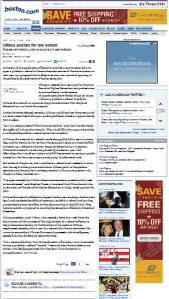
So, why aren’t newspapers able to capture those online advertising dollars?  To illustrate their problems, let’s use the Boston Globe – a paper which has had very public issues adapting to the new world of news.  If you visit the Boston Globe and search for my alma mater, UMass, one of the first stories you get is about UMass angling to open their own law school.  Check out what the page looks like:
globe1

Note the three ads – a banner across the top, a box in the right column, and a tower ad running down the right side a little ways down the page.  The banner and tower in this image are for Roadrunner Sports, and as near as I can tell they rotate.  The big, blue Air France rectangle, though, is all over the Boston Globe’s site today.  That probably means Air France bought a high level of visibility – in other words, they bought ads online the same they would have in the print version of the Globe.

But here’s a pertinent question: why would someone be reading this story?  What does that indicate about their interests?  Air travel seems like an odd fit for a story like this, which one might read if he or she is researching law schools or is a UMass alum.

To contrast, here’s what I found when  searching for “UMass” on Google:

google1

Along the right side are two simple text ads for one of UMass’s satellite campuses and Priceline.com – the Priceline ad trumpeting their ability to find good hotel deals in and around Amherst.  What’s more, the ads look much like the search results – with the search term showing up in bold.  If you are searching for “UMass” because you are looking to further your education or visit your alma mater, these ads are up your alley; if not, the companies that bough the ads lose nothing because they only pay if you click.

While the search ad model anticipates the user’s possible interests and serves ads based on that, newspapers and the ad networks through which they work too often continue to display the ads that they want the user to see – even online.  Why would anyone pay for eyeballs when they could pay for the whole brain?

Pepsi uses new media well. Shame on them.

Pepsi, the Art Garfunkel of the soft drink world, released an iPhone app for its AMP energy drink that drew criticism for being sexist.  Amazingly, some company is trying to market their product by claiming to help boys attract girls.  That’s a first in the advertising world, right?

The idea of the app itself is actually impressive, strategically.  Pepsi and AMP know their target audience, and their target audience is interested in hooking up with young women and telling their friends – or at least sophomoric humor about hooking up with young women and telling their friends.  So the app provides information and enables users to brag about their conquests.  The content may be offensive, but the basics of the social strategy are sound: combining education with channels of communication.

But did it work?  Though Pepsi apologized for the application, it has not been discontinued – and is currently listed among the top ten applications being downloaded from iTunes.  As Mississippi State University opinion writer McNeill Williford points out, “The people at PepsiCo aren’t trying to push a male chauvinist agenda on anyone; they’re trying to sell drinks.”

Despite all the criticism – indeed, possibly because of it – Pepsi probably got what they wanted.