Weed the People

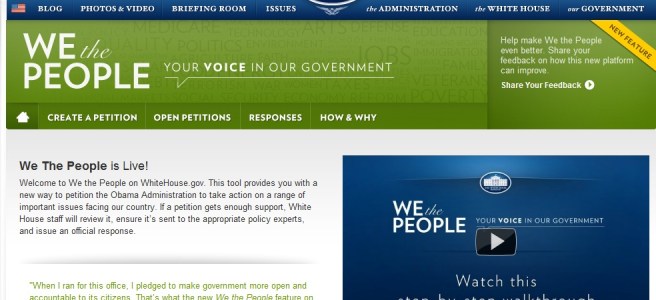
We the People have spoken, and according to the White House’s citizen-driven petition site, the most important issue in America is: the legalization of marijuana.

The White House launched We the People last month as a way to provide commoners like you and me a “direct line to the White House on issues and concerns that matter most” to us.  So far, a petition to legalize pot is the top performer, according to The Hill.  The call for decriminalization has attracted over 50,000 signatures.  It also illustrates nicely why the site is such a waste of time for serious advocacy campaigns:

[National Organization for the Reform of Marijuana Laws Executive Director Allen] St. Pierre said online petitions help spread the word and generate supporters who can call and write Congress, but they have not translated into the real-world pressure — and money — needed for his side to win.

St. Pierre is right: online petition campaigns are an excellent way to find and recruit audience.  So how many supporters did this online petition generate?

None.

To sign the petition, site visitors had to create an account on WhiteHouse.gov.  That means that the White House has their contact information (along with whatever issues are important to them) but NORML gets nothing.  Had NORML hosted the petition on their own site, they might have been able to collect signers’ contact information and email address, which would have allowed them to go back to those folks later with calls to action – such as calling or writing Congress.

At least NORML got some good press out of it, which could indirectly recruit grassroots support.  But if NORML – or any other issue advocacy group – wants to generate real impact, pointing people to the White House’s petition platform isn’t going to work.

Online petitions can recruit and mobilize supporters, but they’re better as a starting point, rather than a finish line.  Since We the People doesn’t allow for the next steps, NORML’s apparent success is actually a wasted effort.

Cross-posted on PunditLeague.us.

Hawking’s “Hail Science!” Moment

Stephen Hawking possesses one of the most brilliant minds of our time. And since he can ponder and comprehend the most complex theories of the nature of time and space, you know the man understands how to sell a TV show.

That was likely part of the impetus between Hawking’s Sunday night debut episode of Curiosity on Discovery networks, provocatively subtitled: “Did God Create the Universe?

Spoiler alert if you haven’t caught it in reruns yet: Hawking says no.

Much of the informational content – the description of the Big Bang, the discussion of the nature of gravity and the theoretical descriptions of the creation of stars – were nothing new to anyone (like myself) with an addiction to documentaries about space. In fact, Hawking himself has covered that ground in previous shows for Discovery networks.

That leaves Hawking’s religious opinions as the only new information in the show – and unlike his understanding of the laws of physics, he doesn’t appear to grasp the fundamental concepts of religion. Like so many others who seek to draw some type of dichotomy between science and faith, Hawking tries to establish a false choice. “Did we need a God to set it all up so that the Big Bang could… bang?” he asks. “I have no desire to offend anyone of faith, but I think science has a more compelling explanation than a divine Creator.”

The thesis is that the Big Bang and everything that came after are wholly consistent with the laws of physics, with no need for “divine intervention” to spark existence.

That’s a fair assessment, but completely parallel to the concept of a universal Architect. That the machinations of the Universe are intelligible does not preclude the presence of divinity. In fact, the idea of laws of physics which govern so rigorously and unfailingly the motion of each cosmic body – from supermassive stars on down to subatomic particles – seems to give an awful lot of power to Whoever it was that wrote those laws, doesn’t it?

In fact, let’s take it one step further and consider the Big Bang, in Hawkings own words:

“Follow the clues, and we can deduce that the Universe simply burst into existence… but I’m afraid we have to stop a moment, before we get carried away by fire and noise. At the very beginning, the Big Bang happened in total darkness, because light didn’t exist yet. To see it, we’d have needed some type of cosmic night vision. But even this, a view from the outside, is impossible. Again, it sounds strange, but space didn’t exist then either.”

Another account of those momentsis probably more familiar to most people:

In the beginning God created the heavens and the earth. The earth was without form and void, and darkness was upon the face of the deep; and the Spirit of God was moving over the face of the waters.  And God said, “Let there be light”; and there was light. And God saw that the light was good; and God separated the light from the darkness.

The latter is, of course, the beginning of the book of Genesis, which is certainly no science textbook. The juxtaposition proves nothing, though it does seem interesting that the description of the creation of the Universe written in ancient times mirrors so closely the result of centuries of astronomical research.

Putting the items side-by-side does demonstrate that even where they intersect, science and religion need not clash.  Forcing a choice between God and the laws of physics is like arguing whether the stuff you learn in history or English is more correct – both subjects are occasionally intertwined, but distinct.

Similarly, someone who studies math and science should also be able to appreciate the beauty and symmetry of the universe without being accused of being irrational.  Isn’t it amazing that the ratio of every circle’s circumference to its diameter is the same (pi)?  Isn’t it fascinating that electrons buzz around nuclei, nuclei buzz around each other, planets buzz around suns, suns buzz around the centers of galaxies?  This type of view of the natural world most likely inspired Georges Lemaitre, who first proposed what would be called the Big Bang theory in 1927.  You might also refer to the good professor by his other job title, Monsignor.

Of course, for all the discussion it has raised, you can say this about Hawking’s thesis: it makes for very provocative television, even when the factual subject matter has been done before.

Cross posted at PunditLeague.us.
Facebook officially goes to Washington

Since at least 2009, Facebook has kept an office here in Your Nation’s Capital, but the company became an official part of the DC community this week when their PR consultant got caught trying to recruit bloggers to write anti-Google stories.

As consulting snafus go, this is pretty mild – especially when a reading of the original emails suggests that the PR consultant was not doing anything wrong, underhanded, or illegal.  This isn’t Jack Bonner’s “contractors” cooking up fake letters, it’s a PR person recruiting someone to sign an op-ed – in other words, exactly what they are paid to do.

The problem is they asked the wrong person.  Sure, Chris Soghoian lists himself as a “security and privacy” researcher.  But the name of his blog is “Slight Paranoia.”  That’s the type of blogger who asks questions about why you’re barking up his tree and encouraging him to take a public stance against Google.

The situation highlights how  trying to wage public affairs battles anonymously can backfire.  Clearly, Facebook wanted to sling mud without getting their hands dirty.  But they had a legitimate point about Google and privacy.  Google collects an enormous amount of information on people, many times without users understanding how they are sending that information.  People have had beefs with Facebook on privacy, but the information you put out on Facebook is information you actively put on the internet; if the world suddenly knows you like My Little Pony and Elmer’s Glue it’s because you signed up for a Facebook account and clicked “like” on those pages, you sick, pathetic degenerate.

Facebook isn’t the only big player going after Google; both MicroSoft and AT&T have put big money into public policy campaigns taking shots at everything from privacy to intellectual property.

Like those other companies and many others in all kinds of industries, though, Facebook figured out that the government’s activities could impact their business.  Because they tried (through their PR agent) to get too cute, Facebook’s message on privacy is obscured because of a tactical misstep.

Welcome to Washington.

Actually, it’s the Data AND Facebook…

President Obama’s first campaign event kicked off on Facebook this afternoon just a few hours after Micah Sifry at TechPresident did a basic overview of the online landscape of for the 2012 race thus far.

Sifry’s attention-getting headline – “It’s not Facebook, It’s the Data, Stupid” – seems to be an indictment of social networks.  But his key point is that knowing the audience is more important than having thousands (or even millions) of friends, followers, or likes.  It’s a point that many have made since 2008 repeatedly, yet it isn’t repetitive.  There are still folks who believe that online success is measured by the easiest metrics of Facebook and Twitter, and not in the more difficult (and final) measurement of votes on election day.  Ultimately, success or failure of the online campaign is tied to the success or failure of the overall campaign:

Facebook and other third-party social network platforms aren’t the central battlefield. It’s data and targeting and figuring out how to use online strategies to enable motivated volunteers to identify, persuade and get out the vote.

Sifry does miss an important shift in voter engagement, though.  He downplays Facebook, noting that the Obama 2012 effort still has the advantages of the MyBarackObama.com networking infrastructure left over from 2008 (with roots stretching back to the nascent Howard Dean effort in 2003).  But that campaign architecture is outdated if it doesn’t work with Facebook.

Consider that in the 2004 and 2008 election cycles, social networking was a varied market.  Friendster, MySpace, AIM, Friendfeed, Twitter, and of course Facebook all had significant shares of the market at one point or another.  Now, Facebook is the unquestioned market leader.  What’s more, Facebook is built as a platform for other services.  For instance, the biggest social network to gain traction since the Obama campaign, Foursquare, allows you to sign up for their service by using your Facebook log in.

There’s no room for MyBarackObama.com in the modern online media and networking environment unless it works seamlessly within the Facebook interface.  If the Obama campaign tries to copy 2008 tactics in 2012 they will fail.

Sifry talks glowingly about the Facebook apps deployed by the Pawlenty and Obama campaigns – and rightly so, because these little programs are monumentally important in bridging the gap between social networking success and data management.  Liking a page is a tangential connection, that can be severed easily and surrenders little information; running followers through an application that allows them to submit contact information and self-identify their interests and issue priorities is much more powerful.

The idea that activity on Facebook is separate from data management is a recipe for a losing campaign; the winner in 2012 will have both working together.  (And despite the attention-grabbing headline, Sifry seems to get that.)

The shrinking relevance of power centers

In a guest post on Social Times, entrepreneur Elle Cachette talks about her experience moving her business out of Silicon Valley.  The business has since thrived, to the surprise of those who advised her that technology companies could not exist in the outside world.

In hindsight, Cachette finds the Valley overrated:

Stop digging. What you see is what you get – there is no gold in ‘them waters. Silicon Valley is the Hollywood of tech, where every waiter is an entrepreneur and every app is the next blockbuster… When you are in Silicon Valley, everything in the media environment confirms that you are indeed in the center of the universe. But similar to a communist North Korean regime,  Silicon Valley drinks much of its own Kool-Aid.

First, it is ironic that in the geographic region that created so much of the technology that Americans now use to telecommute and communicate across great spaces there exists a culture that highly values proximity to a geographic region.

Second, the success of companies beyond places like Silicon Valley is another demonstration of the new realities of work – that almost any job can be done anywhere.

Third, if you substitute “Politics” for “Tech” and “Washington, D.C.” for Silicon Valley, the post would still make a lot of sense.

MySpace makes a “top five” list. From this year. That’s not a typo.

Brandkeys released their annual Customer Loyalty Engagement Index – a ranking of companies by brand identity in a number of categories.  In the social networking group, the ubiquitous Facebook was unsurprisingly first.  But media observers are scratching their heads over MySpace’s runner-up status and Twitter’s fifth-place finish – not to mention the fact that Groupon, Foursquare, and other fast-risers in the social networking space didn’t even place.

They shouldn’t be.  Despite MySpace’s current state of limbo, it does have a very distinct niche – as do LinkedIn and Flickr, numbers three and four on the list.  Despite a large user base, Twitter suffers from the curse of one-time users – people who try it once and leave because they really aren’t sure how the Twitter works, and/or don’t care to learn.  Foursquare is going through a similar growth movement as Twitter did – folks are signing up, but aren’t sure for what.  Groupon and other community shopping sites are utilities more than networks.

Being on the list doesn’t make MySpace’s future any brighter, nor any clearer.  But it shows the erstwhile leader in connecting people online did something right.

Mobile app usage and the 2012 campaign

A study shows that about one in four mobile apps are used exactly once when downloaded.  Aside from downloader disappointment after the first use, it likely also signifies that free apps are easy to forget.

This study is well-timed for any 2012 campaigns that are paying attention.  Several Republican primary challengers will probably join the President in having branded campaign apps, and success or failure of those apps will be measured by raw download figures.  That won’t help anyone get elected, though.

As campaigns begin their planning stages, they would be smart to think about which supporters would download an app and use it multiple times.  This is a group who, in the past, I’ve called the “App Class” – high-level volunteers and grassroots activists, rather than most voters.  Any significant mental and financial resources that go into app building should be allocated trying to figure out how to make these folks more effective.  And instead of determining success based on how many times an app is downloaded, campaigns should look at the metrics that result in votes – in other words, how many phone calls were made through the app, or how many doors were knocked on using voter lists accessed through the app.