Google: booking it out of China?

The big technology news today is that Google is threatening to leave China, leading to a wave of speculation on what that may mean for both the gatekeeper of internet information and the Chinese economy.

On the surface, Google has said this is about human rights and cyber attacks – which are likely, at least, factors in their decision. But this isn’t the first time Google’s China operation has been in the news in the last few weeks.  Recall that Google’s efforts to make all books available online has run afoul of copyright holders in China (as it has here in the States) and even spawned a lawsuit.  Negotiations on what Google would pay the authors of the works it scanned and made available to search users were subsequently put on hold.

While Google’s exit strategy is a good way to draw attention to human rights, in the end it may be a way to beat the Library Cops.

(Disclosure: I have worked in a minor role on projects involving Google’s book settlement in the past, although I do not now.)

When the Superbowl isn’t the Superbowl

A few years back, the late Mark McCormack – a key figure in the sports marketing industry and, by some accounts, the basis for the character Jerry Maguire – wrote an excellent business book, Never Wrestle With a Pig.  It outlines various rules for succeeding in a professional career, one of which is to prepare for what McCormack calls “your Superbowl” – a key event which puts your talents on display.  For a campaign, that’s Election Day, for a conservative organization looking to make a splash, it might be CPAC.  In the big brand advertising world, the “Superbowl” was, well, the Superbowl for decades.

In what is a telling sign of the evolving media landscape, big brands like Pepsi and GM are sitting out the Superbowl this year.  Even as ad prices tick downward slightly, Pepsi chose to invest $20 million in a social media campaign instead.

In many ways, corporate advertising is becoming more like a political campaign.  Successful political operations use broad-based communication – like TV and radio ads – to raise name recognition, but as election day nears they focus on contact with individual voters with targeted messages (those solidly in a candidate’s camp are reminded to get to the polls on election day, while those identified as being on the fence are coaxed onto one side or the other).

Pepsi is the second-best selling soft drink in America.  That’s a great spot to be in – it means selling an awful lot of soda.  But it also means that there are plenty of people who, no matter what, aren’t going to buy your product.  Pepsi could get in front of millions upon millions of pairs of eyeballs with a Super Bowl ad, but would those eyeballs be attached to tongues which desire Pepsi?  Or would their entertaining commercials be laughed at and talked about by people who, at halftime, would still reach for a Coke?

Pepsi first claimed to be the choice of a new generation in commercials which approximately one generation ago, but more recent branding has labeled Pepsi as “forever young.” Their advertising strategy has evolved, too (though they surely hope the comparison of Will.i.am to Bob Dylan isn’t congruent to the comparison of their new strategy to their old one).

Sine we’re all wondering, there’s still no word yet on how all this affects Bud Bowl…

Taxing creatively to subsidize creativity

A government report in France has proposed taxing internet advertising to subsidize creativity:

France could start taxing Internet advertising revenues from online giants such as Google, using the funds to support creative industries that have been hit by the digital revolution, a newspaper reported on Thursday… The levy, which would also apply to other operators such as MSN and Yahoo, would put an end to “enrichment without any limit or compensation,” newspaper Liberation quoted Guillaume Cerutti, one of the authors of the report, as saying.

The reasoning, apparently, is that internet giants provide a bridge between users and free content – reaping  rewards through advertising dollars while content creators are left out in the cold.  While those content creators should have the right to control access to their products, this scheme doesn’t come close to doing that; it does, however, limit internet platforms that more creative artists might use to gain exposure.

Google has it’s problems, but no one can debate that their business model is creative.  Google monetizes free stuff – from search to email and calendar applications to information tracking – by collecting information at every step of the way and using it to fuel a highly targeted and personalized advertising platform.

The ill-conceived subsidy outlined in the report, on the other hand, taxes that money to funnel money to the music industry.  In other words, the report lays out a system that rewards content generators who aren’t creative enough to figure out a way to monetize their product.

Polling for messages

As a follow-up to yesterday’s post about polling, check out the poll being conducted by Organizing for America, the de facto campaign wing of the White House.  With so many plates spinning at once, it’s a smart move by the DNC.   There’s plenty of energy on the right as 2010 kicks off – but not all of it is being ably mobilized by the Republican party.  A poll like this allows the Democrats to not only identify which issues will spur on their base, but also to communicate to activists individually instead of painting them all with the same brush.

Two campaign tools you don’t have to pay for

Google Wave is still a mystery to many folks – I have to confess, I haven’t spend a considerable amount of time pondering its potential yet.  But Wes Donehue of TechRepublican has, and he shares some ways to use this new tool for a cause or campaign:

Also at TechRepublican today: Jeff Vreeland has a good idea about using Facebook as a email match program.  Amassing email addresses has become a basic function of any organized effort, but an email address alone is worth little.  Using that information as a springboard for connecting on other platforms can help draw potential volunteers and donors into the fold.

The Decade of YouTube

The last week of 2009 is a time to reflect not only on the last year, but the last decade as well.  The internet may not have been invented in the 2000s, but it certainly became more integral to our daily lives.  Among the internet innovations that have transformed not only the web but how we communicate, YouTube stands out.

The social web revolution of the last half of the decade made the internet more accessible.  Instead of acting as a one-way flow of information, everyday people could have their own corner of the web and interact with their friends digitally with ease.  But Mashable makes the case that, above Facebook, MySpace, Twitter, and other services, YouTube is the top social media innovation of the decade because it not only offers users a way to display content they have created, but also offers other users a way to easily share content that they like.

But the 2000s became the Decade of YouTube not because of technology, but because of cultural political impact.  In 2006, YouTube had a profound impact on politics, famously changing the course of the Virginia U.S. Senate race (and, likely, the course of the 2008 Presidential nomination). In 2008, Barack Obama announced his candidacy for the Presidency in a YouTube video.

But more important than that, activists have used YouTube to make their case on a number of issues through short videos that have been passed from one person to another.  Activists have taken down ACORN with a YouTube video.  Both sides of the health care debate have made their cases with short online videos.

In fact, the current political climate almost necessitates thinking in terms of short, catchy videos, and not just to defend against a “Macaca Moment.”  If you and your side can’t make your case with a funny or poignant two-to-four-minute video, you simply cannot win.  Sound bites were important for media coverage in 1999, but now campaigns must actively create sound bites – for the media, for their volunteers, for their donors, and for the voters they hope to win over.

Some might say this dumbs down the political process.  But focusing a message into a short video – or into a 140-character Twitter update – doesn’t need to leave out salient points.  It does require a fundamental understanding of an issue.  As Mark Twain said, “With a hundred words to do it with, the literary artisan could catch that airy thought and tie it down and reduce it to a cabbage, but the artist does it with twenty, and the result is a flower.”  Or more succinctly, brevity is the soul of wit.

There have been many ways the Internet has changed politics in the last decade, but YouTube’s impact goes beyond the internet.

The last week of 2009 is a time to reflect not only on the last year, but the last decade as well.  The internet may not have been invented in the 2000s, but it certainly became more integral to our daily lives.  Among the internet innovations that have transformed not only the web but how we communicate, YouTube stands out.

The social web revolution of the last half of the decade made the internet more accessible.  Instead of acting as a one-way flow of information, everyday people could have their own corner of the web and interact with their friends digitally with ease.  But Mashable makes the case that, above Facebook, MySpace, Twitter, and other services, YouTube is the top social media innovation of the decade because it not only offers users a way to display content they have created, but also offers other users a way to easily share content that they like.

But the 2000s are the Decade of YouTube not because of technology, but because of cultural impact.  In 2006, YouTube had a profound impact on politics, famously changing the course of the Virginia U.S. Senate race (and, likely, the course of the 2008 Presidential nomination). In 2008, Barack Obama announced his candidacy for the Presidency in a YouTube video.

But more important than that, activists have used YouTube to make their case on a number of issues through short videos that have been passed from one person to another.  Activists have taken down ACORN with a YouTube video.  Both sides of the health care debate have made their cases with short online videos.

In fact, the current political climate almost necessitates thinking in terms of short, catchy videos.  If you can’t make your case with a funny or poignant two-to-four-minutevideo, you simply cannot win.

It extends to entertainment, too – from Susan Boyle to Saturday Night Live, the availability of short video has served to help turn rank-and-file viewers into unwitting advertisers with the click of a forwarded email.
A Facebook app for the rest of us!

Digital public affairs firm Grassroots Enterprises launched a Facebook application which allows users to celebrate Festivus – the annual holiday which involves an unadorned aluminum pole, Feats of Strength, and – most importantly – the airing of grievances. Grassroots Enterprises has focused on that last one, allowing you to tell your Facebook friends that, in the words of Frank Costanza, “I got a lot of problems with you people.”

The app itself is fun, and shows prospective clients what Grassroots Enterprises can do. Plus, it’s a great way to celebrate this storied holiday.

Write all the white papers you want

When environmental debates are waged, the option of nuclear energy is rarely mentioned as a potential solution despite compelling benefits.  Professor Bill Irwin at King’s College in good old Wilkes-Barre, Pa. blames television’s most famous nuclear family:

The editor of the book The Simpsons and Philosophy says television and movies about nuclear disasters such as Chernobyl and Three Mile Island have also added to negative publicity surrounding nuclear power.

With such shows as The Simpsons poking fun at the nuclear industry and movies that focus on disasters, Irwin says it’s somewhat disappointing there are so many negative stereotypes in the media about nuclear power.

The pro-nuclear energy side has their advocates, of course.  The Nuclear Energy Institute is a quality group, and they make a strong case:

Nuclear energy is America’s largest source of clean-air, carbon-free electricity, producing no greenhouse gases or air pollutants. The industry’s commitment to the environment extends to protecting wildlife and their habitats.

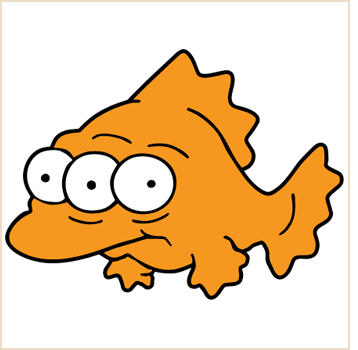
Unfortunately, the American public is more familiar with Blinky the Fish – who makes a more direct point in a joke than NEI could in a ten-page paper:

Isolation brings people together

This past weekend dropped a foot and a half of snow (or more) on the Washington, D.C. are.  And since six inches is enough to grind Your Nation’s Capital to a halt, the Blizzard of ’09 was dubbed the DC Snowpocalypse.

The weather event was a fitting way to end a year that has seen an increased level of attention paid to online social networks.  Those of us glued to the local NBC news coverage found elfin weekend meteorologist Chuck Bell giddily inviting users to get involved by emailing him pictures and name suggestions (his favorite was “Shopper Stopper”).  A Snowpocalypse page quickly popped up on Facebook, and those on Twitter used the hashtags #snOMG and #DCsnowpocalypse to discuss the onslaught.

Twitter, YouTube look back on 2009

This week, both Twitter and YouTube released their 2009 trends list, much as Google did a few weeks back.  Unlike Google, though, these trend lists say more about the way each site is used rather than social trends.

Twitter Trends: The Iranian election was not the top story of the year in American media, but it did top Twitter’s news trends list – largely because Twitter itself was such an important tool in organizing street demonstrations.  In Entertainment, movies Paranormal Activity and District 9 ranked highly.  Both became early examples of what is being called the “Twitter effect.”  Real-time fan reviews on social networks gave both films an instant box-office boost.  (The same effect may have sapped the excitement around other top-Twitter-trenders GI Joe and Watchmen, both of which did worse than expected.

Predictably, there were other trends that lend credence to the “I’m-sitting-on-the-porch” pointlessness of Twitter when misused.  However, these examples also speak to the potential advantage of Twitter as an organizing tool – whether the goal is overthrowing an unpopular regime or flocking to a better-than-expected movie.

YouTube Trends: YouTube is interesting in that it can report two trends: the most-watched videos and the search terms.

The top viewership trends on YouTube centered around you-gotta-see-this viral sensations such as Susan Boyle’s performance on Britain’s Got Talent and the famous wedding party entrance to the tune of Chris Brown’s “Forever.”

Top search trends, which were broken out by month, centered around news and entertainment events but weren’t always directly related.  For instance, the death of Michael Jackson led to an increase in searches for the Thriller music video.  What does this mean?  Probably that a generation that doesn’t remember the dawn of the music video era was looking for a famous short film that was frequently discussed but seldom seen.  YouTube’s slogan is “Broadcast Yourself,”  but it may as well be “Catch what you missed.”

Year in review lists are a chance to look back at the big stories of 2009, but those are common knowledge.  Digging into the trends can, however, show how people are using the online tools – and give insight on how to reach them.