Hillary Clinton’s razor-thin 38-point polling advantage

That’s Hillary Clinton’s average lead among non-white voters over various Republican candidates in the head-to-head questions from the CNN/ORC poll released on Tuesday. But the 64-68% support range she hovers might not be enough. As discussed in this week’s post on Communities Digital News, Clinton is lagging behind President Obama’s 82%-16% edge among non-white voters during his re-election.

All the headlines yapped about the Republican field closing the gap on Clinton. That’s important psychologically, but we all knew the race would tighten. This a much bigger potential problem for Clinton.

The difference between where Clinton sits and Obama’s 2012 performance translates into Mitt Romney carrying Florida, Virginia, and Ohio – with a real shot at picking up either Nevada or Colorado for an Electoral College majority. Again, this doesn’t anticipate any minority votes moving from the blue column to the red column; those are only lost votes.

That’s a real big problem for Clinton, who will surely try to exploit police/community relations as a wedge issue.

Maybe Clinton still gets by with a little help from her friends. The NAACP will surely try to literally scare up black voters with images of Freddie Gray and Michael Brown. The arbotion industry will try to do the same with women. Plus, there’s always fraud.

But the point is that she has to do something, because she isn’t inheriting the Obama coalition – at least, not in the numbers she needs.

These cupcakes, they taste a little… a little… ACK!

CGYjaYiVIAIZCr5Hillary knelt down, staring at the pastry for several minutes before she spoke . “These,” she finally said, her voice barely above a whisper, “will do nicely.”

“It’s become so easy,” she continued, standing and smoothing her suit jacket under her anxious palms. “For all the money that goes into these campaigns, this is the blind spot. There are dozens of people who tell you how to shoot your next commercial, so many who will gladly go door to door. But no one hires food tasters any more.”

Hillary turned to the aide, her eyes wide and her smile broad. “And arsenic is so very, very cheap when you know the right baker.”

“Send a dozen to O’Malley. Include a card: ‘Welcome to the race. I know you’ll see it through to the end.'” Hillary turned to leave.

The aide paused the furious scribbling in her notebook. “O-O’Malley?” she stammered. “But he’s so far behind…”

Hillary wheeled, her smile melted away and her eyes burning with fury. In an instant her face was an inch away from the whimpering aide’s.

“It’s not about O’Malley, dammit, it’s about sending a message!” Hillary growled. Then, as soon as it started, the storm subsided and her face relapsed into its familiar, painted smile. Calmly, Hillary turned to leave as she gave a final order.

“Oh, and don’t forget to sign the card: ‘Love, H.'”

The fake research that almost had real impact

A campaign in support of same sex marriage used in-person conversations and personal stories – and it measurably changed opinions. Sounds legit, right? Well, it turned out the whole thing was fake.

The most sophisticated campaigns usually don’t bother trying to change voters’ minds on issues. Moving opinions, especially on deeply-held beliefs, seemed to happen over much longer periods of time and include forces outside politics. Candidates deal with the realities of their electorate. In many ways, a campaign doesn’t convince voters to agree with the candidate, but that the candidate agrees with them — and downplays the areas of disagreement… LaCour and Green’s study turned this model on its head — until other researchers determined that the original survey data had been fabricated.

Read more in this week’s post at Communities Digital News.

It would be a really, really, really, really bad idea for Metro to post Muhammad cartoon ads.

No one has the right to gun another person down due to speech. Obvious, right?

At the same time, mocking someone’s religion is impolite. It’s not punishable by violence, but you could understand the discomfort someone would fee when the key figures of their religious tradition are mocked. That should be obvious, but people still seem to like draw cartoons of the Muslim prophet Muhammad.

The Washington Metropolitan Area Transit Authority will not accept an ad featuring the winning cartoon from the Texas “Draw Muhammad” contest which ended in gunfire earlier this month. Good for them. It’s one of the few good decisions Metro has made. (Though they, did go overboard by banning all issue-related ads through the end of the year. Perhaps Metro can’t help but be a little wrong.)

What does the American Freedom Defense Initiative think would happen if such ads went up on Metro? Anyone with $1.70 and patience for delays can jump on the Metro without so much as a pat-down or a peek inside a suspiciously bulky book bag. It is, like many places, a “soft” target for terrorists now. Muhammad cartoons would make it a desirable target as well. “Soft” and “desirable” and “not chocolate chip cookies” is not a good spot on the homeland security Venn diagram.

Sure, a violent response from radical Islamic terrorists would be evil and wrong, just as it was in Texas. But it is not unpredictable, and because of that there are many people – train passengers, Metro staff, and the like – unintentionally in the crosshairs.

They would not engage in any speech at all, yet would bear the brunt of the repercussions. In fact, they may not want to engage in such speech at all – since Muhammad cartoons are offensive not only to the radicals who will respond with violence, but for the civilized who won’t respond at all. There’s no need to needle the latter to poke the former.

By rejecting the Muhammad cartoons, Metro is not limiting free speech. In the first place, that’s because Metro owns the ad space, and should be able to rent it to whomever they choose. But beyond that, there will be plenty of people who don’t want to bear the predictable consequences of that speech. Why should anyone be allowed to put words in their mouth?

GOODNIGHT EVERYBODY!

Tonight, David Letterman will sign off for the last time. Now you may say, “Everyone is gushing about Letterman, the last thing the internet needs is another ‘Thanks, Dave’ post.”

Well, that’s too damn bad for you, Paco, because this is my blog and I get to write about whatever the hell I want. Go start your own blog. It’s free.

Watching the retrospectives over the past few months, the reason it’s so sad that Letterman is leaving is that it is so clearly time. Even if he reversed course tonight and said, “Nah! I’m coming back!” he couldn’t recapture the edge he had from his earlier days.

I’ve watched Letterman regularly since the early 1990s, starting out when A&E ran reruns of Late Night at 7:00 p.m. For Christmas 1993, I got a portable, broadcast-signal-only TV. The station that came in clearest was the CBS affiliate out of Philadelphia – and that was all I needed as I watched the Late Show every night. In 1995 I moved to Massachusetts (and got a normal-sized TV); even as many things in my life changed, Letterman was there. One of the best compliments I ever received was during sophomore year of high school, when a classmate turned to me and said, “You know, you remind me a lot of David Letterman.” We weren’t even talking about Letterman at the time.

Not to romanticize the man – Lord knows, he’s had flaws aplenty. But watching his shows, I have taken away some pretty valuable lessons – things that apply to politics, careers, relationships, or anything else you’re getting into these days. If only there was a thematically appropriate way to present these lessons in an ordered fashion…

TOP TEN LESSONS FROM DAVID LETTERMAN

10. Build your own road. There’s room. In 1991, when Letterman was passed over for the Tonight Show, there was Johnny Carson on at night and not much else. Arsenio Hall targeted younger demographics and black audiences, and Nightline was there for the news junkies, but there was only one late night talk show. Now there are at least five. Letterman may not have topped Leno in the ratings after 1995; but by striking out from the safety of his 12:30 Late Night time slot in 1993 – and creating his own show – he found more success.  In the process, he’s become the cornerstone for two late night franchises. Not even Carson could say that.

9. Don’t take yourself too seriously. From goofy hair to the gap between his front teeth, Letterman has never been shy about cracking jokes at his own expense. The occasional rough edge is much easier for others to stomach when you make yourself the target now and then.

8. Everyone has a story (and a joke) to tell. With non-celebrity guests – from audience members to kids who won science contests – Letterman really shined, showing genuine interest in what they had to say. He turned his neighbors around the Ed Sullivan Theater into stars. Being generous with the spotlight made Dave look better in the end.

7. Don’t be intimidated by anyone. …And when the person sharing the spotlight thought too much of themselves, Letterman was never afraid to knock them down a peg or two. (Even big stars like Madonna and Cher.)

6. There is such a thing as good-natured cynicism. Each week, Family Guy does a send-up of the sitcom family trope. The characters assault each other verbally, emotionally, and physically. It’s funny, but you wouldn’t say it’s rewarding. Letterman may have been caustic and sarcastic, but at least you knew there was always a smile on the other side of it.

5. Be respectful. When Letterman left NBC, he also left the blazers-and-sneakers look behind; he understood the investment CBS made in him (a $14 million per year contract) and wanted to at least look nice. That shows a level of respect that isn’t readily apparent in the irreverance. It extended to the audience, too. Daniel Kellison, the segment producer for the infamous 1994 Madonna interview wrote about Letterman’s real problem with the Material Girl’s f-bombs: “He always understood the privilege that came with the ability to broadcast, and the responsibility that accompanied it. Ratings and press were less a consideration.”

4. Rely on your team. Paul Shaffer said that Letterman told him from the beginning to jump in with comments anytime – whether it was during the monologue, during an interview, anywhere. Stage hands, producers, directors, writers, and staff all found themselves on the air. Letterman understood what he did was nothing special, and that talent was everywhere around him.

3. Great things can come from heartbreak. As mentioned above, Letterman is a late night legacy on two different networks, and at two different time slots. None of it could have happened without the crushing disappointment of losing his dream job. Sometimes the bad breaks work out. Everything happens for a reason.

2. Remember how lucky you are. As Letterman himself said, “I cannot sing, dance, or act. What else would I be but a talk show host?”

1. Have fun. I couldn’t tell you exactly when it happened, but my all-time favorite memory came when Letterman, in the middle of a monologue or a bit, called out to no one in particular, “Who has more fun than we do?” Dutifully, Shaffer enthusiastically hollered from off camera, “Nobody, Dave!” It was a small, throw-away moment that didn’t seem rehearsed. Few people probably gave a second thought to it two minutes after it happened, let alone in the decades since.

Yet it always stuck with me as the epitome of Letterman’s attitude toward his own show. Even when the jokes were bombing or the guests were lame, it seemed like Dave and Company understood that there would always be another show. At least until tonight.

This may be the most important lasting lesson of the David Letterman era. In every office I have ever worked at in my professional life, I have, at some particularly tense or busy time, called out loudly, “Who has more fun than we do?” The answer has always come back (from folks I’m certain weren’t avid Letterman fans): “Nobody!” Without fail.

Johnny Carson might have invented late night television as we know it. Jay Leno might have bested him in the ratings. Jimmy Fallon might have merged the TV and internet age better than anyone.

But who had more fun than David Letterman?

A new frontier for pro-life politicians

This week’s post over at Communities Digital News is about some recent polling that shows that many Americans have views on abortion that aren’t as easily categorized as many politicos think. This is likely true of other issues as well. Some things simply transcend politics, so the fight needs to be in a non-political arena. Legislation and policy is certainly important, but not all-inclusive.

Most policy is made by politicians who understand the electoral implications of being for or against something. For example, many conservative politicians wouldn’t have supported a ban on abortion after 20 weeks of pregnancy; now you couldn’t win a Republican nomination for the U.S. Senate in most states, let alone President, if you oppose such a ban.

Through crisis pregnancy centers and post-abortive counselling organizations, the broader pro-life movement handles the non-policy side of the debate well. Political organizations who want to move public opinion on the abortion issue should embrace this.

That may be non-traditional for politics, but it’s ultimately how opinions change.

Something Hillary got right

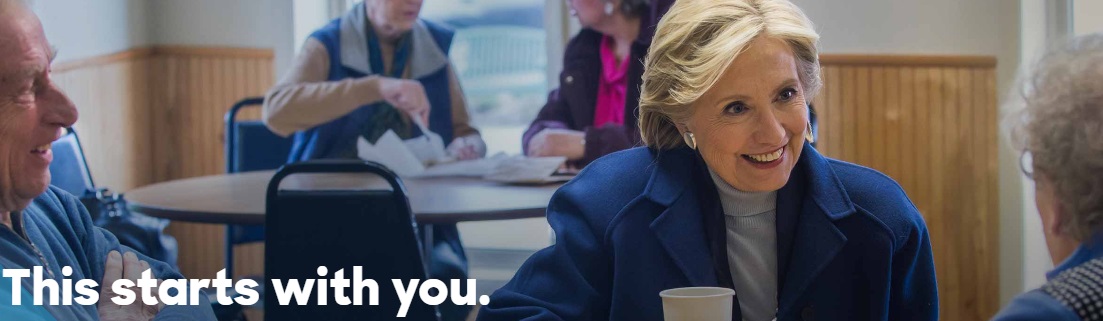
It’s been a fun week to make fun of Hillary Clinton, but she knocked one aspect of her video announcement clean out of the park. As I discussed in my latest Communities Digital News post, Clinton only appears onscreen in her own video for fifteen seconds out of 2:15, and in that time she is either addressing the camera or talking with voters.

Except, she isn’t talking to the voters. In every shot, they are talking to her.

Many political ads and videos have a shot of the candidate meeting with supporters. Usually, in those shots the candidate is dispensing wisdom to a small group of supporters. Check out the very first shot from this ad from Terry McAuliffe’s successful 2013 Virginia gubernatorial campaign:

Candidates must do this to show that their leadership. (Though every time I see this type of shot, the audience looks like they are waiting for the candidate to pause so they can break out of the conversation.) But everything her week-old campaign has done so far has made it obvious Clinton is bending over backward to give the impression that she isn’t full of herself.  So in her video, she listens – sometimes with crazy eyes, but she listens.

Surely, Republican candidates expect to be vilified by Democratically aligned special interest groups in the upcoming cycle. For conservative candidates looking to prove their empathetic chops, subtle visual cues like this can go a long way.

Announcing the start of a campaign and/or murder spree

ThisStartsWithYou

“Death, it comes to us all,” Hillary explained, resting her coffee cup on the table. “For all our advances in medicine and health care, life has a 100% mortality rate. It’s the only thing that really binds the haves and have-nots, you know? The deck may be stacked for the rich, and the system may be rigged so the rich get richer, but no one escapes the end.”

Hillary leaned in, her eyes still wide and unblinking. “We are all equal in death.”

She paused to let it sink in, the smile was still painted across her face.

“After I finish this coffee, I’m getting into my van. I’m going to travel from one end of this country to the other, bringing true equality to the nation. There will be plenty of people out there who want to stop me, small minded people who don’t understand what we’re accomplishing. But one day, history will look back on this trail of death we are forging and appreciate the revolution.”

Hillary took another sip of her coffee. “You’re wondering why I’m telling you all this.”

She leaned in closer, her voice lowering to a throaty, raspy whisper.

“It starts with you.”