Like Newt himself, this is better in theory

My Tuesday post at Pundit League this week (which was actually a Thursday post due to my own fault) discusses the mockery that is the system of campaign finance laws, and how Presidential candidates are often candidates long before they run.  One example of a such a candidate is Newt Gingrich.

Gingrich, who flubbed his announcement-that-there-will-be-an-announcement-about-an-announcement last week, isn’t officially running yet, but has decided that his campaign will commence at Independence Hall in Philadelphia.

No one can argue with the symbolism of the locale.  If Pennsylvania is a blue state, then it is the Philly region that makes it so; yet the middle-class voters of the region are a key demographic for Republican victory nationally.  And of course, standing in front of the building where the Constitution and Declaration of Independence is priceless.  (Mitt Romney probably wishes he had thought of it first.)

And when the folks in this region come together… well, that’s when the fun starts.  Sarah Palin got booed dropping the puck at a Flyers game; Santa Claus got booed by Eagles fans.  Phillies fans whip D cell batteries at players so fiercely you’d think they’re auditioning to pitch the seventh inning.

And that’s just sports.  Don’t forget about the omnipresent unions and occasional voter intimidation tactics.  Does Gingrich really want to stand in front of a crowd of Philadelphians to announce his candidacy?

On the plus side, if Elton John played at Rush Limbaugh’s wedding, maybe he’ll perform for Newt’s kickoff too:

Activating the base so the base activates others

Karl Rove released a brief late last week which demonstrated how over simplistic the idea of “turning out the base” is.

The phrase is political shorthand, but it makes it sound like each election turns on whether dyed-in-the-wool Republicans or Yellow Dog Democrats actually show up to vote.  But as Rove points out, analysis of election results in 2010 and 2008 demonstrate that stalwarts of each party showed up to the polls.  So John McCain’s poor showing in the Presidential election could not be chalked up to Republicans sitting at home, right?

Well, not quite.  Those who strongly identify with one party or another probably do so because of an interest in politics, and are most likely to vote no matter what.   A lack of excitement about a candidate manifests itself in other ways – borderline activists are less likely to go to rallies, make phone calls, or knock on doors if their candidate isn’t exciting.  They’ll still vote, but they’ll do little else to convince others to vote along with them.  Rob Eno of the excellent Massachusetts blog Red Mass Group sums up the need for a good infrastructure based on local activists; that type of activism doesn’t happen if “the base” doesn’t feel like a candidate really represents them.

All of which adds up to less outreach to independents – who are, says Rove, the real collective fulcrum of each election.

The right answer on retirements

Remember when politics was more than a sport?

Years back, I told Matt Lewis I thought candidates were starting to sound too much like strategists.  John Thune fell into that trap with his reaction to the slew of recent Democratic retirements:

“It certainly suggests that the pathway to get to 51 is achievable,” Sen. John Thune (R-S.D.) said Thursday. “I think depending on what happens in the next couple of years and depending on what retirements we have, a lot of these Democrat seats that are opening up, I think there are some opportunities for us — and I hope if we can get the right candidates in the races and resource them, we’ll have a shot at changing the equation.”

Nowhere in Thune’s response is the idea that Republicans could win every seat up for grabs with the ideas that voters are looking for.  He boils it down to an “equation” – a numbers game, as if he’s analyzing fantasy baseball for the MLB network.  Thune would have been better off giving a more general answer about the need to compete in all states, and to focus on working with everyone to make laws that will help out the American people no matter which party wins this election or that election.  It’s not all that quotable, but it’s still better than what was quoted.

It’s true that there are lots of strategic elements that go into winning races.  But speaking about them publicly belittles the fact that for all the microtargeting, get-out-the-vote technology, polling, and positioning, elections are still about ideas.  The techniques of battle don’t change the reason for battle.

And it’s simply poor technique to talk about the machinations of the campaign rather than the ideas.

As the political press covers the horse-race details of campaigns, it’s tempting to use their language and outlook.  But candidates, party leaders, and movement figures have to be above the fray, and their comments have to reflect a commitment to creating policies which benefit the American people rather than building campaigns which outscore the opponent.

Come to think of it, maybe the right kind of media-savvy, unflappable sports star would be a good role model after all.


What’s so great about “Standing with Scott”?

Tim Pawlenty received some attention for a recent video highlighting his tea party bona fides.  But as I wrote over at Pundit League, it’s his “Standing with Scott” video that means the most to T-Paw’s nascent campaign for the Presidency.

Unlike his other videos, which mix action-movie trailer style with platitudes about America’s problems and potential, “Standing with Scott” pointedly takes on public sector unions in general and the mess in Wisconsin in particular.  The footage of students cluelessly protesting based on their teachers’ instructions along with the direct criticism of the President give the video a clear, policy-driven message while maintaining a broad appeal.  It touches on specific issues without going into so much depth that the average viewer would turn away.  In that way, it’s a good road map for future messaging.

The video is also significant for who is not featured in it: Tim Pawlenty himself.  Outside of a mention at the beginning and a quote at the end, the former Minnesota governor is nowhere to be found.  With other videos featuring a heavy dose of T-Paw, the series run the risk of becoming an exercise in glorification.  More videos like “Standing with Scott” can counterbalance that.

And the video goes beyond messaging, directing viewers back to a landing page where they can sign up for the Freedom First PAC mailing list.  (It would be better if the page included facts about Walker’s position in Wisconsin, but it’s better than nothing.)

Pawlenty’s videos are an attempt to elevate the rhetoric and the urgency of the campaign and position the former Governor as a transformational leader in the mold of Obama.  But empty rah-rah speeches ring hollow in the ears of savvy activists.  If “Standing with Scott” becomes a first step – and more similar videos follow on other issues as they arise – questions about whether Pawlenty’s “Minnesota nice” personality can play on the Presidential stage may be answered.

3 Reasons Why This Is Christie’s Time

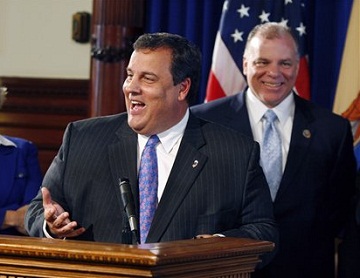
Politico reports grumblings out of New Jersey that Governor Chris Christie is mulling the first tentative steps of a Presidential run.  Up to now, Christie has been consistently adamant that he isn’t running, but his candidacy was extremely likely even before this revelation.

The bottom line is that if Chris Christie wants to be President, a 2012 run makes the most political sense for three big reasons:

1.  Christie is well-positioned to deliver the right message for the times.

The protests in Wisconsin may have been a tipping point for Christie, as they look to be the first in a series of clashes between public sector employees unions and the unfortunate realities of states in the upper Midwest, Northeast, Rust Belt, and West Coast whose tax bases are dwindling and whose budget deficits are expanding.  If the abstract concept of reducing government spending was the central theme of 2010, the issue of whom gets what from shrinking government doles will be a recurring discussion leading up to 2012.

How this discussion is framed will go a long way toward deciding how many seats Republicans gain in the Senate and how successful the 2012 GOP candidate is.  Unlike many national elections of recent vintage, 2012 has the potential to pose to the voters a meaningful question about the role and size of government.

Christie has already waged this fight in New Jersey (the only GOP candidate who has done so recently).  But what’s more important than that has been the direct, unapologetic tone he has used in doing so.  With tough financial decisions on the horizon, Christie has become Mr. Tough Love – and unlike most successful politicians, he has not shied from confrontation.

If the momentum from the tea partiers continues into 2012, and there remains a swath of the Republican electorate that still feels government is not working for them, is there a better person to lead the charge against entitlements and special interest groups – and get rank-and-file Republicans excited about it – than Christie?

2.  Christie’s larger-than-life personality can go head-to-head versus President Obama.

That isn’t a fat joke.  It is a recognition that the sitting President enjoyed a huge charisma advantage over all his opponents in 2008, and the electorate still likes him.  Why not?  He’s a cool guy, he fills out an NCAA bracket every year, and he jokes around about salmon during his addresses to Congress.  More important, he still has a remarkable campaign infrastructure in place and is well-positioned to take on any Republican who can’t provide some level of excitement.

But he also has trouble with confrontation.  From the town halls of 2009 to the tea parties of 2010, President Obama has consistently shown that a full frontal assault on his initiatives is the best way to throw him and his administration off their talking points.  Christie’s blunt style seems best suited for flustering the President – and making the election narrative follow the script Christie sets out.

3.  Christie is popular among Republicans now, but political memories are short.

Hillary Clinton might have been President if she had run in 2004 – President George W. Bush squeaked out a reelection victory over a challenger who looked like a sad puppytalked like the Mayor from T’was the Night Before Christmas, and provided precious few reasons to switch horses.  By 2008, she had become Washington establishment – part of the problem that the Obama campaign sought to solve.

Her husband, of course, beat the first President Bush in 1992, less than two years after the incumbent enjoyed record-high 90% approval ratings.

In between 2012 and 2016, there are plenty of things that could go wrong for Christie.  His hold on the blue New Jersey electorate could slip, he could enter into a legislative compromise that sours his standing among social conservatives, or he could simply become yesterday’s news with a lost reelection bid 2013.

Christie running in 2012 isn’t just a convenient answer for Republicans looking for a leader.  Second chances in presidential campaigns are rare.

The biggest obstacle to Christie’s candidacy will of course be his promises that he won’t run.  His denials have been just as adamant as Barack Obama’s in 2006, and getting around the statement “I swear I’m not running” is one of the easiest maneuvers in politics.  If anyone could get away with, “eh, I changed my mind” as a response, Christie’s the one to do it.
It would be nice to spend lots of money, but is it smart?

Has anyone noticed that Washington, D.C. and St. Louis have some eerily similar discussions going on?

The last decade or more has demonstrated that bloated budgets are inefficient at best and simply untenable at worst.  While it would be nice to allocate large amounts of resources on the things we want for the next few years, those decision will come back to haunt us in the future.  We must establish a plan and maintain discipline.

That could be the mantra of the budget hawks freshly minted from the tea parties of 2009-2010, or it could be the rationale behind the Cardinals telling Albert Pujols to go find himself a better deal than the reported offer that was on the table.

Just as the Republicans wear the black eye of the Bush-era spending increases, the Cardinals must answer to Pujols – and their fans – how they signed Coors Field product Matt Holliday to a contract which paid him $16 million per year, but would be willing to let the far superior Pujols walk because he’s too expensive.

Republicans are likely fearful of the Democrats accusing them of ripping Social Security checks from the arthritic hands of World War II veterans.  The Cardinals can’t be looking forward to the sports page headlines and the talk radio chatter in St. Louis the day Pujols signs with the Seattle Mariners.

But in each case, the powers that be must recognize two realities.  First, bad decisions in the past do not justify bad decisions in the present.  Second, voters and fans are smarter than most people give them credit for.

And since the baseball problem is easier, here’s something to consider: teams lose superstars all the time and go on to have success.  Seattle lost three franchise cornerstones – Randy Johnson, Ken Griffey Jr., and Alex Rodriguez – in consecutive years, and actually got better each year.  Johan Santana left the Twins, and they still find their way into the playoffs with regularity.  The Marlins won the World Series in 1997, dumped almost their entire roster, and rebuilt another championship team within six years.

On the other hand, teams just as frequently make signings that seem like great ideas at the time, but turn into albatrosses as players age.  The Mets surely wish they could trade Carlos Beltran, and might try to murder Luis Castillo to get him off the roster.  Vladimir Guerrero was a great pickup for the Angels in 2003, by 2009 they couldn’t get him out the door fast enough.  And don’t you think the Cubs wish they could take a mulligan on the eight-year pact they signed with Alfonso Soriano in 2006?

Just as voters want a responsive, healthy economy, baseball fans want a winner.  The Cardinals have to know that they more likely to successfully recover within a few years after Pujols walks away than to sign him to a deal that truly works out for the team.

The budget battle in St. Louis, just as the budget battle in Washington, is best viewed through the lens of recent history.

The Tea Party’s first casualty of 2012

A moderate Democrat Senator, who had been backed into some tough votes, was made vulnerable by his public allegiance to President Obama.  The only possible path to victory would be a tea party Republican candidate lacking in media savvy and unable to connect with voters.  Unfortunately for Jim Webb, he isn’t Harry Reid.  Despite a wide-open Republican field stuck between lesser-known candidates and former YouTube sensations, Webb is not running for re-election in 2012.

Many political observers thought a groundswell of conservative activism would upend incumbents in 2012 – speculation included Orrin Hatch, Dick Lugar, and even the normally safe Olympia Snowe falling in primaries.  Webb’s surprise exit beats them all.

Even without an opponent at this point, Webb had to see the writing on the wall that his re-election would be tough.   The redemption-seeking retread candidacy of George Allen is ripe for a tea party upset, and other candidates are lining up as well.  But with excited conservative activists and the absence of national Democrat momentum, Webb was destined to join Creigh Deeds in the second place circle in November 2012, even against a fringe tea partier.

Put another way, Sharron Angle, who narrowly lost to Reid, probably would have beaten Webb in Virginia.  John Buck in Colorado likely would have beaten Webb in Virginia.  Webb doesn’t have the long record of public service that Reid boasts, nor the leadership, nor the ability to raise nearly $25 million to holdhis seat.  Democratic campaign committees and independent groups were unlikely to chip in – races in Missouri, Pennsylvania, Ohio, Florida, West Virginia, Wisconsin, and New Mexico, plus pickup opportunities in Nevada and Massachusetts, will all rank ahead of Virginia for national Democrats.

Aside from the realities of the electoral map, investing in a Virginia race with Jim Webb as your candidate has a strategic messaging issue.  After all, Democrats were able to beat back some challengers in 2010 by convincing independents that specific Republicans – such as Angle – were a bit loony.  Michael Bennet, Chris Coons, Reid, and others were able to paint themselves as sane alternatives to “crazy tea partiers.”

There is simply no conceivable way the tea party could out-crazy Jim Webb.


Mobile app usage and the 2012 campaign

A study shows that about one in four mobile apps are used exactly once when downloaded.  Aside from downloader disappointment after the first use, it likely also signifies that free apps are easy to forget.

This study is well-timed for any 2012 campaigns that are paying attention.  Several Republican primary challengers will probably join the President in having branded campaign apps, and success or failure of those apps will be measured by raw download figures.  That won’t help anyone get elected, though.

As campaigns begin their planning stages, they would be smart to think about which supporters would download an app and use it multiple times.  This is a group who, in the past, I’ve called the “App Class” – high-level volunteers and grassroots activists, rather than most voters.  Any significant mental and financial resources that go into app building should be allocated trying to figure out how to make these folks more effective.  And instead of determining success based on how many times an app is downloaded, campaigns should look at the metrics that result in votes – in other words, how many phone calls were made through the app, or how many doors were knocked on using voter lists accessed through the app.