Romance, sarcasm, math, language, and crowdsourcing controversy

Web comic XKCD – which chronicles stick figures discussing physics, science fiction, and computer programming – has unwittingly (or possibly wittingly) touched off a mini-controversy on  Wikipedia.

The original comic featured a made-up word made up of words that dealt with making up words (with the original words, ostensibly, disproportionately popular on Wikipedia).  Don’t be ashamed if that seems tough to follow – any web comic that has an explanatory blog is pretty high-end stuff to begin with. What isn’t tough to follow is that some enterprising fans created a Wikipedia entry for the made up word.

The ensuing debate among Wikipedia users and site editors took 19,000 words and resulted in searches for the word (“malamanteau”) redirecting to XKCD’s own Wikipedia entry.  But it illustrates a good cautionary tale for user-generated content: it’s best to have good site rules up in advance in case you want to maintain any semblance of message control down the line.

And it’s also good to keep an eye on Wikipedia.  Anyone can edit it, including people who might not have good things to say about you.

When Supreme Court nominations stop being polite and start getting real

The Elena Kagan pick has been a perfect, hand-in-glove fit with the criticisms that Washington DC has grown out-of-touch with the rest of the nation.  The prospect of an exclusively Ivy-educated Supreme Court has sparked questions about Eastern corridor elitism.

Of course, not helping was that Senator John Kerry picked a Politico Arena discussion board – ostensibly set up to discuss whether the nominee is too steeped in “Ivy League education and elite positions in government” – to sing Kagan’s praises from their time working together on high stakes tobacco legislation in 1998.

Kagan’s camp could not have asked for a worse messenger with a worse message:

“Massachusetts has been Elena Kagan’s adopted home, but it’s not for such home state boosterism, parochial reasons why I think she’s a terrific choice.

No, it’s because I got to know her well not in Boston, but here in the Senate.”

That’s John Kerry, who connected so poorly with voters in 2004, the poster child for liberal elitism.  And his comments have nothing much to do with the topic: he’s essentially adding his two cents to a discussion about Euros – and helped keep alive the notion that Kagan is an insider pick.

The court looks different from this angle

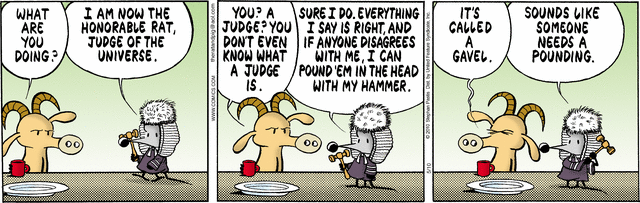
This morning’s Washington Post Express had the following installment of the excellent comic strip Pearls Before Swine:

And then, by a happy coincidence, the worst-kept secret in Washington DC is confirmed: President Obama will nominate Elena Kagan – who hasn’t been a judge – to be the next Supreme Court Justice.

Despite a different experience than others, having a legal scholar on the bench may allow the court to reach opinions based on legal theory rather than the circumstances presented.  Though given the qualifications President Obama has put forward in the past, don’t hold your breath waiting on it to happen.

3 (more) ways for SNL to be more fan friendly

Betty White hosts SNL this week, thanks in large part to a Facebook movement.  It was a savvy move for the television institution – which, at 35, might as well be as old as White in TV years.

SNL’s target audience has always tended to be younger, and as such the show must constantly adapt to changing times.  Tapping White to host in response to popular demand is a good start, as is the Backstage blog which includes sketches cut at the last minute.  But SNL  can do even more:

1.  More online video content

I don’t know how many times I’ve wanted to make a post using an obscure SNL sketch to make a point.  And honestly, there’s no reason (other than to promote DVD sales) for SNL not to have a library of all their sketches available on YouTube.  Currently, only select sketches are available.

Aside from my selfish reasons, having every sketch ever made available could be a good business decision for SNL. Old, obscure sketches could become viral sensations when exposed to a new audience.  And then there’s the social factor: For many folks, watching SNL is a social activity, and so any sketch can become an inside joke among friends – whether or not it’s a “classic.”  An otherwise unfunny 1999 sketch where Horatio Sanz repeatedly screams, “a bear ate my parents!” was pretty lame, but it would get plenty of laughs from some of my UMass chums if I sent them a link to it.  You and your friends probably have sketches like that too.  SNL is missing out by not tapping into that emotion – it keeps viewers loyal.

2.  Viewer-generated content

Andy Samberg’s Digital Shorts have helped SNL advance in the online video space.  So why is Samberg to only one making digital shorts?  There are some talented comics out there who can make funny videos.

By inviting submissions and letting viewers vote on which one should be on TV, SNL can not only build a great interactive relationship with their audience, but also find cheap talent.

3.  Viewers pick the host

SNL understood the dynamics of audience engagement early on, running an “Anyone Can Host” contest back in 1977.

Offering a season-long, election-style contest between two good comedic actors for a spot hosting the season finale would not only be comedy gold, but would reach into those actors’ networks – their Facebook fans and Twitter followers would suddenly have a reason to visit SNL’s website, and to recruit friends to do the same.

If Tim Pawlenty figured it out, you’d think Lorne Michaels could, right?
Santa Clara County is your new Mom!

I know: it doesn’t seem fair.

All the kids in the other counties get a toy with their Happy Meal.  But you live in Santa Clara County, and Santa Clara County says you aren’t allowed to have toys with your fast food.

This is important.  After all, some foods aren’t good for you if eaten in excess, and someone has to be there to tell you to stop.  Who else is going to to that?  Your parents?  With kid’s meal toys out of the picture, there’s nothing that draws kids into these fast food restaurants.  Well, other than the fact that the food tastes really good to a kid.

Those other counties may seem “way cooler” now, but wait a few years and you’ll see that Santa Clara County really did know what was best for you all along.

(Unless you run a fast food franchise close to one of Santa Clara’s county borders and are looking to get any business on a Saturday afternoon.  Then you’re screwed.)

Facebook reporting

New York Times tech blogger Nick Bilton tweeted an “off-the-record” quote from an unnamed Facebook official today.  The groundbreaking revelation: CEO Mark Zuckerberg scoffs at privacy.

The leak was ill-timed for Facebook.  As Wired’s coverage points out, the “official” nature of an off-the-record conversation means that it probably shouldn’t have been repeated:

“‘Off the record’ restricts the reporter from using the information the source is about to deliver,” reads NYU’s Journalism Handbook, in one definition of the phrase.  “If the reporter can confirm the information with another source who doesn’t insist on speaking off the record (whether that means he agreed to talking on the record, on background, or not for attribution), he can publish it.” “On background” usually means that information can be used, but can’t be attributed to a specific person.

In other words, the person making the quote might have thought the information was private, but the conversation was set up so that information was revealed.  Boy, wouldn’t that be instant karma.
In reality, the unnamed source apparently understood that he would be quoted – which is good.  In media relations as well as Facebook, nothing is really off-the-record.

South Park at 201 (and counting)

South Park got everyone talking last week, but not for the right reasons.

Now thirteen years old, the show celebrated its 200th episode a few weeks ago.  This milestone should have received some more attention than it did: aside from basic longevity, South Park was and is the signature show that put Comedy Central on the cable map.

More significant than that, though, is the unique social commentary South Park offers up from a center-right perspective – and the fact that no other show does that as well.

One episode called out hybrid enthusiasts as presumptuous yuppies who enjoy the smell of their own farts.  Two episodes made the point (using thinly veiled surrogates for Starbucks and Wal-Mart) that big businesses are big because people want their products, not because of some evil corporate trick. A sixth season episode managed to mock lawsuit abuse, political correctness, and draw a line between tolerance and acceptance.  A two-part episode glimpsed into a future without religion and found devout atheists arguing over whose scientific logic was superior.

South Park has been a turn-of-the-20th-century incarnation of an Ayn Rand novel – telling a compelling story while making important and uncommon cultural points.  In fact, a 2005 book about the rise of media-savvy conservative activists was titled South Park Conservatives.

But calling South Park a political show is a misnomer.  Other efforts to become conservative or libertarian alternatives to left-leaning television shows, movies, or other media outlets have failed because those outlets put politics before content; South Park is a funny show that happens to be made by people with a libertarian-oriented worldview.  It would be hilarious either way; the leanings of creators Trey Parker and Matt Stone just make it different.

If you want to learn more about smaller government and individual freedom, Hayek and Bastiat are better philosophers than Parker and Stone.  But it you want entertainment that comes from a different perspective than most of the stuff out there – and that is, despite some shock value jokes and toilet humor, pretty smart – go on down to South Park and have yourself a time.