Crowdsourcing commencement

My former employer, the Leadership Institute, is collecting information on college commencement speakers through its Campus Reform blog.  And, instead of emailing their contacts and scanning the internet looking for that information (as we used to do back in my day) they’re relying on the wisdom of crowds to help them fill in information.  Users who don’t see their school or alma mater on the list can email the information, presumably to LI Worldwide Headquarters in Arlington, Va.

The list, predictably, shows a leftward bias, so LI further helps out by sharing tips on how to take action and provide a counter to the speakers.

Hopefully LI’s call to action will result in student-filmed user videos of the commencement speeches themselves.  Most of the big speakers – such as President Obama and other national politicians – will have their comments on C-SPAN, of course, but that won’t be the case for everyone.  Wouldn’t you be interested to see the things discussed during commencement season?

3 Up: Nancy Pelosi, the Yankees, and GOP messages

Joel Sherman – who, despite growing up a Cincinnati Reds fan, does a better job than anyone of giving a voice to New York baseball – called out Milwaukee Brewers owner Mark Attanasio in his daily blog for Our Nation’s Newspaper of Record.

Attanasio, who is trying to lock up franchise cornerstone Prince Fielder to a long-term contract,  complained that the Yankees spent a lot of money to pay their players. Sherman rightly observes that Attanasio uses the Yankees as a convenient straw man, much like a politician devoid of a message:

Look, I get it, we live in talk-radio world now. If you are failing your constituency then don’t take any personal responsibility just demonize an easy bogeyman. The Democrats do it to the Republicans, the Republicans do it to the Democrats, and in baseball, when you have no other answers blame the Yankees.  …[P]ulling the Yankees into the Fielder discussion is either the act of a lazy mind or the act of an owner who wants to rile up his fan base so nobody notices his own failings.

At TechRepublican, Wesley Donahue makes a similar case against the “Fire Nancy Pelosi” messaging of many Republicans:

Last week I went to a “Listen and Learn” event in Charleston with S.C. Republican Party chairwoman Karen Floyd. What I heard was exactly what I’m hearing through emails and blog comments to all my clients. People want more than “No.” They want alternative plans.

Both baseball teams and politicians rely on a base of people whose support isn’t entirely rational.  In politics, Candidates like Ronald Reagan and Barack Obama with pleasant personalities are able to gloss over policy differences.  Sports fans will change their behavior to avoid jinxing their team.*

But in neither case is affection blind.  The most diehard sports fans can endure losing seasons, if there’s some reason to hope their favorite team can either build a winner or at least be competitive (Redskins fans understand this, especially this week).  But fans bases – and voters – lose interest when teams are stuck in the mud and going nowhere.

Nancy Pelosi and the Yankees are both easy targets.  That doesn’t make them good long-term targets, though.

*Fun story: during the baseball playoffs last year, I texted disparaging, negative comments about the Yankees to both of my brothers during the games; each time I did, the Yankees came back to win.  I even sent a text when one of my brothers was sitting in the same room, watching Game 3 of the World Series with me.  My phone should have been named World Series MVP.

Sadly, the tactic proved ineffective for the New York Giants.

Freedom of Informa…

Last week, Big Government covered the exposure of US Deputy Chief Technology Officer Andrew McLaughlin’s personal contact list through Google Buzz.  Though many Gmail users had the same problem, McLaughlin’s personal electronic Rolodex was embarrassing because it contained people potentially affected by the policies he was in charge of.  Because of this, Consumer Watchdog filed a Freedom of Information Act request.

And then the information was gone.  Left in its place are some tough questions about data on government computers – and whether or not that qualifies as government data.  Does Google have to release any data they have on McLuahglin?  He may have deleted his Google Buzz account, but does Google have that information backed up somewhere?

Situations like this make it clear why last week some of the biggest names in technology called on the federal government to establish strict protections on personal data.  They don’t want to be forced to reveal your personal data because then it will become obvious just how much of your data they have.

Eight-year-olds, Dude

Erick Erickson of Redstate reports on a county council race in Ohio that features candidate Tim Russo.  The twist: Russo was arrested and convicted in 2001 on charges of soliciting minors for sex – turned out, the minor was actually an undercover FBI agent.

But Russo has an ardent defender in blogger Howie Klein.  Klein calls the 2001 incident “the most boring episode of To Catch a Predator ever” in a cross-posting at both DownWithTyranny and The Huffington Post:

Easily the most reactionary pope since Hitler’s boy Pio, Ratzinger didn’t have a problem with priests raping young boys– as long as they stuck with conservative dogma. When he ran the Munich diocese that was also the birthplace and heartland of the Nazism that he once fully and openly embraced, the future Pope had hundreds of child rapists and mentally unbalanced priests in his ranks and he never said a word beyond, “don’t get caught, boys.”

My mistake – that last paragraph was Klein criticizing the Pope and the Catholic Church for covering up instances of adults taking advantage of minors.  It was written way back in those simple times of late March 2010.

Of course, Klein has a point – no matter how much you agree with someone philosophically, if they do something wrong that has consequences.  Unless, apparently, it’s a political candidate Klein supports:

Russo has the sort of leadership experience Cuyahoga County desperately needs at this dangerous, hopeful crossroads. But local media are doing their best to scuttle his campaign before it really begins. Why? Because in November 2001 he solicited sex from an FBI agent posing online as a minor and was made Pervert of the Day for an entire 24-hour news cycle. Local media want him to pay for that for the rest of his life.

Clearly, Russo has paid for his crimes, but there are a few mistakes which you simply can’t pay off – and soliciting minors for sex is one of them. As Edwin Edwards famously quipped, the scandals which end political careers are getting caught in bed with a dead girl or a live boy.

Russo has compounded his crime with his own words, sounding more defiant than understanding of the reluctance to embrace him.  “Bottom line, I survived it. Many would not have. That should tell you all you need to know,” he writes – just before asking for donations.

Automatic to the People

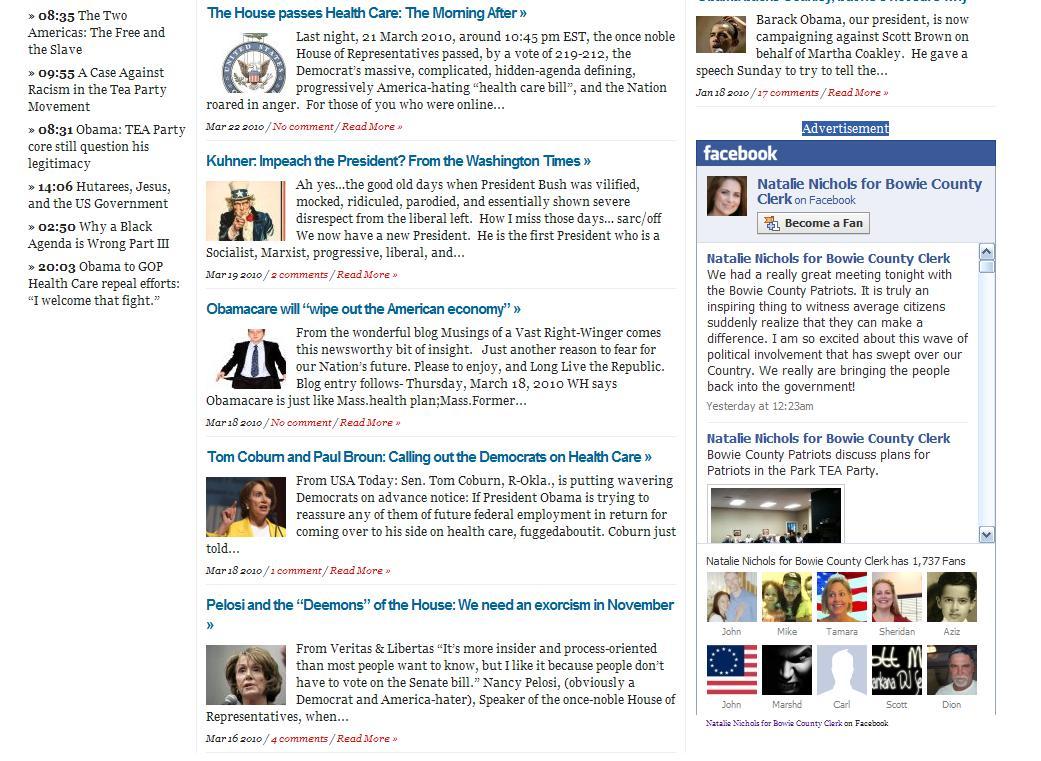
Readers of Political Integrity Now – or, most likely, any of several other websites – may have caught a nifty advertising tactic from Natalie Nichols, who’s running for Clerk down in Bowie County, Texas.  Nichols’s campaign is using ads to direct people right to her Facebook page through a Fan Box.

Facebook created Fan Box widgets to let visitors of a given website see the corresponding fan page without having to click through or anything.  Nichols is putting her Fan Box on other people’s networks by making it the creative of her ad campaign:

Nichols has a nice looking website, so why wouldn’t she just direct people back there and wow them with the flashy design?  Because as impressive as it may look, people don’t visit Nichols’ campaign website every day.  Many do visit Facebook every day.  By directing people to the Facebook page, Nichols is getting people where they already operate.  People who join her Facebook fan page are probably more likely to take further action down the road than folks who sign up for an email list and then forget two days later.

The Facebook Fan Box also has an advantages that shouldn’t be overlooked: it shows the pictures of people who have joined up.  People are hard-wired to look for images of other people, and ads which feature people tend to draw our eyes more successfully.  Nichols didn’t even have to design such an ad – she let the fan box do the work.

Best of all, readers of Political Integrity Now – or any other site on which the Fan Box appears – can join the cause in one click.  Thus they are able to take a small yet significant action without leaving the site they were on in the first place.

Flubs of Steele

Michael Steele shouldn’t have blamed his recent fundraising flaps on racism.  Luckily, he didn’t, despite the headlines crawling around today

Watch the clip: Race was actually brought into the discussion as part of a viewer question, which Steele answered honestly – and, to be fair, correctly.

Maybe Steele should have been a little clearer on the fact that he was speaking broadly about the fact that, although we have come pretty far in this country, black people still get the crap end of the stick more than they should.  He did bring it up as a bipartisan issue.

But his out-of-context quote has been framed to sound like an excuse and repeated over and over.  Any person who wrote a headline – or worse, a story – that implied that Steele was hiding behind race for the recent RNC scandal is either a political hack or a bad journalist.  (And ABC’s own site, which claimed Steele “played the race card today,” is no better.)

Again, watch the clip.

Last week the New York Times went over the top, implying that anyone who opposes government-run health care might as well be hanging with Ed Norton and Edward Furlong and giving out curb smileys to anyone who rooted for the Lakers over the Celtics in the 1980s.  In comparison, Steele’s mild observation is a much more reasoned and well-thought-out social commentary on race relations.

Thankfully, the White House’s Robert Gibbs set everything straight during the daily press briefing, calling the concept that black people and white people are treated different “fairly silly.”

Because there could be no better expert on race relations than this guy:

The YouTube Network

The first YouTube video was uploaded in April of 2005, making this month the five year anniversary of the online video revolution.

Wired celebrates with their top five reasons YouTube was successful, and all are valid: YouTube attracted viral content, found a workable business model (eventually), cooperated with those concerned their content was being uploaded illegally, gave rise to a new class of talent, and continues to innovate.  These were all instrumental in the rise of YouTube, but they missed an important factor that doesn’t fit into any of those qualities.

YouTube was one of the first sites to recognize that a website could be popular without anyone visiting it.  By making videos embeddable on any blog or website, YouTube didn’t have to bring you to www.youtube.com to get you to watch their videos.  Thus YouTube became less a video sharing website than a video sharing network – a distinction which invites more content.

The embed code on most YouTube videos is a string of letters and numbers that means little to most users.  Yet that string is why YouTube is where it is today: everywhere.

Apple, the iPad, and the Palin effect

The fact that Apple’s iPad will be released at the conclusion of Holy Week is entirely appropriate, given how some in the tech press are treating this arrival. (“Behold!  Your new God!”)

But as much fun as it would be to deflate the hype, the iPad will most likely be a runaway success – not only because it’s probably neat to play with, but because Apple is the Sarah Palin of the tech industry.

Hear me out.

Apple has had detractors for years – from complaints about the difficulty in transferring legally purchased but DRM-restricted songs among multiple devices to criticisms about the walled garden  that is the iPhone/iPod touch app store.

Yet, their track record for translating innovation to consumer success is built on a cultural coolness factor that transcends technical specifications.  And Apple capitalizes on this through the app store – inviting third parties to have some sort of vested interest in the product’s success.

The Wall Street Journal announced their iPad subscription model last week.  Amazon’s Kindle reader dominates the electronic book market today; but a free iPad application is an apparent nod to Apple’s emergence in that market.  Apple is so culturally entrenched they didn’t even have to pay for product placement when Modern Family devoted a show to the iPad release.

Apple has created a cycle – its products have been successful, so new product lines will attract third party support from companies looking to cash in – which will in turn make those new products successful.

The other new product debut from an established brand came on Fox News, where “Real American Stories” television special launched with Sarah Palin as the host.  The show’s debut comes a week after the announcement that she will host a documentary on Alaska for The Learning Channel.

Like Apple, Palin has cultivated a strong core following and reputation that invokes attention – from supporters and opponents alike.  Fox News and The Learning Channel both know this translates controversy, media buzz, and ultimately ratings.   And as is the case with Apple, third party groups (like TV networks) to have a stake in the attention that Palin receives.  In many ways, she doesn’t even have to be creative about how she’s presented – just as Apple largely relies on app developers to define how the iPad is used.  Those third parties benefit, and therefore have a vested interest in her continued visibility.

Lather, rinse, repeat.

So if you find yourself watching the coverage of the iPad and wondering whether or not it will earn enough industry support to eventually take off, ask yourself how long you’ll have to go before seeing something about Sarah Palin on TV.