March Madness, April sanity, and managing expectations

The NCAA college basketball tournament is the biggest sporting event of the year, so no one can blame the NCAA for wanting to cram more teams into their biggest cash cow.  Still, analysts seemed to worry that the 96-team tournament idea that had been floating around for the last month was overkill – even if the decision seemed imminent.

Whether intentional or not, the 96-team idea made yesterday’s announcement that the tournament would add three extra teams much more palatable.

It’s a good lesson in managing expectations; without that original 96-team plan, the move to 68 might have been perceived as the first step toward an ever-expanding format and draw a healthy round of criticism itself.  The alternative to the 68-team tournament that will probably be in effect next year is now the theoretical 96-team format, rather than the 65-team format we’ve enjoyed since 2001.

(None of this, of course, is going to help me pick a bracket that stays in contention in any office pool past the second round.)

Going green

Check this out:

This commercial, which appeared on Good Morning America today, sends two interesting messages about the environmental movement here on the 40th anniversary of Earth Day.

First, if you do not live green, a barrage of tiny fists will rain down justice upon you unless your socks and underwear are earth-friendly. Be afraid.

Second, ecological awareness can lead to economical success.  The New York Times reports that environmentalism is now a business practice for many big companies.  Some activists are nonplussed:

To many pioneers of the environmental movement, eco-consumerism, creeping for decades, is intensely frustrating and detracts from Earth Day’s original purpose.

“This ridiculous perverted marketing has cheapened the concept of what is really green,” said Denis Hayes, who was national coordinator of the first Earth Day and is returning to organize this year’s activities in Washington. “It is tragic.”

Those that frown on corporate participation miss an important aspect of American business: left to their own devices, companies are reflections of culture.  If Hanes is push eco-socks and 20th Century Fox is adjusting normal schedules to release the highest-grossing movie in history on Earth Day, it’s because environmentalism is recognized as an important social value.  What isn’t recognized as an important social value is government regulation, which is why environmental consciousness has not always translated into support for the environmental political movement.

What might a more middle-of-the-road environmental movement look like?  Organizations which promote ecologically sound personal activity and issue report cards on corporate green initiatives should be the centerpiece.  Individuals are already interested in becoming more environmentally friendly and can vote with their own behaviors and their own wallets if properly informed.

No one wants to be beaten up by a gang of toddlers in a shopping mall, right?

More PR lessons involving iPhones

This morning, TechCrunch innocently poked fun at a press release from an iPhone retailer announcing that iPhones make men more attractive according to a survey of 1500 women.  Neither the retailer nor their PR agency knew anything about the somewhat embarrassing release, which led to an email exchange with blogger Robin Wauters.   Wauters, predicatbly,  has made the whole thing public.  (As Wauters reveals, the retailer and the PR agency eventually determined that the release was sent by another consultant, which through some mix-up in communication thought it was cleared to send the release.)

That second post detailing the back-and-forth calls parallels the story of former U.S. Senator William Scott of Virginia, who was named “The Dumbest Congressman of Them All” by New Times Magazine in 1974.  New Times only lasted for a few years, and was best known for investigating conspiracies and left-leaning social commentary.  Polling data from the era is sketchy at best, but it’s a safe bet that if Sen. Scott had constituents that subscribed to New Times, they weren’t people who were going to vote for him.  Still, Sen. Scott held a press conference to denounce the magazine article – a move which only served to give the story legs and make sure more of his constituents knew someone had called him an idiot.

Sometimes, if you shut your mouth, the bad news just goes away.

TechCrunch is a great, widely read blog; but if the retailer and their PR consultants had said nothing, would this morning’s tongue-in-cheek post have resulted in fewer iPhone sales?  It’s doubtful.  Much more likely to hurt sales is the perception that the retailer is disorganized and has the fingerprints of professional public relations operatives all over their brand.

When negative information gets out there, the objective is to put out the fire.  Sometimes, if you throw a blanket over it, the blanket bursts into flames.

Hitler finds out he’s pulled from YouTube

Downfall is the movie about the final days of the Third Reich.  But of course, many of us know it for its climatic scene of Adolf Hitler’s bunker tantrum – which has been re-subtitled on YouTube to make Hitler rant about HD-DVD losing to Blu-ray, his car getting stolen, the Cowboys losing to the Giants in the 2007 playoffs, and even everyone forgetting his birthday.

Coming soon: Hitler finds out that Constantin Films, which owns the rights to Downfall, is pulling the clips from YouTube.

While it should be well within their right to do so, is this the smartest business move for the film company?  Recall that Chris Brown (before his alleged domestic violence incident made him untouchable) was able to use a viral video of a wedding party dancing to one of his songs to sell mp3 downloads.

I added Downfall to my Netflix queue last month just because of the Hitler parodies – how many DVD sales is Constantin missing out on?

iJournalism or iReceiving stolen goods? (Or something iElse?)

The lather over Gizmodo’s exposure of the new iPhone 4 has ignited some debate over whether the techno-geek blog went too far in buying a possibly lost and/or stolen iPhone prototype for their exclusive.  Joe Wilcox does a pretty good job summarizing how Gizmodo’s scoop broke the law:

California’s “Uniform Trade Secrets Act” is unambiguous, partly defining “trade secret” as “information, including a formula, pattern, compilation, program, device, method, technique, or process.” The Act uses several definitions of “misappropriation,” of a trade secret with one being: “Acquisition of a trade secret of another by a person who knows or has reason to know that the trade secret was acquired by improper means.”

An unreleased phone accidentally left in a bar and sold to Gizmodo surely qualifies as acquisition “by improper means.” Proper means would be purchase of the device from Apple, following its public release.

Wilcox also mentions the recourse Apple would have if they chose to pursue it.  At this point, it doesn’t look like Apple is going to make a move – and from that fact follows the point which makes the whole discussion moot: Apple doesn’t want Gizmodo to take down their “exclusive look” at the iPhone – not even the post where the phone gets dissected it like a science class frog – ostensibly, the party that tips Apple’s hand the most to industry competitors.

Of course Apple wants the pictures up on the internet, and of course they want everyone talking about the brand new secret product.  Consider that Apple announced the existence of the iPad months before the official release date; this staged rollout allowed Apple to break into two news cycles.

Not to play conspiracy theorist, but Apple could benefits from three rounds of coverage – the current stories about the leak, stories about the announcement, and finally the release (complete with the requisite long lines around the block early in the morning at an Apple store near you).  Is it far-fetched to think Apple would have left this “lost” phone in plain view as a brilliant guerrilla marketing move?  Then again, maybe Apple wouldn’t have any security systems in place that would prevent an engineer from taking a super-secret prototype out of a lab and into a bar.  Apple may not have purposefully leaked the iPhone 4, but they clearly aren’t crying about it now.

How deep is America’s distrust of Washington?

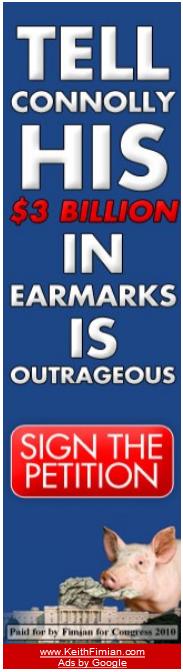
This ad showed up next to an online news story today:

Running for Congress by running against Congress is nothing new.  But running for Congress because your opponent brings too much money to the home district?  National politicians love to talk about pork barrel spending, but their tune changes when the conversation turns to their own district.  The battleground for Keith Fimian’s challenge to Rep. Gerry Connolly is VA-10, my current district of residence and one that probably gets a lot of money in federal funds.  Connolly is also a targeted freshman member of Congress, so Democratic leadership is probably eager to help him buy votes.

Of course, even if Fimian wins, he might not be any different – but the rhetoric of going to Washington, D.C. and sending less money home is still pretty notable.

iContribute’s shot to ActBlue

Online campaign consultancy Engage – who, helmed by Patrick Ruffini and Mindy Finn, helped out on Scott Brown’s upset in January – released a new wrinkle to their iContribute platform today:

Through iContribute Slates, political action committees can now raise money for directly for a slate of endorsed candidates. PACs can easily set up their pages, pick the candidates they want to highlight, and offer supporters a chance to support selected candidates with a contribution of whatever amount they wish.

Last month I discussed why the right doesn’t really need an ActBlue-esque clearinghouse for online fundraising – and Slate is a good example of why (despite Ruffini’s contention otherwise within the post).  Slate isn’t as much a fundraising tool as it is a chance for a PAC to become transparent and helpful to other campaigns – it’s more about communication than money.

Tim Pawlenty’s FreedomFirst PAC, which Ruffini cites in his post, is a good example.  A donor could cut the PAC a check of up to $5000, which would then be distributed among various candidates.  Or, through Slate, that donor could give $2,400 each to eight different candidates.  Not only does that add up to a lot more, but it lets the PAC share contacts with the campaign – and someone who donates $50 today may be able to donate another $50 in two weeks, or may be interested in helping out in other ways, like making remote GOTV calls.

When ActBlue launched, it transformed passion into money.  Slate transforms donors passionate about one candidate or committee into potential activists for others.

The coming political apocalypse

Start the hand-wringing and eulogizing: 80% of Americans don’t trust the government.  Combined with the fact that some people like to own guns and the calls for rebellion by national policy experts like Glenn Beck and Sarah Palin are inciting rebellion with seditious rhetoric, the violent revolution can’t be far behind.

Our Republic is clearly doomed.

Based on what I caught on the Sunday Morning talk shows yesterday, here’s what we can expect in the coming months:

Increased antagonism between right-wing ideologues and progressive thought leaders. As experts examine previous social programs – and which new social programs must be implemented to fix them – the tea partiers will grow louder and louder.  Their simple-minded sentence fragments – such as a call for a more reserved and focused federal government which permits society to develop its own mores and guidelines organically to reflect those of the people combined with stronger states which work in harmony with federal officials to ensure that government services are optimized to best serve the needs of the people – will drown out the more educated progressives’ more refined and intellectual plans to pump up program budgets.

More people buying guns and getting violent. As if to gnash their metaphoric teeth in the wake of Tax Contribution Day, a bunch of right wing nut jobs got together in Northern Virginia this past weekend to rally for their Second Amendment rights.  Some even brought their guns to the rally!  In contrast, cooler heads held a rally opposing gun ownership just across the river in Washington, D.C. – where tight restrictions keep out gun violence.

Violent overthrow of the government. These bitter, angry people who distrust government may even coalesce into a bitter, angry mob and try to disrupt the November elections.  Foaming at the mouth and blinded by their hatred of the government, they may descend on local polling places, march in one by one, check in with a poll worker, show necessary identification if required, and then angrily pull levers other than the one with “Incumbent” written in next to it and thus tossing the people in office out instantly (after a careful counting of the votes and a two month transition period).

It wasn’t exactly clear how we’ll get from these initial steps to Beyond the Thunderdome.  We’ll have to tune in next Sunday morning to find out.

3 Ways the Democrats Won on 4/15

And that isn’t counting a penny of tax money, either.

Yesterday was a big news day. Tea partiers marched here in DC and elsewhere to define their core principle: that the federal government is too big, that high taxes siphon money out of the economy, and that government programs tend to make matters worse, not better. Overall, yesterday’s messaging seemed positive for limited government activists.

But the opposition was smart, too.  Nationally, Democrats drove three well-timed news stories – two by President Obama, one by Sen. Harry Reid – that added up to a communications masterstroke.

1.  President Obama announced we’re goin’ to Mars (eventually).

This was a good story to grab headlines on the other side of the tax day protests.  Instead of trying to directly engage, President Obama simply highlighted a use of taxpayer money that many folks from both sides of the aisle agree with: scientific research.  The space program specifically creates tons of jobs not only in research but in manufacturing the components of Major Tom’s tin can.

You can’t answer a call for lower taxes with the stance that taxes are just fine.  However, showing a positive use of tax dollars can undermine that message.  It wasn’t a happy coincidence – the Florida trip has been on the President’s schedule for weeks, if not months.

There’s another, more subtle attempt at differentiation here, too.  The announcement of an advanced science program will now be played on the same newscast with footage of grassroots protesters – citizen activists who, in their haste to participate, misspell signs and don’t have a staff of speechwriters to help them articulate their views.  Without actually saying it, Obama gets to present his side as better-educated and smarter than the knee-jerk, anti-tax tea partiers.

2.  President Obama signed an executive order permitting hospital visitation rights to same sex couples.

This is another point of differentiation – and a chance to bait his opponents.  Most of the focus of tea party activism has been on fiscal policy, and many Americans tend to agree with the most conservative segment of the electorate that the government spends too much and spends it wastefully.  For social issues, there is less common ground, and yesterday’s announcement has the potential to begin peeling off moderate voter support from the Republicans.

Making this announcement on a busy news day means that there won’t be much media discussion – unless someone at a tax day rally goes off message, and gets captured in a YouTube video proselytizing about moral codes.  Then it feeds the idea that tea parties are run by intolerant bigots.  It’s a win-win for Obama – either his announcement slips almost completely under the radar, or it’s a chance to take shots at the other side.

3.  Sen. Reid announced that financial reform package will hit the U.S. Senate floor next week.

The Democratic talking points for November are already written: Republicans are the party of Wall Street.  They will attempt to make this distinction with a bad financial services reform package scheduled to hit the floor next week.

Like the other two examples, Reid’s announcement serves to distinguish the Democrats from limited government activists by calling for a larger government for an ostensibly good cause – safeguarding consumers and investors.

There’s also a great strategy in this timing that has nothing to do with tea parties but everything to do with tax day.  The folks who would be most likely to oppose this legislation would be financial professionals, who understand that it isn’t all it’s cracked up to be.  If they had the time to do it, they might rally their customers and colleagues, making the case that the bill would actually hurt efforts to keep the players in the financial system honest, and mobilize a strong push against the bill.  They haven’t had time, of course, because over the last two weeks, financial professionals have been working around the clock at their day jobs – because yesterday was April 15.  So when the bill hits the floor next week, they won’t be ready to stir up opposition.

Gearing up already?

Passion is important in politics because it helps win over the uncommitted moderate voters; excited activists are the ones making phone calls, dragging people to the polls, and giving one side the image of a winner.  In 2008, then-candidate Obama’s campaign enjoyed demonstrable shows of emotion from his supporters.  In 2010 that excitement is trending toward the right – so far.

But it isn’t to early (or too late) for the President and his allies to begin letting some air out of that balloon.  The further he can create the perception of a gulf between conservative activists and the values of moderate voters, the more Republican chances in 2010 and 2012 will deflate.