Add this phrase to your arsenal: “Health Care Reform”

…or “Healthcare reform.” Either way, it’s time for center-right voices to stop talking about “Obamacare Repeal” and start talking about “Healthcare Reform.”

The website might as well have been cobbled together on Geocities.  Premiums are going up, and current plans are being cancelled.  Jobs are being downgraded and lost.  The flashpoint of the recent government shutdown was Obamacare, which has many on the conservative side locking and loading for 2014 and 2016 with the hope of repealing the law with a more favorable Senate and White House.

There’s a reason a President was able to get elected and re-elected based on the idea of improving the country’s health care system (even if the actual policy won’t do that): people were generally dissatisfied with the health care system.   They were  very satisfied with their own coverage, but unsatisfied with the system overall (kind of like the old “I hate Congress but love my Congressman” mentality).

So talking about going back to 2008 isn’t going to move voters, no matter how horrible the law is.  It also doesn’t help the GOP emerge from the “Party of No” boulder they keeping getting stuck  behind.

Republicans can win on health care by ditching the talk about “repeal” and carrying the mantle of “reform.”  Costs are high, the program is mismanaged, and people are being forced into inefficient, one-size-fits-all coverage plans.  In other words, health care now is just as ripe for reform as it was in 2008, but the Democrats have had their shot – and it failed.  The Republicans have the opportunity to fix it.

The vision of a better tomorrow resonates a lot better than the image of a slightly better yesterday.

Lonegan beats the spread

Lost in the news about the final shutdown showdown was Cory Booker’s 11-point win over Steve Lonegan in the New Jersey’s special Senate election yesterday.

Lonegan was always a long shot.  Booker gained national attention in 2009 and 2010 for personally shoveling snow for his constituents and allegedly saving one of them from a fire.  A big Booker win wasn’t only inevitable, it was the likely first step in things to come: He was the Democrats’ next rising star.   Known for being a primary opponent to Chris Christie, Lonegan was best known for his outspoken conservative activism – the type of sacrificial lamb a party runs when they know they are going to lose.  In June, Vega$ might have put the spread at, say, 19 1/2 points – and they might have started taking will-he-or-won’t-he Booker bets for 2016.

Lonegan was unsuccessful, but fierce.  He and his allies managed to crawl within 11 points (despite a bawdy interview from his campaign’s head consultant coming out the weekend before the election), and in the process showed Booker’s made-for-TV story is, well, made for TV.  His drug dealer friend T-Bone?  Most likely fiction.   The story where a young man died in his arms?  Not exactly how he remembered it.  That woman he saved from a fire?  Highly questionable.  The city that calls him mayor is deeply infected with violent crime.  He used to own a crack house.

After his first real election, Booker is already damaged goods.  The playbook to beat him – either in 2014 or in 2016 – has been written.  He’ll likely win re-election to the Senate, but it won’t be a slam dunk if the Republican Party of New Jersey fields a good candidate.  Martin O’Malley, Hilary Clinton, or any other Presidential contenders from the left have plenty of ammunition now.  Booker has lost the veneer of inevitability that he enjoyed, and shown that he isn’t the powerhouse he once seemed to be.

Sure, Cory Booker won this week – but that may be all he gets, thanks to Steve Lonegan.

Asking the wrong questions about 2012

John Sides and Lynn Vavreck had an insightful post on the 2012 election, where they chart out 10 points that challenge what they consider to be conventional wisdom.  Some of them are right on, but some of them simply ask the wrong questions.

Finding 1: Republicans liked Romney.  

Finding 2: Conservative Republicans liked Romney, too.

Finding 3: Republican Primary voters were not much divided by ideology

Finding 4: Romney appealed to the mainstream of the party

Much of the post tries to dispel the myth that primary Republicans were in an “anyone but Mitt” kind of mood.  The conventional wisdom, as Sides and Vavreck recount it, is that Romney was imagined as too moderate by the predominantly extremely conservative base of the Republican party.  By charting his favorability ratings against other candidates, Sides and Vavreck claim Romney was always viewed as a palatable choice.  To underscore the point, they note the philosophical consensus of most GOP primary participants based on their candidate of choice, and note that they are pretty much bunched together.

The problem with these three points is a misreading of the fundamental problems Romney had among primary voters that drove the “Anybody But Mitt” movement.  “Favorability” is not the same as enthusiasm.  Polls as late as January 2012 showed a primary electorate eager for an alternative: 58% of GOP voters wanted more choices on their Presidential slate.  Rick Perry’s campaign fizzled, Herman Cain, Newt Gingrich, and Rick Santorum took turns in the media spotlight but without the resources to turn go beyond media attention.

Most famously, Romney had changed his views on public health care and the right to life.  Public shifts in views when one is running for a new office are generally looked down upon by people in the know.

That all suggests Romney was the veggie tray of the 2012 buffet: it’s certainly palatable, but only when you find out there isn’t any popcorn shrimp.  Demonstrating that he had broad appeal to Republican voters doesn’t mean he inspired excitement.  Did Republicans like Romney?  Maybe the way one likes a carrot stick smothered in ranch dressing.  I would have liked to see Sides and Vavreck delve into questions of voter intensity – in other words, just how much did they like Romney?

Finding 5: The economic fundamentals favored Obama 

There’s no beef with this one – they are right on.  While those on the outside could yammer about lost jobs and economic theory, Obama could point to real progress.

Finding 6: Party loyalty is really powerful.

Finding 7: Most groups of voters move in a similar fashion from election to election.

These two were interesting and a little surprising, since party identification is down overall.  But those who still identify as Republican or Democrat tend to stick with their horse.  That should inspire a wave of voter registration and recruitment efforts and help Republicans realize how critical local party committees and organizations like the College Republicans are for building a foundation.

Finding 8: Obama “gifts” didn’t amount to much.

Demographic groups who voted for Obama didn’t view their support as transactional, Sides and Vavreck claim.  As evidence, they point to the lack of support spikes or bumps in public polling around certain events.  For example, blue collar workers did not start supporting the President more around the the auto bailout.

This is buyable, but like the Anybody But Romney findings, it glosses over the subtleties of the politics of voter support.  A vote isn’t usually a quid pro quo.  This is something that Republicans misunderstand when they clumsily try to out-conservative each other in primaries.  A pattern of action builds support more than rhetoric or an isolated policy statement.

The gifts phrase comes, of course, from Romney’s bitter postgame assessment of his failed campaign.  It’s a flawed assessment, so Sides and Vavreck are right to blow up this myth, but it wasn’t worth taking seriously to begin with.

Finding 9:  It was hard for Obama or Romney to out-campaign the other.

Sides and Vavreck look at GRPs and money spent on ads – by both the campaigns and outside groups – and find them roughly equal.  Therefore,  “their campaigns were often canceling each other out.”  This position is as questionable as the “Anybody but Romney” points.

It makes sense because there’s only so much advertising time to buy.  But there isn’t much discussion of the quality of the ads, or of the source.  Remember Obama’s strategy of targeting low-information voters at the margins with ad buys on Friends reruns?  Fewer people saw those ads  – and they cost much less – than the Romney or Crossroads GPS ad buys during local news programs.  But those ads may have turned out more voters.

This point excludes the possibility that one side’s ads could have been more effective than the others’.  Further, putting so-called allies in the same bucket with the candidate assumes that said allies are equally effective at communicating the candidates’ messages.  While both Romney rooters and Obama fans might have had equal shares of the airwaves, that’s poor evidence that one side would cancel the other out.

Finding 10: Romney did not lose because he was perceived as too conservative.

Here’s an interesting point: voters perceived Romney’s political views as closer to their own.  “This also complicates any interpretation of the election as a mandate for Obama,” write Sides and Vavreck.  “He seemed to win in spite of how his political beliefs were perceived, not because of them.”

This one is right on, and there’s a very valuable lesson in it: Voters won’t punish a candidate for being “too conservative” or “too liberal.”  They will punish a candidate for being weird.  If you use words like “varmints”,  if you randomly ask “Who let the dogs out?”, or if you say your don’t care about 47% of America,  you might have trouble getting people who agree with you to think you’d be a good President.
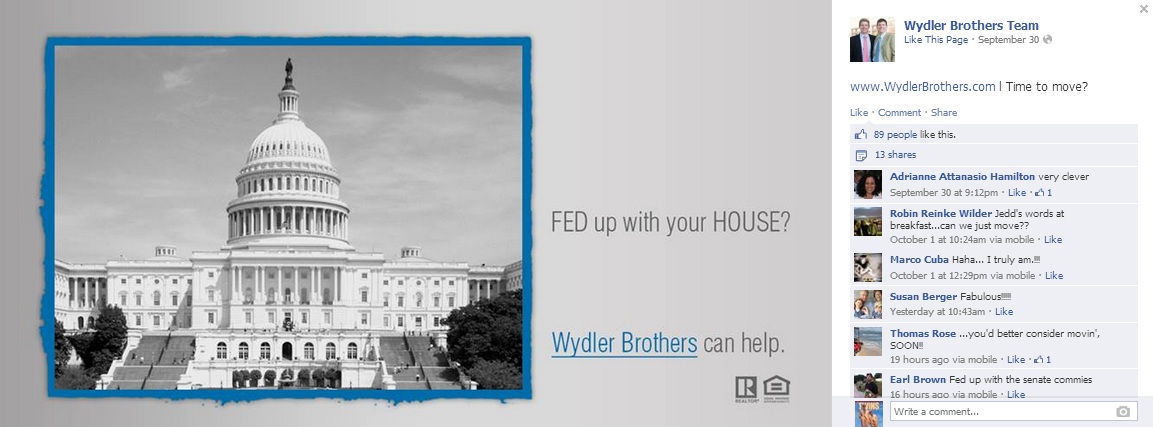
Facebook Ad exploits the shutdown

shutdown_fbad


The Wydler Brothers – the Hans und Franz  of Beltway-area real estate – are promoting this picture in Facebook sponsored posts.  It’s not entirely original – plenty of shops in and around DC are trying to drum up business based on the shutdown – but it is pretty clever,

It might be the most useful though – depending on how the messaging wars go in the next 13 months, there could be some new lobbyists/former Senators looking to buy.

Who’d respond to a conservative grassroots campaign? Norwegians would.

(Yes, that’s a pretty tortured Beatles reference, but Mama E would be upset if it wasn’t there.)

Norway has a center-right government now, led by the second female prime minister in their history, Edna Solberg.  Congratulations to Høyre, the Norwegian conservative party, that forms the backbone of the governing coalition.

Their success did not happen overnight.  Back in the summer 2009, the conservatives were decimated and trending downward.  Even the activists were wary or being active – knocking on doors for politics was viewed by some as an invasion of personal space, and no one wanted to be impolite.  (Imagine the political process being stymied because people are too polite.  Now there’s a foreign concept.)

There were, however, some very positive leaders within the party who appreciated the opportunities of technology and how it could help with a door-to-door and voter-to-voter ground game,  (They even brought in some bumbling American to help them make the case to their activists.)

This week, they realized the fruits of their efforts:

Conservatives in America can learn how to win elections from Erna Solberg and conservatives in Norway… For example, in the city of Hamar (population 29,000), the Conservative Party’s voter technology identified over 5,000 homes where the bulk of their base vote would come from.  

In the week leading up to the election, every identified home was personally contacted by a volunteer.  In addition, all identified conservative voters throughout the entire country received text messages on election day.


The Ruben Sierra of Viral Video

Making the rounds of sharing this week is the video of Marina Shifrin resigning her post at Next Media Animation.  Shifrin, who used to make news videos, dances through her resignation while the subtitles tick off her reasons for quitting – most notably, the fact that her “boss only cares about quantity and how many views each video gets.”  Her video, she contends, “focus[es] on the content”:

It would be easy for some curmudgeon to yell that Shifrin is looking for creativity in the wrong place – that work is about making money, rather than fun and games.  But that wouldn’t be entirely appropriate.  You’ve probably heard of her former company, Next Media Animation – or at least seen their work.  They make those funny, Taiwanese animated videos about the news.  In 2010, they made this one about the Thanksgiving-weekend revelation that Tiger Woods was playing a few rounds outside of his marriage:

Shifrin wasn’t working at a gulag making plastic widgets for export, she was making funny, creative news videos.  NMA’s website brags about their speed, and that’s pretty important when your company’s key product is so heavily dependent on news cycles.  Ditto for quantity – NMA has released two videos already this week, one for the government shutdown and one for Lane Kiffin being fired by USC.  The company is based on producing timely content that attracts viewers and stays ahead of the news.  It probably means working off-hours (since Taiwan and America are on opposite sides of the globe).

That’s a tough job, so you couldn’t blame anyone for saying it isn’t for them.  But Shifrin’s self-indulgent resignation video says a little bit more. Specifically, it says “Be careful about hiring me, because if we have a difference of opinion, I’ll try to embarrass you.”  Working at an online video company while complaining about needing to come up with content frequently that attracts views is like former New York Yankee Ruben Sierra, after being traded in 1996, complaining that the Yankees only cared about winning.

The team at NMA seem to be taking it in stride, though:

Instant Credibility on Syria in Three Easy Words

America may or may not go to war in Syria.  There are compelling, valid arguments for and against military action.  That’s a good debate to have.

Less useful – but still valid – is the infusion of political positioning.  The anti-war left has predictably been quieter for President Obama than they were for President Bush, and some neoconservative hawks who banged the war drum for invading Iraq in 2003 are now rather dovish.  Both sides will point to the other and cry “Hypocrisy!”

For Republicans, who spent the early 2000s arguing so vociferously for war, changing positions is especially tough, as Obama repeats the Bush arguments of a decade ago.  But it should really be an easy pivot, consisting of three words:

“I was wrong.”

It’s a humbling message, but one with some resonance.  Remember that in March 2003, 72% of Americans supported the Iraq war.  A lot of us were wrong about that.  Before 9/11, the concept of war was abstract for most Americans – the stuff of Tom Hanks movies or History Channel documentaries.  Iraq and Afghanistan introduced the public to the realities of young service men and women shipping off to war and sometimes not coming home.

Between the first flashes of shock and awe and the final grudging withdrawal, an awful lot of minds changed.

And Republicans paid a political price for it, too: the Congress flipped in 2006 and the White House in 2008.  (And Joe Lieberman, who supported the war, was all but drummed out of the Democrat party.)  A Republican looking to change his or her mind now will find a public that has trod the same path.


Email: The Once and Future King

Harvard’s Nieman Foundation had a post today about The Slurve, a daily digest of baseball.  (While I don’t subscribe, I see plenty about it on Twitter and Facebook from intelligent, baseball-oriented friends to know that I probably will at some point.)  Blogger Adrienne LaFrance opines that journalism-by-newsletter may be underrated:

After political reporting and editing stints at The American Conservative and Business Insider, [Michael Brendan Daugherty] decided to quit his job and launch The Slurve, a daily baseball newsletter that began last March on the eve of the 2013 baseball season.

Dougherty saw the opportunity to create a bespoke editorial product for an audience that was inundated with great baseball coverage but had to traverse a huge swath of the web to find it.

Daugherty’s model is subscription, not advertising-based.  He has built an audience and feeds it with great content, and the subscriptions continue.  It’s similar to the model magazines may have used in their heyday, but without the high costs of printing and distribution.

The Slurve is not the first to use such a model.  A few years ago, the National Journal’s Hotiline was required reading when it popped up subscribers’ inboxes right around noon; Ben Domenech’s The Transom treats center-right subscribers to news and analysis each morning.  At some point, LaFrance speculates, specialty email list curators might find seats in traditional media.  She may be right; former Hotline editor Chuck Todd has certainly done so.

In making her point, LaFrance may have hit on something traditional media need more of as they claw their way into the digital age: a direct conduit into the inbox.  Sure, news organizations love to invite viewers to “join the conversation” on Twitter or Facebook.  But doing so is a thin attempt to appear multi-directional: CNN really doesn’t care what you tweeted about Syria, even if it posted your tweet on the air.

News organizations are a one-way conduits of information.  People who know stuff about the world are paid to tell you about it, if you’re interested.  If they are interested in finding your eyeballs online, they would be wise to reach out through your email inbox.

Crossroads GPS vs. Bankrupting America: Which Video is Better?

Let’s get it out of the way up front: Bankrupting America wins.

Crossroads GPS released this video this week:

It’s pretty funny – the sarcastic tone and the point of view – as a mock government promotion – make for a great political video.  It probably won’t change many minds on Obamacare, but it will take people who are leaning against it and help illustrate why the program is so flawed.  For people who instinctively dislike Obamacare, but aren’t quite sure why, this illustrates it in a funny way.  If this aired during the local news, you’d stop and take notice.

It calls to mind this video from last month from Public Notice’s Bankrupting America.  The Office parody (which I’ve already gushed about) pokes fun at government’s excessive spending.  Bankrupting America’s effort enjoys good acting and writing, but doesn’t have quite the same production value as Crossroads GPS’s commercial.  What it does have is the potential to illustrate all that’s wrong with a big government mentality.  It plays on people’s notions of inefficient government, but doesn’t ask the viewer to make the mental heavy lift of deciding on a policy position.  The single episode that has been released has the potential to blossom into something more that entertains first, and leaves impressions about bureaucracy as a by-product.  As satire, it’s more effective than the Obamacare video, as a political messaging device it is less efficient.

You might take notice of Crossroads GPS’s video if you saw it in the background.  But you’re interested in seeing more about the characters in the Bankrupting America video.  You want to see more of the protagonist deranged boss and the Carter Administration holdover who just doesn’t care.

Walt Disney once said, “I would rather entertain and hope that people learned something than educate people and hope they were entertained.”  Both of these videos are funny, but Bankrupting America has the potential for a broader appeal because it does a better job of staying true to that mindset.


How MLB Started ARod’s Punishment Early

America has had more than a week to digest Alex Rodriguez’s 211-game suspension by Major League Baseball.   ARod’s legal team has rattled their sabers a little more, suggesting legal appeals to the suspension on top of the current Player’s Association appeal already underway.

Leading up to the suspension, the chattering class of the sports journalism wondered if Rodriguez would face a lifetime ban, effective immediately, under the “Best Interests of Baseball” power that has allowed previous commissioners to ban the likes of Pete Rose and the Black Sox of 1919.  But for MLB, putting Rodriguez on the field might be the best option.

Unlike the other players suspended for cheating, who are taking their lumps immediately, Rodriguez will run out each night in front of tens of thousands of fans.  Many of them may be buying tickets solely to boo him.  He’ll get no break at The Stadium, where the fans would give him guff even when he didn’t have the stench of cheating wafting off of him.  For the next month and a half before the Yankees’ lost 2013 season mercifully ends, Rodriguez will be front and center.  Discussions about him will not be abstract, conducted through attorneys and spokespersons.

Since the suspension for Rodriguez is so much more severe than any of the other players, that type of debate would certainly benefit him, if only marginally.  Fans might lose their edge if the question becomes how long ARod should be suspended, rather than whether he should sit out.  Public anger against cheaters can only subside if the matter drags into next March with public enemy number one out of the public eye.

Instead, ARod will get an earful.

By creating a situation where Rodriguez is constantly in the public eye, MLB gets to watch its verdict vindicated in the court of public opinion.  When the jeers rain down on ARod, MLB will let the fans be the messengers to other players.  Public opinion will become clear to those who would be outspoken about the outsized suspension, as well as to players who are candidates to get caught in the next giant steroids scandal (like David Ortiz).

MLB will, naturally, be helped by Rodriguez’s apparent combination of narcissism and a complete and utter lack of self awareness.