Bill Simmons and the myth of sports journalism

ESPN and Boston Sports Guy Bill Simmons are breaking up. There are probably no good guys in this split since the talented Simmons has come to embody every horrible stereotype of a Boston sports fan over the past 15 years or so (it’s not his fault, they’ve all gotten like that).

But ESPN is just pathetic in its self importance. Even the statement from network head John Skipper dripped with it: “I’ve decided that I’m not going to renew his contract,” he said. It sounds like the person who tells you the end of a relationship was a mutual thing. You know that person is probably the one who got dumped.

ESPN, the “WorldWide Leader” in sports, didn’t rip the lid off the somewhat obvious steroid use in baseball. They aren’t blowing up the out-and-out lie that publicly-funded sports stadiums are a boon for the cities which shell out the money for them. The closest they come to “sports journalism” is the nightly highlight reels of SportsCenter, or the longer-form, incredibly informative 30 for 30 documentaries that were spearheaded by, you guessed it, Bill Simmons.

Otherwise, the ESPN media empire is a wasteland of loud talking heads on TV and radio like Skip Bayless and Colin Cowherd and Mike and Mike in the Morning – all personality-driven, somewhat entertaining in doses, and devoid of intellectual heavy lifting. They’ll still talk in reverent tones about hallowed records or greats of the game – as if sports really matters. It doesn’t, at least not the way they cover it.

And they don’t cover it seriously because ESPN is also based around live games. And even paying huge sums of money in broadcast rights, the network can still act like a scared employee, worried that during the next round of negotiations Roger Goodell might decide he would rather have Monday Night Football on TBS. Last year, when Goodell was facing very serious and very legitimate questions about wether the most visible American sport was unwittingly giving cover to domestic abusers, Simmons found out the hard way that you don’t bite the hand that feeds you. Even if you are the one paying that hand.

The fact is that ESPN probably is better off without Simmons. They can probably replace him with someone cheaper, maybe someone whose pop culture references will be a little fresher. And the content ESPN churns out will be every bit as bad as it used to be.

Baltimore needs Dads

A Facebook friend posted two startling statistics the other day in light of the mess in Baltimore:

  1. Young men with absentee fathers are twice as likely to wind up in jail.
  2. An astounding 83% of black kids in America will reach their 17th birthday without a father in the house.

There certainly may have been justified anger in Baltimore, but manifested itself as unjustified behavior. In this week’s “By the Numbers” post at Communities Digital News, I note that the 2010 census showed that 53% of Baltimore’s children under six are in fatherless families (and 63% are in single-parent households).

There are plenty of questions for the City of Baltimore to answer in how it handled Freddie Gray, and there are reasons for the citizens to be reproachful of the police. But maybe the anger, distrust, and frustration could have come out differently than the ugliness of destruction.

In the coming weeks, plenty of policy experts will have political solutions to help – things like police reforms or community initiatives to help bridge the gap between law enforcement and their constituents. These proposals might help the problem. Still, there are deeper rooted issues whose solutions simply go beyond the relatively limited realm of politics.

There is no substitute for Dad.

A new frontier for pro-life politicians

This week’s post over at Communities Digital News is about some recent polling that shows that many Americans have views on abortion that aren’t as easily categorized as many politicos think. This is likely true of other issues as well. Some things simply transcend politics, so the fight needs to be in a non-political arena. Legislation and policy is certainly important, but not all-inclusive.

Most policy is made by politicians who understand the electoral implications of being for or against something. For example, many conservative politicians wouldn’t have supported a ban on abortion after 20 weeks of pregnancy; now you couldn’t win a Republican nomination for the U.S. Senate in most states, let alone President, if you oppose such a ban.

Through crisis pregnancy centers and post-abortive counselling organizations, the broader pro-life movement handles the non-policy side of the debate well. Political organizations who want to move public opinion on the abortion issue should embrace this.

That may be non-traditional for politics, but it’s ultimately how opinions change.

Nostalgia takes 20 years

ABC’s Fresh Off the Boat isn’t what I would call appointment television, but it’s kind of interesting because of when it’s set: the mid-1990’s. The sitcom is set in the past and told through modern-day narration (like The Wonder Years and The Goldbergs); and following an Asian-American family that had just moved to Orlando.

“Wait – the mid-1990’s? For a nostalgia sitcom? Surely,the world has gone mad.”

I thought the same thing too when I first tuned in. But then I thought some more and it actually makes perfect sense.

In the late 1970s and early 1980s, Happy Days took us back to the 1950s and 1960s. The Wonder Years aired from 1988-1993, with the events of the show happening exactly 20 years prior. The early 1990s years of The Simpsons evoked images of the 1970s such as Homer and Marge’s “Goodbye Yellow Brick Road” Prom (you can make your point about Artie Ziff in the comments, Comic Book Guy). That 70s Show premiered later in the decade. In the 2000s, Family Guy’s 1980s cutaway references ranged from The Transformers to  The Facts of Life.

It looks like the rule is that nostalgia is fondly remembering the past, so long as the past was at least 20 years ago.

Something Hillary got right

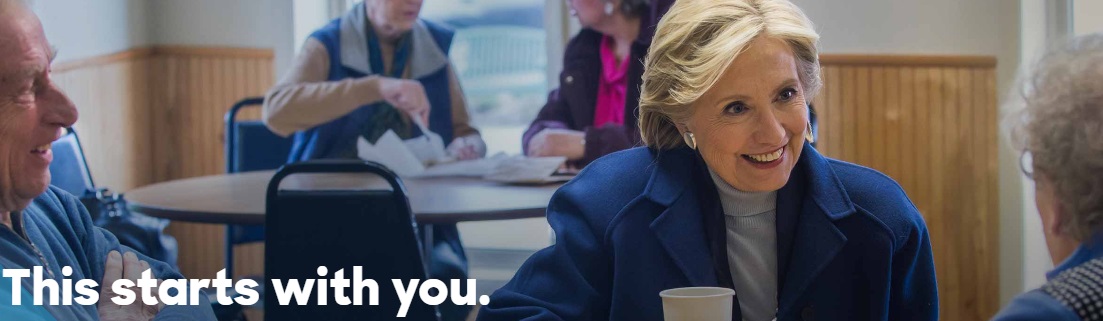
It’s been a fun week to make fun of Hillary Clinton, but she knocked one aspect of her video announcement clean out of the park. As I discussed in my latest Communities Digital News post, Clinton only appears onscreen in her own video for fifteen seconds out of 2:15, and in that time she is either addressing the camera or talking with voters.

Except, she isn’t talking to the voters. In every shot, they are talking to her.

Many political ads and videos have a shot of the candidate meeting with supporters. Usually, in those shots the candidate is dispensing wisdom to a small group of supporters. Check out the very first shot from this ad from Terry McAuliffe’s successful 2013 Virginia gubernatorial campaign:

Candidates must do this to show that their leadership. (Though every time I see this type of shot, the audience looks like they are waiting for the candidate to pause so they can break out of the conversation.) But everything her week-old campaign has done so far has made it obvious Clinton is bending over backward to give the impression that she isn’t full of herself.  So in her video, she listens – sometimes with crazy eyes, but she listens.

Surely, Republican candidates expect to be vilified by Democratically aligned special interest groups in the upcoming cycle. For conservative candidates looking to prove their empathetic chops, subtle visual cues like this can go a long way.

Announcing the start of a campaign and/or murder spree

ThisStartsWithYou

“Death, it comes to us all,” Hillary explained, resting her coffee cup on the table. “For all our advances in medicine and health care, life has a 100% mortality rate. It’s the only thing that really binds the haves and have-nots, you know? The deck may be stacked for the rich, and the system may be rigged so the rich get richer, but no one escapes the end.”

Hillary leaned in, her eyes still wide and unblinking. “We are all equal in death.”

She paused to let it sink in, the smile was still painted across her face.

“After I finish this coffee, I’m getting into my van. I’m going to travel from one end of this country to the other, bringing true equality to the nation. There will be plenty of people out there who want to stop me, small minded people who don’t understand what we’re accomplishing. But one day, history will look back on this trail of death we are forging and appreciate the revolution.”

Hillary took another sip of her coffee. “You’re wondering why I’m telling you all this.”

She leaned in closer, her voice lowering to a throaty, raspy whisper.

“It starts with you.”

Clinton’s gift to Rubio keeps giving

Friend of the Program Matt Lewis said Marco Rubio owed Hillary Clinton a thank you note for announcing her candidacy the day before the Florida Senator threw his hat into the ring. The low-key Clinton announcement underscored Rubio’s forward-looking message without overshadowing it.

When word leaked that former Secretary of State Hillary Clinton was planning to announce her candidacy on Sunday — one day prior to Sen. Marco’s scheduled announcement — the conventional wisdom seemed to be that she might overshadow him. Instead, she turned out to be the perfect foil… “Just yesterday,” Rubio said, “a leader from yesterday began a campaign for President by promising to take us back to yesterday. But yesterday is over, and we are never going back.”

He’s definitely right, but there’s more than just the contrast with Clinton making the speech more colorful. More than any other Republican contender so far, Rubio got to talk about Republicans versus Democrats. Clinton was in the news during his announcement. When his Senate colleagues Ted Cruz and Rand Paul announced in the previous weeks, the natural question (and the tone of the ensuing coverage) was where they fit in the Republican primary field.

That let Rubio elevate his rhetoric a bit at the outset. For a little while, he can position himself as the adult among the rabble, while the others carve up intra-party factions with labels like “tea party” or “libertarian.”

It may not last, but it’s a heck of a way to start.

“And I’m ‘almost got sued by Comcast Rob Lowe’…”

A few months back, as the wife and I watched DVR’d TV shows on a cold winter’s eve, a funny thing happened: We stopped fast forwarding through a commercial break to watch one of the ads.

It was the latest Rob Lowe DirectTV spot at the time. But last week, DirecTV ended that campaign after Comcast objected to some of the commercials’ claims.

What made those ads so good wasn’t that they were funny enough to get you to stop skipping through a commercial break. (You can still watch them all, incidentally, on DirecTV’s YouTube channel.) When they launched last fall, the alternative Rob Lowes stayed on point; their unfortunate circumstances or ridiculous behavior tied directly to the shortcomings of cable. For example, “Creepy Rob Lowe” was “down at the rec center, watchin’ folks swim” because his cable was out:

(By the way, is Creepy Rob Low related to Joe Biden? Or a time-traveling Young Joe Biden?)

Compare that to recent entries like “Total Deadbeat Rob Lowe,” whose divorce and back alley dice games do nothing to highlight cable’s shortcomings. After loaning his car to a drifter, “Poor Decision-Making Rob Lowe” would miss his show even if he had DirecTV. The commercials were still funny, but they were becoming unfocused and non-product centered.

In other words, they were about to lose their effectiveness.

Comcast may have done DirecTV a big favor by forcing the campaign to end before it got silly.

Winning on issues

At Communities Digital News this week, I opined that Democrats and their left-tilting interest group allies are probably hard at work on issues that straddle the line between news and pop culture to identify voters early on who might be receptive to campaign messages next year. The article talks about wages, religious freedom, and police-involved shootings as the primary opportunities.

If it hadn’t been for the Rolling Stone debacle, the broad umbrella (no pun intended) of women’s issues might make the list – and it might still, once the concern over shoddy journalism evaporates.

The point is, grassroots campaigns need hooks that bring in voters who wouldn’t otherwise show up. Whichever side does a better job finding and using them will have an easier time of it next year.