My work alma mater and school alma mater collide

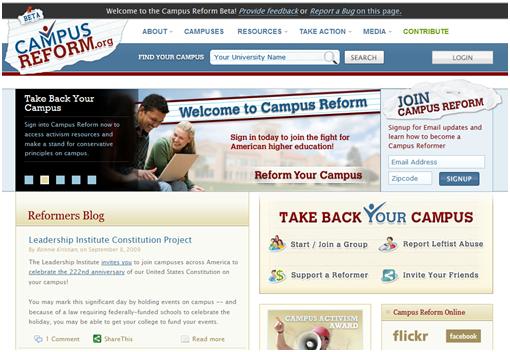
campusreformThe Leadership Institute (my former employer) will launch a new website, CampusReform.org, officially next week – but it’s live now if you want to take a look.

One of the challenges LI – or any similar organization – has always faced in campus outreach is connecting with interested students; though interested students are always out there, colleges represent fairly cloistered environments.  Previously, finding students to get involved in the conservative movement often meant physically going to campuses, setting up membership tables, and recruiting people face to face.  Considering that America has well over 2,000 four-year colleges, that method becomes a tedious (and expensive) fishing expedition.

Whether your business is starting conservative groups or selling dictionaries door-to-door, the best prospects are usually referrals or the potential customers who seek you out.  By establishing a broad web presence, LI is embracing that model of expansion.  CampusReform mobilizes student activists – rather than Washington, D.C.-based representatives – to strengthen the conservative movement in higher education.  It’s strategically smart and just good business.

There’s another benefit that CampusReform offers down the road, after it establishes an audience among college students: alumni relations.  With CampusReform, if I want to see what’s going on with the University of Massachusetts, I am just a click away.  If LI wanted to, they could create a fundraising option that would allow their donors to give directly to campuses and groups they care about.  (And if they wanted to get really advanced, LI could empower individual donors to create campaigns and recruit others to give money, as well.)

As a campus outreach effort, Campus Reform is a more effective conduit between interested students and the people trying to recruit them.  Its potential is greater: to function as a network connecting people trying to break into conservative politics with those in a position to help.

Macaca vs. the Thesis

The comparisons are being made between the flap over Bob McDonnell’s thesis and George Allen’s infamous gaffe that opened the era of YouTube politics.  The comparisons to the 2006 Senate election are apt – but not in the obvious way.

Allen’s “macaca moment” was a key reason he lost his Senate seat, but it didn’t happen in a vacuum.  Opponents had long alleged that Allen was a closeted racist and Confederate sympathizer.  His verbal gaffe gave those opponents visual evidence – and another chance to dredge up those accusations.  Macaca wasn’t the issue, it was just the event that exposed a major issue.

Through “Thesisgate” the Deeds campaign is seeking to re-define McDonnell by exposing old writings which suggest his views are out of line with the electorate.  In the 2006 race, the obvious parallel actually came later on, when desperate Allen campaign blasted eventual victor Jim Webb for novels which he had written depicting graphic and bizarre  scenes.

“Read the Thesis” means “Read our parts of the Thesis”

In the Commonwealth I currently call home, the fight for Virginia’s governorship is becoming downright Jerseyan thanks to Creigh Deed’s attempt to leverage an old grad school paper written by Bob McDonnell.

Deeds is following an important rule – when negative information is out there about an opponent, the best thing is to keep it alive for as long as possible.  Since the McDonnell thesis is 90 pages long, the Deeds folks have selected the juiciest clips and added their editorial content.  It’s a good way for them to excite a base which is currently unexcited and raise some money.

Missing in a lot of the coverage is a link to the actual thesis.  I had to do about 20 minutes of searching before I found and downloaded McDonnel’s work.  If you haven’t actually read the thesis, it really is heavy on the involvement of church and family, but also has some harsh treatment of federal social programs – such as welfare, which was reformed six years later.

Since few voters will bother to read 90 pages, they may go back to their own memories of writing college papers.  How many people who took political science or current events courses would want their words revisited?   During my time at UMass, the Journalism department offered a class called “The Press and the Third World.”  I took it during my sophomore year, and usually sat next to a friend of mine with whom I worked at the campus radio station’s sports department.  (The class fulfilled a requirement for our major, but we were both aspiring sports journalists.  The subject matter was not in our area of expertise.)  Every Tuesday, our professor would look over the New York Times – what he called the “newspaper of record” for America – and express disgust that the Third World was rarely covered.  And when it was, he would express disgust that the stories would only cover corruption, violence, or the bizarre.

We could have pointed out that the local Springfield, Mass. television stations only covered corruption, violence, or the bizarre in Western Massachusetts, or that regional news outlets usually cover the regions they are based in.  We could have pointed out that his gripe was with media in general, not in American media’s treatment of the Third World.  Actually, one of our classmates brought that up during discussion one day, and was shouted down by other students as the professor encouraged them.  My friend and I shut our mouths, parroted back the professor’s comments when it was time to take a test, accepted our A- grades and went back to WMUA to cover sports.  The content of those papers would be wholly inconsistent with the content of this blog, but the Worker’s World Party might enjoy them.  (Although, I believe I criticized Jon Stewart’s coverage of the Middle East in my final paper.)

With a heavily college-educated voting populace who can identify with the college writing process, McDonnell’s thesis may not have quite the impact that Deeds would hope.

Facebook… without the “not sucking”

FamousDC and Politico have both already weighed in on “Republicanville” – which is, apparently, supposed to be a Facebook-type social network for Republicans.  Meghann Parlett at TechRepublican has the best take on it, and it only takes two words: she calls it a “walled garden” – an online utility exclusively for Republicans that doesn’t really help counter the left-leaning tendencies of other social networks, online news sites, or (most importantly) the last two election cycles.

For the last few years, this has been a consistent trend.  I’ve seen people try to bill themselves as “conservative comics,” and they almost always suck.  “Conservative filmmakers” tend to make good factual documentaries (sometimes), but lousy dramas and comedies.  Conservative alternatives to pop culture entities are never as cool as those entities because the “conservative alternative” is by definition all about politics first, rather than entertainment.

That’s not to say that Republicanville will be a wasteland – surely, with enough financial backing, they will recruit membership.  But “walled gardens” aren’t the places to make a difference.